Trine 6: Together in Time Shows Off a Demo Full of Surprises - Preview
The demo version of the sixth installment confirms a more cooperative and accessible direction, but leaves open questions about character identity and puzzle depth.
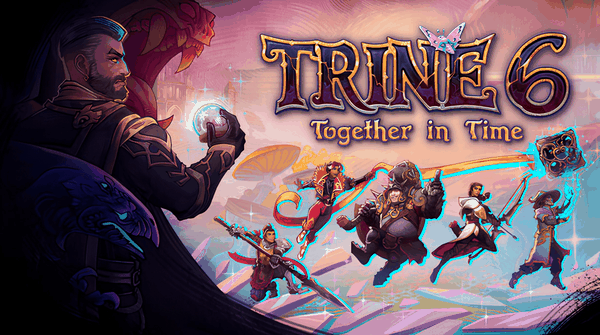


Trine has always worked when it forced you to look at an obstacle in three different ways. Faced with a broken bridge, a platform too high, or a blocked mechanism, the question was never just how to overcome it, but which character had the right tools to do so. Amadeus the wizard could create boxes and manipulate objects in the environment, Zoya the thief moved with ropes and arrows, while Pontius the warrior used strength, shield, and physical weight to clear the way. It was a simple formula to understand, but flexible enough to allow for invention.
It's this memory that makes the Trine 6: Together in Time demo, presented at Steam Next Fest, more ambiguous than expected. On one hand, Frozenbyte's touch is still recognizable: polished scenarios, a fairy-tale rhythm, recognizable characters, and visual construction superior to the genre's average. On the other hand, the game seems to want to become more immediate and more co-op-oriented, distributing tools and possibilities more uniformly among all heroes. This choice has a precise logic, and in the context of co-op for up to four players, it's also understandable. The problem is understanding whether this greater freedom truly produces more solutions, or if it risks becoming a counterproductive choice.
The demo covers two levels and makes all five characters available with only basic ability levels. A tempting appetizer just enough to give us an idea while waiting for the release. Trine 6 is expected on September 17, 2026, on PC, Nintendo Switch, Nintendo Switch 2, PlayStation 5, and Xbox Series X|S.
From Trine 5 to Together in Time: Why the Group Expands
To understand the narrative starting point of Trine 6, one must know where the fifth chapter concluded. In Trine 5: A Clockwork Conspiracy, two nobles of the kingdom, Lady Sunny and Lord Goderic, had enacted a conspiracy capable of damaging the heroes' reputation, stripping them of their powers, and endangering those closest to them. Amadeus had seen his own family directly threatened, Zoya had to confront the weight of her choices, and Pontius with the idea that saving the world wasn't enough to put everything back in its place. The threat was stopped, powers were restored, but the ending was not a perfect return to normalcy.
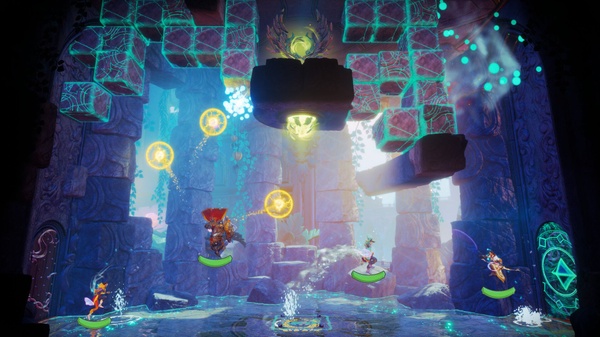
Together in Time chooses a lighter and more dynamic premise. Moira and Adrius, two young, novice thieves, make a mistake in an ancient sanctuary and unleash a magical disaster that binds their fate to that of Amadeus, Zoya, and Pontius. It's a simple narrative justification that works because it immediately establishes the expanded group without requiring extensive preparatory work. The problem, if anything, is that adding two characters isn't enough if the game can't make them feel truly necessary.
More Accessible Puzzles, Not Necessarily More Creative
The central question of the demo is this: how much accessibility can Trine afford before losing something essential? The series has always been immediate to understand but not trivial to play well. Its pleasure lay in recognizing an obstacle, choosing the right character, and finding a solution that could be the intended one, or something slightly different, more creative, even a bit unconventional.
In this demo, many passages already have the answer incorporated into the scenario. Faced with an obstacle, an object appears positioned to be moved, a lever to be activated at the only useful moment, a sequence to be executed in the prescribed order. The player immediately understands what to do, does it, and moves on. There is almost never a moment where you look at the situation and wonder if there's another path, a different angle, a creative use of what's available. In the best chapters of the series, that pause was as valuable as the solution: it was the point where the player stopped following the game and started reasoning with it. Here, that pause almost doesn't exist. It's not a matter of pure difficulty.
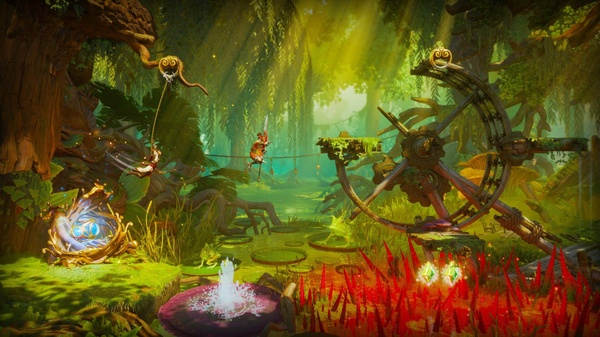
The double jump and air dash available to all heroes are the most evident example of this new direction. They make movement fluid, help avoid frustration, and allow each character to traverse spaces with greater autonomy. At the same time, they reduce the weight of differences: if everyone can manage distances and elevations similarly, changing heroes becomes less necessary. The same applies to Time-Slow, useful for reading jumps and traps in the more frantic sections, but an additional common tool within a series that has always worked precisely because each character had something only they could do.
If Frozenbyte wants to recapture the spirit of the best chapters, it's not enough to return to the fairy-tale atmosphere or two-dimensional level design. It needs to return to that feeling of physical freedom where the player tries, fails, combines, and feels ownership of the solution found. The demo, for now, seems to build a smoother but less surprising game.
The New Heroes Are Present, But Not Yet Indispensable
Moira is a quick acrobat, built around close-range attacks, kicks, and a grappling hook. Adrius is a squire with a spear, also capable of creating small platforms for the team. These are clear profiles consistent with the series' tone, but the demo doesn't yet manage to make them impactful enough. Moira is pleasant to use, especially in combat. Adrius has a more technical role, related to space management. Both work, but neither yet opens up a different way of interpreting the levels.
The comparison with the three historical heroes becomes inevitable. Amadeus, Zoya, and Pontius were recognizable because their relationship with the scenario was clear from the beginning: the wizard manipulated objects, the thief moved with vertical agility, the knight managed strength and protection. With Moira and Adrius, this identity appears less incisive, at least in the build available in the demo.
Amadeus is the most delicate case. Immediate levitation, one of his most recognizable abilities, is not available from the first use and is moved into progression. At the beginning, the wizard is more limited, with a role that in the demo makes him less present than one would expect. In the full game, progression might restore his complexity, but in the current taste, the loss is felt.
Pontius has changed weapons: he abandons the sword for an electric hammer and a shield with a grappling hook. If Moira is faster and more effective in close combat, Pontius risks losing centrality precisely in the territory that historically belonged to him. In a specific section of the demo, Pontius's shield also becomes usable by other characters: it's not a universal mechanic, but it's a signal of the overall logic the game is following.
The difference between "I can use this hero" and "I need this hero" matters a lot in Trine. For now, the demo doesn't yet manage to make that difference clear enough.
Combat Arenas Interrupt What the Game Does Best
Combat in the demo focuses on two short sequences and a final boss fight against Grim. In the first case, players face anthropomorphic arboreal creatures armed with two-handed swords and shields: to defeat them, it's necessary to hit them from behind, a basic but functional constraint, because it forces players to manage positioning instead of attacking head-on. In the second sequence, similar enemies explode upon death in a circular area, and ignoring the distance from other targets means taking unintentional damage. These are simple ideas, but they have their own tactical logic.
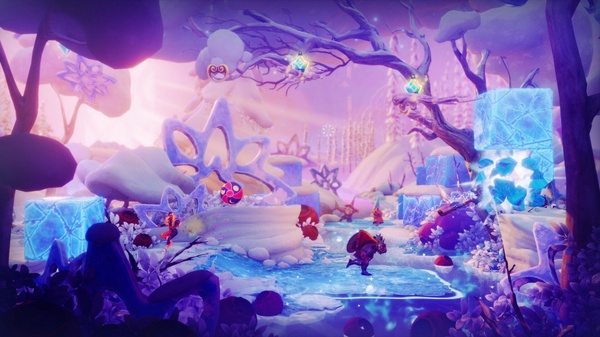
The problem isn't the logic of individual enemies: it's what's missing around them. The demo doesn't include lives or game overs, so every mistake is absorbed without consequences. In a game that has always built its identity on reasoning and problem-solving, this absence drains the encounters of any weight. It doesn't matter if you misposition or ignore the explosion radius: the game continues. The risk exists on paper, but it's never truly felt.
The fight with Grim, the demo's final boss, features distinct phases and a more articulated structure compared to previous sequences. It's the most developed encounter and suggests that Frozenbyte has worked on the variety of main battles. Here too, however, the absence of consequences reduces the pressure that a boss fight should progressively build. As this is a demo, the choice might be deliberate, and the full game might introduce a different system. For now, it's a point on which to reserve judgment, not a dismissal.
Technically Solid, With a Build Still to Be Refined
On the technical front, the demo shows a stable foundation. The scenarios are rich, legible, and well-lit, with that depth that has always allowed Trine to appear more scenic than the level design structure requires. The ultrawide format enhances the lateral development of the levels, broadening the scene without forcing the interface. General performance is smooth in platforming sections and quieter spaces, while some transitions to more crowded arenas produce sporadic frame pacing uncertainties: a sign that the build is not yet refined. On this front, it's advisable to remain cautious, as the provisional nature of the code makes it unhelpful to turn current impressions into a definitive technical verdict.
The art direction is polished but leaves a more mixed feeling. Trine 6 is softer, more refined, closer to the aesthetic of modern digital animation compared to previous chapters. This isn't a flaw in itself, but compared to the first Trine games, where there was something strangely dark in the lighting and textures, the current result is elegant and less personal. The visual quality is high; the aesthetic identity, for now, is less recognizable.
Trine 6: Together in Time clearly shows a direction, but it doesn't fully convince yet. The game is technically solid, visually polished, and built around an idea of expanded co-op that has its own logic. The problem is that this logic, at least in this test, brings with it shared tools, less open puzzles, and characters that seem more interchangeable than the series has accustomed us to. Frozenbyte still has time and material to prove that cooperative accessibility was a premise, not a compromise. For now, the demo poses the question without answering it.
Trine 6: Together in Time Shows Off a Demo Full of Surprises - Preview
The Trine 6: Together in Time demo shows a technically solid game, beautiful to look at, and still capable of evoking the series' fairy-tale tone. At the same time, however, it raises concrete doubts about the direction chosen by Frozenbyte. Broader co-op makes sense, but it seems to bring with it a more uniform distribution of abilities, less need to alternate characters, and puzzles that, at least in this test, appear less creative than we would have expected.
The problem isn't that Trine 6 wants to be more accessible. The problem is that accessibility, alone, isn't enough. If every character can solve almost everything, then the game needs to work even harder on the quality of alternative solutions. It needs to make us feel that choosing Moira, Adrius, Amadeus, Zoya, or Pontius truly changes how we interpret the scenario. In the demo, this only happens in part.
The real question remains: will Frozenbyte use expanded co-op to create freer, more varied, and more intelligent puzzles, or will it make Trine a more convenient but less personal experience? If the answer is the former, Together in Time could become a natural evolution of the series. If it's the latter, it risks being a pleasant chapter to play through, but less memorable to solve.
Similar articles