Anno 117: Pax Romana – The Order of the Empire and the Maturity of Ubisoft Mainz's Management Philosophy
The Anno series takes a decisive step towards classicism: the Pax Romana preview reveals an administrative vision founded on balance, faith, and systemic coherence.
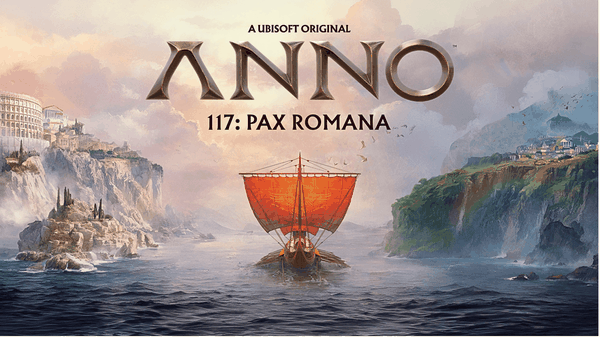


After the excellent response to Anno 1800, Ubisoft Mainz embarks on a new management experiment set in the heart of the Roman Empire. Anno 117: Pax Romana aims to adapt the economic and administrative structure typical of the historical city builder to a context where the idea of progress gives way to the stability of power. This is a significant choice, as it tests a system built on technological evolution, now asking it to function in an era that, by nature, resists change and thrives on political balance and social coherence.
The most immediate comparison remains with Anno 1800, but the conceptual difference is evident: where the previous chapter represented the drive towards innovation, Pax Romana explores the maturity of a complete empire, where success does not come from discovering new resources but from the management of abundance and consensus. In this sense, the title is closer to a classic like Caesar IV, heir to that management school that placed the player in the role of public administrator, architect of urban order and guardian of civilization.
With Anno 117, Ubisoft Mainz consolidates the dialogue between its own tradition and that of great historical simulators, proposing a model of strategic simulation that prioritizes urban planning, measure, and cultural rigor. The operation suggests a change of pace in the genre's language and opens a broader reflection on how civilization can be represented through the management of its cities, where every street and every temple becomes a visible expression of the harmony between technique and power.
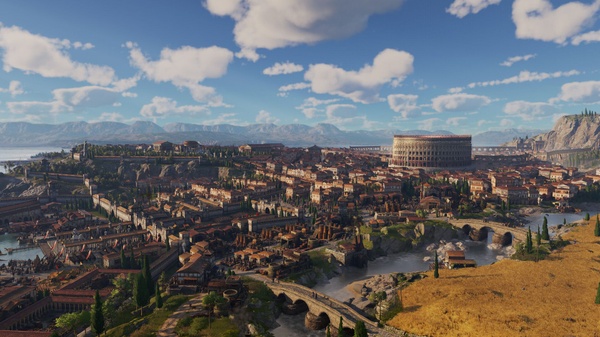
Knowing how to govern is an art, and Pax Romana wants to emphasize it loudly!
The narrative component of Anno 117: Pax Romana is based on a principle of balance between storytelling and administration, restoring a more conscious political dimension to the Roman city builder. At the beginning of the experience, the player can choose between two different governing figures in temperament and social status: one marked by doubt and the search for legitimacy, the other called to emerge in a context dominated by men.
The two perspectives not only offer different nuances in tone and personal motivations but also evoke recognizable historical archetypes: on one side Pliny the Younger, a loyal official constantly torn between obedience and moral integrity, on the other a figure like Agrippina the Younger, an emblem of determination and political intelligence in a world that tends to exclude the female voice from power. Despite the difference in approach, the game's structure remains unchanged, focusing on the responsibility of command and the construction of a stable and coherent government model.
The accessible content allows players to tackle only a portion of the narrative campaign, with an average duration of two to four hours, designed to introduce the logic of governance and the fundamentals of administrative simulation. In this phase, the player takes control of an Imperial province and makes decisions that define their political and administrative identity. The experience is guided but not rigid, emphasizing the moral and managerial weight of each choice.
The Sandbox mode expands freedom of action, allowing players to choose their starting province, explore Latium and Albion, and shape their governing approach according to economic and cultural priorities. Every decision directly impacts the well-being of citizens, the productivity of resources, and the overall balance of the colony, rewarding long-term planning and the ability to maintain harmony between development and control. Overall, Pax Romana seems to aim for a gradual and systemic narrative, where the plot does not progress through plot twists but through administrative continuity and the coherence of exercised power. The game longevity, though limited in the trial version, hints at significant potential in managing time and social relationships.
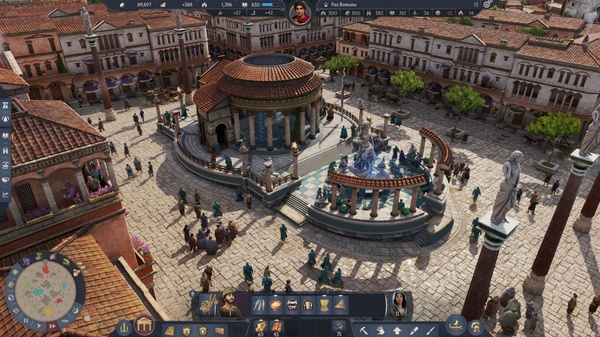
Is it possible to evolve an already functional system? Apparently, yes.
The preview of Anno 117: Pax Romana shows an already solid management structure that evolves the foundations of Anno 1800 without overturning them. The trial code allows exploration of the fundamental mechanics of Roman management, highlighting a calibrated balance between continuity and innovation. Some functions are not yet definitive, but the overall picture is clear: Ubisoft Mainz aims to perfect the classic model of the historical city builder, making it more strategic, more coherent, and more aligned with the complexity of the imperial context.
The production system is based on interconnected supply chains, where each building contributes to the collective well-being and economy of the province. Social classes dictate the pace of growth: lower-level citizens require essential goods like food and textiles, while higher strata demand complex products, cultural buildings, and places of worship. This progression forces the player to think in terms of economic planning and urban sustainability, as uncontrolled expansion can compromise the stability of the entire system.
Compared to previous chapters, Pax Romana introduces two central innovations that expand management depth.
The first is the technology tree, which allows the province to develop along three main axes—economic, civil, and military—transforming into a true strategic planning tool. Each choice directly impacts production efficiency, citizen training, or the speed at which new knowledge is generated. It is a system that encourages constant adaptation and balancing between innovation and stability.
The second innovation is the system of deities and sanctuaries, a new element that intertwines spirituality, economy, and urban planning. Each temple can be dedicated to a specific deity, capable of offering thematic bonuses (military, commercial, or naval) based on the chosen cult and the degree of citizen devotion. The arrangement of sanctuaries, their proximity to dwellings, and the distribution of worshippers become an integral part of territorial planning.
Beyond its managerial value, this mechanic introduces a political dimension: religion transforms into a tool for legitimizing power, capable of combining social consensus and economic prosperity.
Overall, the preview delivers a title more focused on administrative logic than territorial expansion. The pace is deliberate, resources are limited, and growth requires constancy rather than speed. The balance between order, faith, and technological progress defines the true challenge of Anno 117: Pax Romana, which does not propose itself as a revolution of the series, but as its most mature evolution: a digital Rome that reflects on the nature of power more than on territorial conquest.
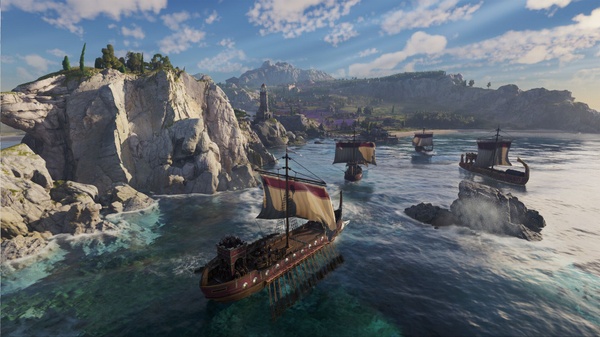
Ubisoft Mainz has created an almost unparalleled visual harmony
From a visual standpoint, Anno 117: Pax Romana confirms the aesthetic excellence that distinguishes the series, but adopts a more measured color palette and visual language compared to Anno 1800.
The Mediterranean setting delivers warm, diffused tones, dominated by ochre lands, olive greens, and pale blues, in line with classical imagery. Cities develop as coherent organisms, with particular attention to building placement, street continuity, and overall territorial legibility. The result is a vibrant but never excessive Rome, built on a sober artistic direction, attentive to architectural details and the natural rhythm of light.
The preview highlights a good balance between historical fidelity and aesthetic interpretation. The dwellings, forums, baths, and temples show care for proportions and materials that enhances authenticity without sacrificing visual clarity. The game world appears less crowded than Anno 1800, but more legible, with texture and shadow management that prioritizes management functionality over pure graphical virtuosity.
This choice strengthens spatial understanding, helping the player perceive the connections between productive, residential, and monumental areas.
On the technical front, the preview code proved stable and well-optimized, even on older configurations. During testing sessions, the build maintained a fluid framerate, supporting DLSS and minimizing performance drops. This result is notable considering the complexity of real-time simulations typical of the series. The user interface, though still subject to revisions, shows a more linear design, with simplified icons and panels, designed to make resource and trade route management more intuitive.
The overall impression is that of a title which, while not revolutionizing the visual sector, manages to define a new stylistic identity. The Rome of Anno 117 is not that of cinematic blockbusters, but an ordered and functional ecosystem, where visual harmony serves managerial clarity. The coherence between aesthetics and mechanics constitutes one of the most convincing results of this preview, suggesting that the final game will be able to achieve a rare balance between formal beauty and operational legibility.
Particularly relevant is the work of the Ubisoft Mainz software house, already responsible for Anno 1800, which confirms its ability to reconcile artistic vision and management engineering. The German team, supported by other European Ubisoft studios, continues a development path focused on technical precision and systemic legibility, two elements that clearly emerge in this trial version. The care in visual balancing and the choice to maintain a sober interface demonstrate the desire to create an accessible yet deep title, faithful to the brand's tradition and at the same time open to a new generation of city builders.
Anno 117: Pax Romana – The Order of the Empire and the Maturity of Ubisoft Mainz's Management Philosophy
The preview of Anno 117: Pax Romana confirms the solidity of the series and the experience of Ubisoft Mainz, capable of renewing the management formula without distorting it. The technology tree and the sanctuary system offer new strategic perspectives, while graphics and stability show evident care. Although limited in content, the preview hints at a mature, coherent, and rich title with potential.
Similar articles