La La Land, Ten Years Later: The Musical That Taught Us the Cost of Choices
Damien Chazelle's musical transformed a romantic story into a reflection on the price of choices. We haven't gotten over La La Land... and perhaps that's how it should be.
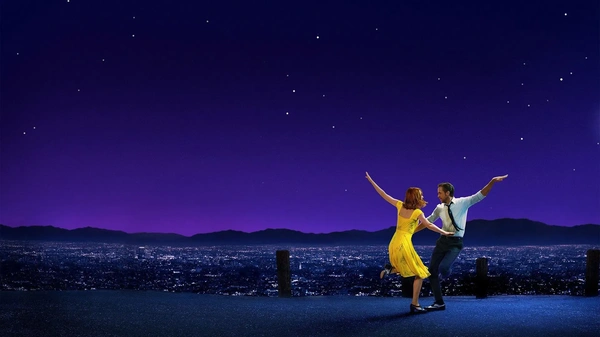


Ten years after its release, La La Land continues to occupy a special place in the collective imagination. It is a work that, over time, has changed its nature. What seemed like a contemporary romantic musical in 2016 now appears increasingly as a reflection on the cost of choices, the difficulty of reconciling ambition and emotional stability, the weight of sacrifices necessary to become the person one wishes to be, and, at times, even the need to stop.
Watching it again today produces a different sensation than ten years ago. The initial enthusiasm gives way to something more complex and less comforting. Damien Chazelle's film does not promise a final resolution and never truly tries to sweeten the story's central conflict. On the contrary, it progressively builds a tension between love and personal fulfillment that traditional romantic cinema often tends to avoid or resolve. Its strength lay precisely in this: telling the story of a generation raised with the idea that talent and feelings could find a natural balance, only to then confront a much more fragmented reality.
- A generational film that tells of failure without rhetoric
- Damien Chazelle and the musical transformed into contemporary melancholy
- Love and ambition: the true fracture at the heart of the film
- The ending and the weight of the “what if”
- Jazz as a symbol of a past impossible to hold onto
- A divisive film that has stood the test of time
- Why the film still resonates with us today
La La Land is a generational film that tells of failure without rhetoric
When it was released, La La Land captured a specific historical moment. Many viewers immediately recognized themselves in the emotional and professional precariousness of the protagonists. Mia and Sebastian were neither unattainable figures nor fairytale characters. They lived in that intermediate zone made up of temporary jobs, failed auditions, creative compromises, and the fear of never being able to transform their talent into something concrete.
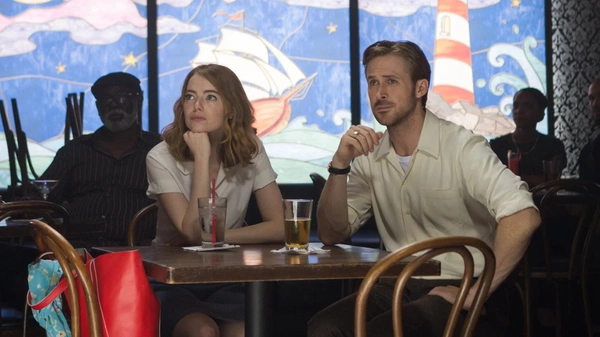
The film managed to speak of ambition without turning it into motivational rhetoric, instead showing how the desire for self-realization can become an exhausting and profoundly solitary process. Its strength lay precisely in its ability to capture a generational unease without reducing it to a slogan or identity manifesto.
Damien Chazelle and the musical transformed into contemporary melancholy
For this reason, too, Damien Chazelle's musical stands apart from the Hollywood tradition it pays homage to. Formally, the film recalls classic cinema through saturated colors, artificial sets, fluid camera movements, and long takes that evoke the great musicals of the past. Linus Sandgren's cinematography transforms Los Angeles into a suspended, almost unreal space, where the city seems to exist as an emotional projection.
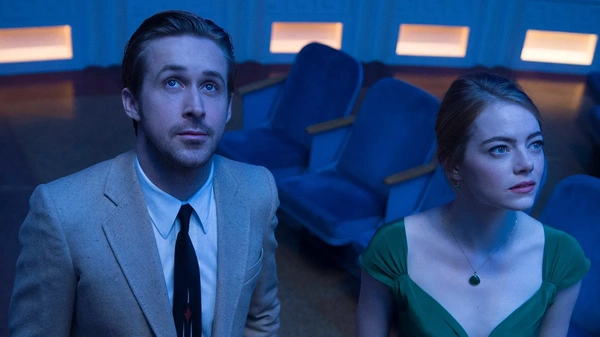
Behind this nostalgic aesthetic, however, lies a story much more bitter than it appears on the surface. Chazelle uses the language of classic musical to create a constant contrast between fantasy and reality, between what the characters imagine and what they actually achieve.
Love and ambition in La La Land: the true fracture at the heart of the film
The heart of La La Land is not the love story itself, but the way it is stripped of its redemptive function. Mia and Sebastian are not separated by betrayal or an irreconcilable conflict: their relationship slowly consumes itself because the individual trajectories of the two characters begin to move in incompatible directions.
The closer they get to the version of themselves they wanted to become, the less space the relationship has to survive. It is here that the film formulates its most destabilizing idea: loving someone may not be enough. Not as a cynical provocation, but as a deeply human observation.
The film does not suggest that the protagonists made the wrong choice, nor does it construct a moral hierarchy between career and feelings. Rather, it shows how every important decision inevitably entails a sacrifice. The true antagonist of the story is not failure, but the necessity of choosing.
The ending of La La Land and the weight of the “what if” (spoiler)
In this sense, the film openly dialogues with other works by Damien Chazelle, from Whiplash to Babylon. Here too, artistic success is depicted as something that requires emotional sacrifices and isolation.
The moment that best synthesizes this vision naturally remains the ending. The long sequence built around the “what if” continues to be one of the most discussed conclusions in recent cinema precisely because it rejects a simple and definitive emotion.
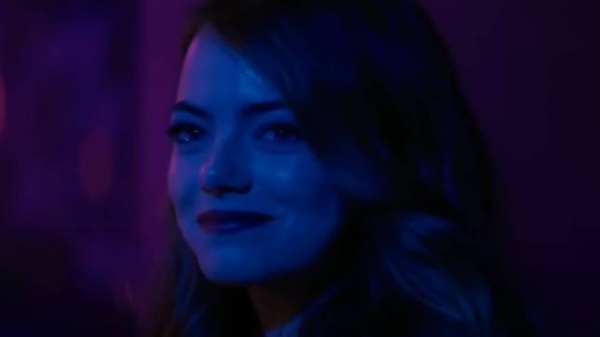
Chazelle uses unreal sets, theatrical transitions, saturated colors, and deliberately artificial staging to construct an emotional fantasy. That sequence does not show what should have happened, but what the characters, and perhaps even the viewers, will inevitably continue to imagine.
The result is an incomplete catharsis, capable of leaving both satisfaction and pain. The film does not suggest that there is a better version of the story, but only different versions, each accompanied by a precise cost.
Jazz as a symbol of a past impossible to hold onto
In the film, jazz becomes the symbol of a romantic idea of the past, of something that constantly risks disappearing in a world dominated by speed. Sebastian defends it with an almost nostalgic attitude, considering it a pure language to be preserved rather than transformed. It is no coincidence that the character constantly lives on the brink between artistic authenticity and professional compromise: jazz represents precisely that tension.
Damien Chazelle also uses this obsession to tell the risk of idealizing what can no longer exist in its original form. Sebastian dreams of saving jazz, but the film suggests that no art can survive by remaining static. Even the relationship with Mia ends up reflecting this dynamic: something authentic and precious that, in an attempt to remain intact, fails to adapt to change.
In this sense, jazz becomes the language through which La La Land speaks of the fear of losing oneself while trying to become what one wishes to be. To revisit the film through its music, here is the official soundtrack.
La La Land is a divisive film that has stood the test of time
Over time, there has been no shortage of criticism. Some have accused La La Land of idealizing a privileged world and of depicting creative difficulties through characters who are still far from the harsher forms of contemporary precariousness. Others have criticized its relationship with jazz or the film's strongly constructed aesthetic veneer.
Yet, precisely this division has contributed to strengthening its cultural legacy. A work that continues to generate divergent interpretations often endures over time, because it avoids transforming into a unanimously shared and thus quickly consumable experience.
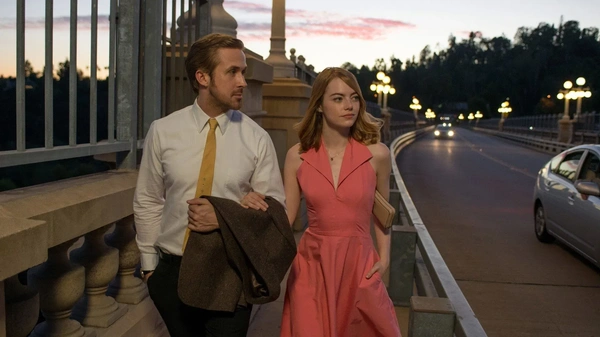
Why La La Land still resonates with us today
Today, perhaps even more than in 2016, La La Land appears less romantic and more realistic. In a present marked by job insecurity and the difficulty of building stable relationships while pursuing increasingly competitive personal goals, the film seems to have lost some of its nostalgic fairytale aura to take on that of a painfully contemporary story.
And this is probably why we haven't been able to leave it behind yet. Not because it tells an ideal love, but because it tells something much more difficult to accept: the idea that not all the things we desire can coexist at the same moment in our lives.
Similar articles