Nvidia, DLSS 5 and the Myth of Perfect Communication
Between neural rendering and controversy: why Nvidia's message divides the community and developers.


“Communication is content” is today a mantra stripped of its original meaning, repeated ad nauseam by digital marketing gurus hosted on black and white podcasts or thrown to the crowd from the stage of some provincial event that mistakes emphasis for depth and rhetoric for vision, transforming every concept into a ready-to-use slogan. It’s a bit like quoting Machiavelli without ever having read The Prince: one stops at the label, bending it to convenient and superficial interpretations, very useful for clearing one’s conscience. Thus, the public ends up being treated as a passive spectator, complexity is simplified until it dissolves, details disappear. In this context, it is not surprising that fertile ground is created for misunderstandings and disappointments, especially when technical reality does not coincide with the narrative built around it.
Mantra and Reality
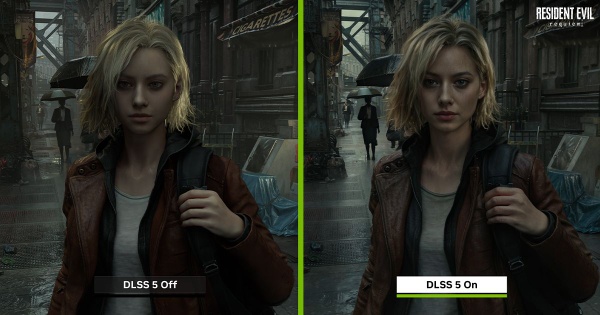
Nvidia’s announcement of DLSS 5, presented during GTC 2026 as a true “GPT moment” for real-time graphics, quickly transformed into one of the most controversial communication cases in recent years. In the initial presentation and FAQs published shortly after the event, the Californian company described the latest super sampling update as an epochal step beyond simple upscaling: a neural rendering system capable of intervening at the level of materials, lighting, and perceived geometry, while leaving full creative control in the hands of developers.

The message was clear and reiterated by Jensen Huang: DLSS 5 is not a filter, but a tool integrated into the pipeline, capable of preserving artistic direction and being granularly adjusted, to the point of being invisible or completely irrelevant. This reassuring narrative was based on two precise technical pillars. On one hand, the idea that DLSS 5 operated at a deep level of the scene, with a semantic understanding of 3D elements; on the other, the promise of refined control by developers, through intensity parameters, masks, and stylistic adjustments. In other words, Nvidia sought to position DLSS 5 not as an intervention on the image, but as an extension of rendering itself, a kind of invisible co-author capable of amplifying, but not betraying, the original intention.
The picture changes radically when the famous YouTuber Daniel Owen publishes an analysis built not on assumptions but on direct correspondence with Nvidia itself. In the video, Owen reports and comments on the responses received from a company representative, who clarify the system’s operation in a surprisingly explicit way. Among the most relevant passages, Nvidia confirms that DLSS 5 uses an already rendered 2D frame along with motion vectors as its main input, and does not have access to scene geometry or physically accurate data on materials and lighting. In another exchange cited in the video, it is specified that materials are not “read” by the engine but inferred by the model, probabilistically deduced from the resulting image.

Even more significant is the clarification that the underlying geometry is not modified, implying that any perceived variation in the scene is the result of a visual reinterpretation and not a real intervention on the rendering. This difference is not only technical but conceptual, a series of glaring contradictions with what was published and promoted just a few days earlier. According to what emerged, this fifth version of super sampling would behave like a probabilistic layer superimposed on the final result, deducing materials, lights, and details without having access to the scene’s ground truth data. It is therefore not surprising that early analyses reveal tangible alterations, including changes in character faces or material appearance, precisely because the system is pushed to “guess” what it sees.
If the first versions of DLSS had already met with resistance and distrust, these were mostly “gut” reactions, linked to image quality or the fear of visual artifacts, which were then progressively reabsorbed with the evolution of the system. In this case, however, the response was much sharper: the widespread perception is that a threshold has been crossed, moving from a technical improvement to an active reinterpretation of the image, with all the implications this entails in terms of control, authenticity, and transparency. This is where the most significant fracture opens.
Nvidia continues to talk about control, integration, and respect for artistic intent, while what emerges from its own technical explanations is a system that, in its purest form, is tremendously binary: on or off. Intermediate options exist, but they operate on an already interpretive, non-deterministic process, and this introduces a form of structural ambiguity. A tool that should be, by definition, predictable and measurable instead becomes opaque, probabilistic, subject to variations that are not always controllable. In this gap between narrative and function lies the core of the controversy.

Artistic Compromises in the Race for Efficiency
For those who follow the evolution of 3D graphics, Nvidia was, until recently, a benchmark not only for hardware but also for technical communication. Old tech demos were not just visual spectacles; they were used almost as educational tools. The closed-door “Speed of Light” demo in 2008 came with a 72-page whitepaper explaining pipelines, CUDA kernels, memory management, and optimizations. “Reflections” in 2018 was accompanied by 64 pages of documentation detailing all phases of ray tracing, from ray generation to reflection and shadow management, with diagrams, graphs, and pseudocode. This level of transparency allowed developers to understand, test, and integrate technologies with a very concrete margin of prediction.
Today, Nvidia seems to have forgotten all this: DLSS 5 is announced to the public as a generational leap, with the promise of an imminent revolution, but without any technical documentation. The official FAQs are vague, and communication oscillates between marketing and pseudo-technical jargon borrowed from generative artificial intelligence, without ever clarifying the real boundaries of the system. We do not know for sure what data is accessible, what parameters are truly adjustable, and, above all, what the definitive limits of the tool are. The contrast with old demos could not be starker: from dozens of pages of illustrative whitepapers, we have moved to a few lines that justify the product without allowing it to be understood.
Yet, as suggested by NVIDIA itself, this is a technology in a more than embryonic state: one then wonders why publish it so early, also aware of the reputation that today accompanies any AI-related product, launched into the crowd without providing adequate explanations. One possible answer lies in the need to preside over public and technological discourse, set the pace of the narrative before the competition, and consolidate a perception of leadership even in the absence of actual product maturity; another, more pragmatic, concerns investor and market pressure, which requires constant demonstrations of advancement, even when these are still in the experimental phase. In this sense, remembering that DLSS 4.5 will be released in public beta on March 31st, the picture appears as a showcase.
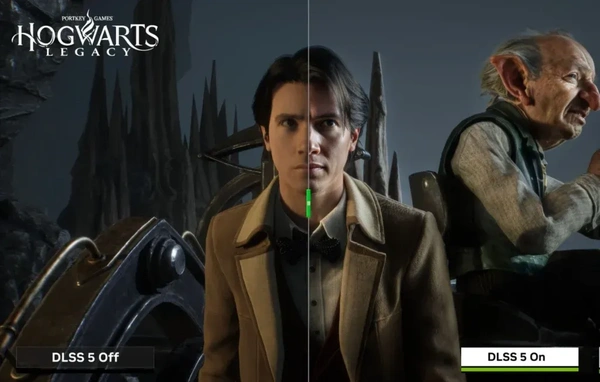
Yet, compared to previous storms of criticism that hit the Santa Clara giant, the GTC presentation opens a much more complex and systemic scenario for the entire sector. If previous releases had already pointed the finger at developers, accused of relying on these solutions at the expense of traditional optimization processes, DLSS 5, as it has been communicated so far, is destined to generate structural friction within the workforce, redefining not only technical practices but also the balance between skills, roles, and responsibilities. A tool based on probabilistic models that directly intervenes on the image and whose internal logic remains difficult to decipher tends to shift creative control away from artists, animators, and 3D developers.
In increasingly compressed production contexts, the promised efficiency easily transforms into a constraint: investments in assets are reduced, verification phases are shortened, and the risk grows that artistic choices are subordinated to technical stability. In a sector already marked by continuous restructuring and cuts (just think of the post-launch layoffs at Electronic Arts after Battlefield), the spread of tools perceived as automating risks further decimating the operational space for those who remain. In an industry increasingly driven by fiscal results and far from the direct performance of what ends up on shelves, pressures to continuously show technical progress can lead to presenting immature technologies as ready-to-use revolutions.
DLSS 5 is a media product: it serves more to convince investors, the general press, and the market of Nvidia’s innovative capacity than to be a tool truly ready for daily integration into game engines. Today, however, we are witnessing fragmented and defensive communication, with CEO Jensen Huang ready to dismiss criticism as misunderstandings, instead of clarifying doubts and boundaries. It is ironic, but tremendously bitter, that all this happens in the professional tech sector, which by definition should be based on clear and rigorous processes, and instead gets lost in communicative dilutions that reduce the product until it almost disappears. Technology is no longer described for what it is, but for what it must represent; and in a sector where art, technique, and commerce coexist in a fragile balance, this choice risks having concrete and lasting effects on the work of those who build digital worlds.
Similar articles