The problem with All’s Fair isn’t how bad it is (very), but what it says (terribly)
It’s easy to criticize the ugliness of Ryan Murphy’s first legal drama starring Kim Kardashian, but All’s Fair is at its worst with its little lessons on women, career, and relationships.
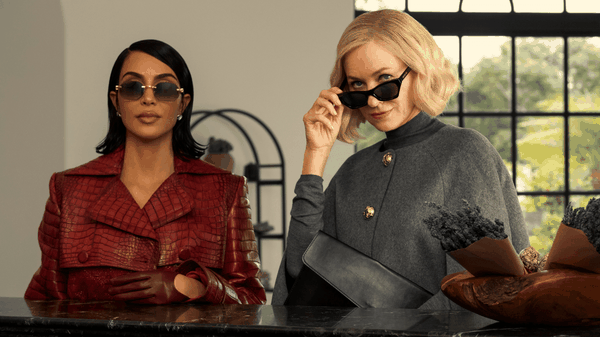


Contrary to what many think, writing a scathing review is not very demanding and even less satisfying: like all extremes, it lacks the nuances necessary to make transposing one's thoughts into words complex and challenging. At least when one encounters something of excellent quality, one is motivated by the urgency to tell about it, share it, recommend it by explaining its value as best as possible. In the case of the writer, there isn't even the sadistic joy of demolishing something that deserves it with carefully crafted sharp adjectives: no one will give me back the time lost watching something that deserves an unequivocal review. The only consolation I get is being able to prevent others from wasting their precious free time.
All’s Fair made headlines precisely because of the exceptional wave of condemnations it received, which its embargo, expiring after its broadcast, already foreshadowed. Not since the highly controversial The Idol by Sam Levingson (which I also had the displeasure of following and reviewing) had a series made news for the ruthlessness of the judgments it garnered. Qualitatively speaking, All’s Fair is much worse than The Idol, which, in its exaggerations and vulgarities, at least had the urge to say something.
Very Little Happens in All’s Fair
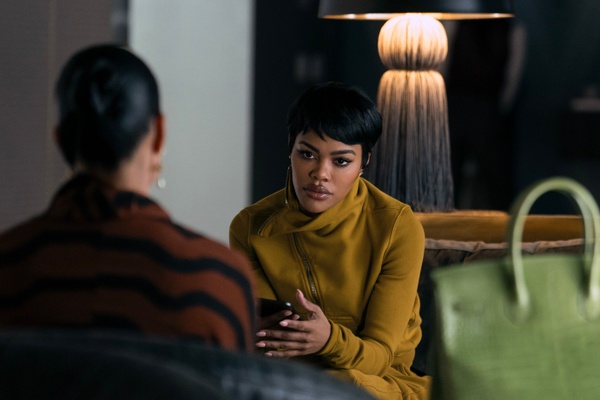
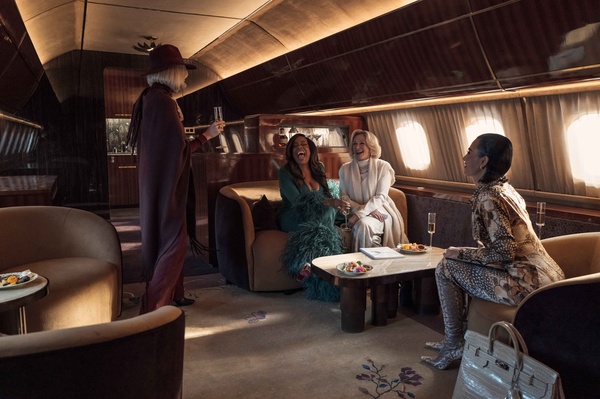
What is most astonishing in All’s Fair is, first and foremost, the total lack of events. We are in a legal drama where legal cases occupy a few minutes of the entire episode, where the personal lives of the protagonists (one's children conceived through artificial insemination, the other's stable relationship, and the third's husband's infidelity) are continuously recounted in hyper-static scenes where the three actresses are sprawled like sphinxes on sofas or armchairs, designer bags at the center of the frame: their Gucci and Valentino have more space (visual and narrative) than their lives and careers.
There is so little in All’s Fair that one wonders how forty minutes are filled in each episode, even considering that realism is not really the point of the series. In his first legal endeavor, Ryan Murphy wants to create a sort of glamorama version of the world of big law firms, just as great titles like Damages, The Good Wife, Ally McBeal did in their time: citing them in the same sentence as this latest series is already a controversial move in itself, even if in theory they share the genre and approach to it.
Murphy creates a utopia where Kim Kardashian and Naomi Watts leave the very male-dominated law firm where they work to found their own and represent only women, mostly in rich divorce cases. Clients who are obviously at odds with their disgusting husbands, from whom they extort such astronomical sums as to be ridiculous, despite having signed draconian prenuptial agreements. Utopia, agreed, but it is the complete lack of friction that is perplexing, if not, I reiterate, the complete lack of story. The two protagonists leave the firm, taking a paralegal assistant with them with the blessing of veteran partner Glenn Close, and vow to create a legal empire in ten years. A time jump, and ten years later, there they are, no impasse, no difficulty, no reference to how they found a client base and the funds to succeed.
The day they leave is also the genesis of the series' villain, Sarah Paulson. She, the veteran partner's darling, an indefatigable worker and extremely talented lawyer, swears mortal revenge on the two fleeing colleagues because... it's not entirely clear why. Why don't they take such a good colleague with them? The series of ridiculous excuses listed in this particular scene (culminating in the revelation that Paulson stole one too many lunches from the communal fridge) is such that in the end, you end up siding with the very angry villain. At least until the series forces her to write a note to the two so stupid in its vitriol that it makes you reconsider the choices of a professional career that put you in front of such a series.
The Acting in All’s Fair Ranges from Terrible to Totally Absent
I cannot skip a necessary, astonished comment regarding Kim Kardashian's performance. What can I say? It's difficult to evaluate acting when every attempt to convey any feeling or emotional reaction from the character being played is essentially absent. No one truly acts well in this series, not even the poor Teyana Taylor and Glenn Close, but Kardashian merely exists on set, offering the camera a face characterized by an absolute lack of reaction to what is happening around her. Kardashian is impeccably dressed, charismatic in her own way in expressing a complete and absolute nothing, detached even from her own affairs, physically and emotionally immobile.
So far, the predictable demolition of a series badly written, worse directed, which transforms its eagerness to be glamorous into an endless parade of exaggerated outfits, including python-print coats and trench coats that change instantly between when the character gets in and out of their car, without any explanation. I also laughed a lot at another detail, staying on the topic of cars: the series exhibits such an exaggerated wealth of the protagonists that the character (annoying in her cloyingness) of Niecy Nash goes to stalk a man to photograph him with compromising pictures... but remains in the back seat, SLR in hand, while a private driver drives and accompanies her to the stakeout.
The ostentatious wealth in All’s Fair is as annoying as that in the reality shows Kim has starred in for years: an exaggerated luxury without motivation or taste, which the protagonists have not earned except in words, and which is normalized without providing any kind of contribution to the narrative. All’s Fair talks about the 1% of the American population, normalizing their elite behaviors while simultaneously positioning itself as a champion of equity. The series makes one bitterly regret certain sweeping generalizations that Suits slipped into in its later seasons.
All’s Fair’s Feminism is Superficial and Detrimental
Particularly odious is the thread of superficial and uncomplicated feminism it seeks to propagate. The writer particularly dislikes all those simplifications that, in order to talk about a more just society for women, end up depriving them of any negative traits and the potential to also be bitches, when necessary. All’s Fair does much, much worse than that, presenting us with a handful of clients who are as helpless and despicable as their husbands. Women who may have found true love or fulfillment despite their millionaire ex and are willing to leave without caring too much about money, but allow themselves to be convinced that they deserve millionaire “compensation,” because ultimately here money is the only true measure of justice employed.
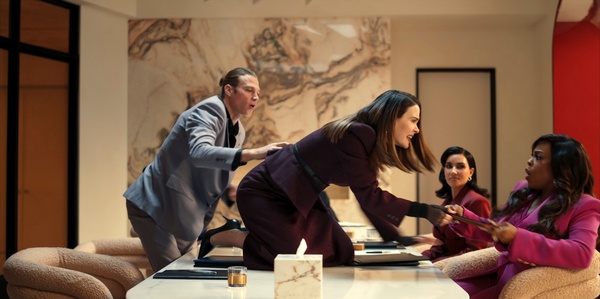
The passage that truly tested my patience, however, concerns the world of kink and sadomasochism, in a series that apparently speaks freely about sex but, in fact, merely talks about it between champagne flutes, reducing intimacy to a series of male genital measurements. From someone like Ryan Murphy, who has practically made fetish imagery and kitsch and trashy excess his banner (bringing back forgotten icons of the past from the rest of the production world), I expected anything but the solid demonization of the world of sadomasochism and role-play. There's a dominatrix who willingly sells photos of her client (already completely misrepresenting the trust and confidentiality on which this world is based) with the excuse that “the practices he loves are disgusting,” but even worse, there's an equating of harmless fantasies with something so shameful and sinful that it's worth two hundred million dollars.
After all, All’s Fair is populated by sphinxes with inexplicably gloved hands, who revel in their detachment and measure the world in millions, in a universe completely devoid of vulnerability, emotionality, perhaps even feelings. Therefore, there is nothing left to do but chatter about the (admittedly minimal) work done, what has been achieved, and the measurements of the man who, for now, is by one's side. Even as
Score
Editorial team

The problem with All’s Fair isn’t how bad it is (very), but what it says (terribly)
It’s hard to say what’s worse in All’s Fair; whether it’s the disastrous acting, the ill-advised choice to rely on an imperturbable Kim Kardashian as the emotional core of the story, how little the story itself has to tell, or the fact that what little it does tell is even detrimental as an all-female utopian fantasy. Even for a career marked by qualitative ups and downs like Ryan Murphy’s, it’s an abysmal result, which hopefully will at least serve as a tombstone for Kim Kardashian’s acting ambitions.
Similar articles
Lee Cronin's The Mummy is Not Very Mummy, But It's Truly Scary: The Review

Summer Game Fest is Today at 11 PM, Follow it With Us

Cate Blanchett Talks About the Future of Hollywood at Cannes: “The Problem with AI is Consent”