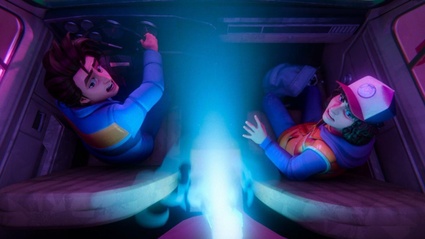
Stranger Things 5, Finale Review: Still Astonishing, Until the End
A consistent and emotional farewell that concludes a decade-long story without sacrificing intensity.
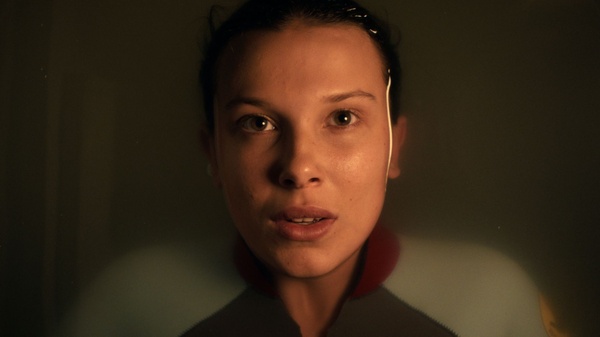


The fifth season of Stranger Things comes to a close as only works that have surpassed themselves do: with a symbolic weight that goes far beyond mere narrative closure. In an era where serial viewing is often accompanied by the anxiety of prediction and the need to dissect a work before it is even complete, Stranger Things reclaims an increasingly rare gesture: the possibility of being astonished by television and cinematic art. Hypothesizing, certainly, but without the desire for control stifling the experience. And in this sense, the finale is already a declaration of poetics: it doesn't seek another clever trick, but the coherence of a journey.
It is no longer just a television series, but a cultural phenomenon that must confront its status as a pop myth. This season does not attempt to downsize that weight. On the contrary, it fully embraces it, accepting the risk of appearing disproportionate, redundant, even imperfect. It is a precise choice that defines the tone of the operation from the outset: not an elegant refinement, but a conclusive act that prefers intensity over measure.
- A quality finale, consistent with ten years of journey
- Why the finale is truly emotional
- The series' identity: from discovery to awareness
- A multi-layered struggle: physical, mental, and metaphysical
- Writing and exposition: the price of clarity
- Direction and duration: seriality looking to cinema
- Characters and performances: the value of emotion
- Rhythm and structure: excess as a poetic choice
- Closing without diminishing
- Conclusion
A quality finale for Stranger Things 5, consistent with ten years of journey
The keyword is consistency. Stranger Things 5 truly concludes, and it does so without betraying what it has been: a story that has always balanced trauma and hope, horror and tenderness, spectacle and intimacy. It is a quality finale precisely because it does not try to be “smarter” than its own story, but brings it to its natural completion. Of course, along the way, small simplifications and some physiological gaps emerge, as happens when one has to tie up the threads of a layered mythology. But these are marginal frictions compared to the result: a coherent, readable conclusion, and above all, capable of placing every knot within a recognizable emotional design.
And here lies its most evident strength: emotion is not just an effect; it is the very material with which the series chooses to conclude.

Why the finale is truly emotional
This epilogue is striking for two complementary reasons. The first is historical, almost biographical: we are saying goodbye to a story that has accompanied us for a decade. Stranger Things is not “a season ending”; it is a portion of time closing. And that duration—ten years of anticipation, theories, discussions, and collective ritual—weighs within every final scene, transforming the conclusion into a generational farewell.
The second reason is narrative and affective: the connection with the characters. The series may stumble when it tries to explain too much, but it rarely errs when it needs to let the faces, the bonds, the silences, and the small gestures breathe, certifying all that these characters have lost and saved. The finale is emotional because it doesn’t just “close the plot”; it closes a relationship between the viewer and the story, between the viewer and imaginary people who, season after season, have become familiar.
The series' identity: from discovery to awareness
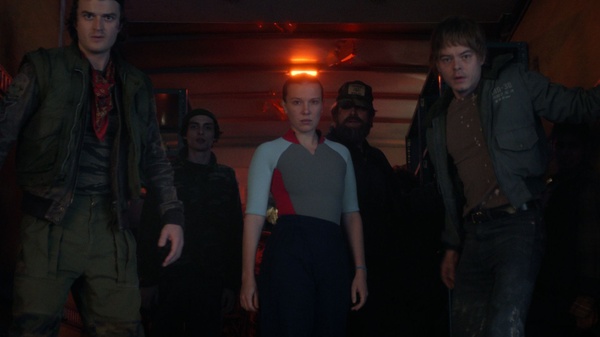
If the early seasons thrived on mystery, discovery, and the progressive unveiling of the unknown (I explain everything here), the final season moves in the opposite direction. Here, everything is known, or at least recognizable. The characters know the evil they face, have experienced its consequences, and, most importantly, bear its marks. Stranger Things thus becomes a series about awareness: not about the irruption of horror, but about coexisting with it. This paradigm shift also explains the lack of lightness many have perceived. It is not a flaw, but a transformation: the story no longer seeks to surprise with the unknown, but rather to question what remains after years of shared trauma.
And it is here that the final season plays for higher stakes: not to “defeat the monster,” but to demonstrate that growing up does not mean forgetting.

A multi-layered struggle: physical, mental, and metaphysical
The thematic heart of the season lies in the construction of a stratified conflict. The physical dimension, set in a now compromised Hawkins, maintains a brutal concreteness, made of sieges, bodies, and resistance. In parallel, the mental conflict shifts the focus to the characters' interiority, where imprisonment is spatial and psychological, linked to guilt and the fear of being defined by their pain. To these two levels, a third, more abstract, almost metaphysical one is added, involving identity, destiny, and deep bonds. It is in this intertwining that the season finds its most authentic ambition: not to tell a single battle, but a system of clashes that reflect and feed each other.
In other words: it’s not just Hawkins against horror; it’s Hawkins against what horror has etched into its inhabitants.
Writing and exposition in Stranger Things 5: the price of clarity
The writing remains the most controversial element of this season, not so much for what it tells as for how it chooses to tell it. The need to clarify, explain, and organize a mythology accumulated over years often leads to verbal overexposure that slows the pace and weighs down the viewing experience. It is one of the “small simplifications” whose presence is felt: at times, the series prefers exposition to vertigo.
Yet, within this limitation, there is also an act of responsibility: Stranger Things does not choose ambiguity as an escape. It takes on the burden of settling accounts with its own universe, accepting that order, in such a popular saga, is also a form of respect for the audience.

Direction and duration of Stranger Things 5: seriality looking to cinema
From a formal standpoint, Stranger Things 5 continues and radicalizes its transformation into a serialized cinematic event. The extended episodes no longer seek classic television autonomy but function as acts of a single monumental narrative. This choice enhances some emotional moments, allowing them to breathe and settle, but weakens the overall progression, which proceeds by accumulation rather than momentum. The series seems constantly suspended between two natures: that of a conclusive film and that of episodic storytelling. The synthesis is not always successful, but the ambition is evident and, in many ways, consistent with what is at stake.
Characters and performances in Stranger Things 5: the value of emotion
With such a large cast, the season inevitably accepts an unequal distribution of attention. Not all character arcs receive the same space, but what emerges is a strong centrality of emotion as a narrative glue. The performances often support sequences built more on confession than on action, and when the series stops explaining and lets the faces speak, the strength that made it iconic resurfaces. Stranger Things continues to believe in the power of explicit feeling, without fear of being emphatic. It is a choice that divides, but confirms the deep identity of the work.
And in the finale, this choice pays off: because the true farewell is not a plot twist; it is an acknowledgment.
Rhythm and structure: excess as a poetic choice
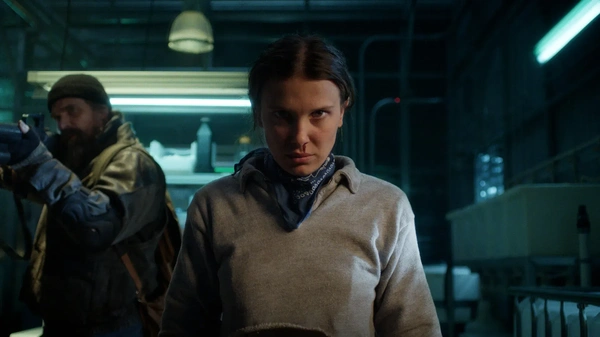
The season's irregular rhythm is not just a structural problem, but also a declaration of intent. Stranger Things does not seek a dry conclusion, but rather a total experience that encompasses everything it has been. This leads to a narrative that at times pauses, reflects, and insists, but it is precisely in this insistence that it builds the sense of a definitive farewell. It is a poetics of excess, which rejects subtraction and embraces memory as narrative material: the work doesn't just want to end; it wants to “say goodbye.”
The Stranger Things 5 finale: closing without diminishing
The finale does not aim for shock for its own sake nor for a traumatic break. Instead, it works on the idea of completion: the conclusion as an act consistent with what the series has been, not as a spectacular betrayal to leave its mark. It is an emotional closure, because it restores the sense of a ten-year journey and makes evident the connection built with the characters. Even where small gaps or simpler-than-expected solutions emerge, the whole holds together: because the overall design remains faithful to the work's trajectory.
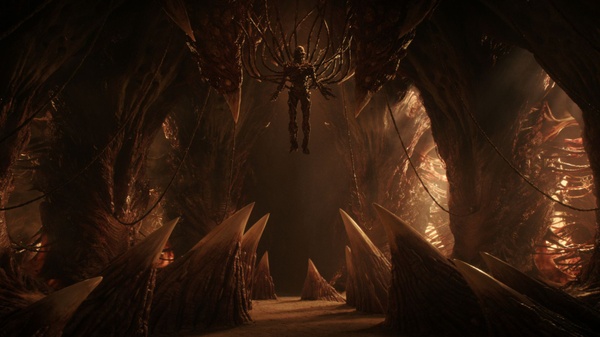
Stranger Things 5 Review: Conclusion
Overall, the fifth season of Stranger Things is an imperfect, but deeply felt, work that chooses to embrace its own myth instead of lightening it. It is a season that asks the viewer to be astonished without the need to control every step and to accept emotion even when it is excessive. Its small simplifications do not erase the substance: a coherent, emotionally powerful conclusion capable of truly ending a journey that has spanned (and partly defined) ten years of pop culture.
Score
Editorial team
Stranger Things 5, Finale Review: Still Astonishing, Until the End
Not because it’s impeccable, but because it deliberately chooses not to be. The fifth season accepts the risk of excess and foregoes formal neatness in favor of something rarer in contemporary serial storytelling: the desire to still astonish, to ask the viewer for trust instead of control, emotion instead of continuous hypothesis testing. In an era obsessed with prediction and anticipation, Stranger Things 5 reclaims the value of disorientation and the right to conclude coherently, without diminishing what it has been.
Similar articles