Creative Sound Blaster X5 - Hi-Res DAC for PC and Consoles Review
PCM 32-bit/384 kHz playback with 130 dB DNR and 2x Cirrus Logic CS43198 DACs
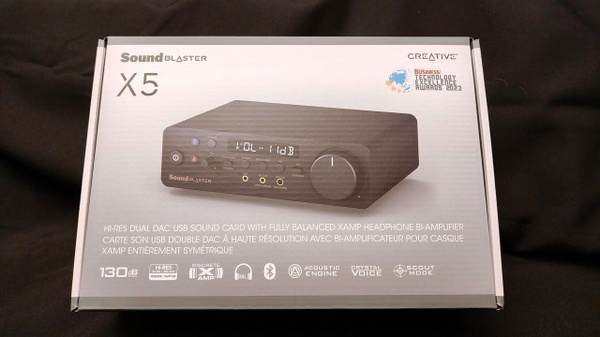


For audio quality enthusiasts who want a versatile device that works well with computers as well as game consoles and media players, Creative has designed the Sound Blaster X5. With a sober and even somewhat anonymous design, the casing is plastic except for the rear terminals, yet it doesn't give the impression of being a cheap product. It's solid, well-assembled, with smooth knobs, stable on the desk, and less suited for constant movement.
Even the lighting follows the same philosophy: deliberately discreet LEDs, never dazzling. The large volume knob has a soft white light and doesn't strain the eyes even during listening sessions in dim light. The display is clear, with large, legible characters, bright enough but not intrusive. An appreciable detail is the automatic display change when headphones are connected, in addition to the precise volume level indication. Every switch produces a crisp click and mechanical feedback that reinforces the feeling of physical control.
Sound Blaster X5 - Accessories between analog and digital
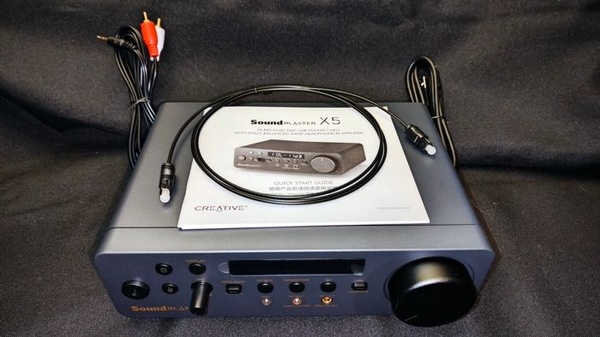
The layout is intelligently designed: even with all available terminals connected at the back, there's never a sense of clutter. The RCA, optical, USB-C, and USB Host ports are well-spaced. USB-C power adds versatility: it can also be powered by compatible laptops, tablets, or even smartphones. The thick, grippy rubber feet slightly elevate the unit for better ventilation and prevent any slipping.
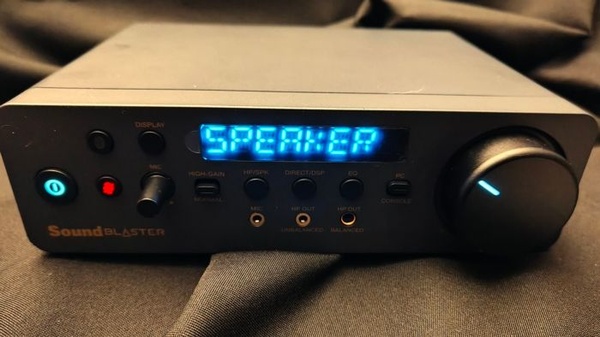
The front features the power button, microphone mute and corresponding gain adjustment, High/Low selector for headphones, toggle between headphones and speakers, Direct/DSP mode, EQ change, PC/Console switch, as well as 3.5 mm inputs and a 4.4 mm balanced output. It's rare to find such an abundance of physical controls in this price range. The X5 doesn't force you to always go through software: many adjustments are immediate and intuitive. Dedicated DAC for each channel (CS43198) with independent L/R management, eliminating the risks of noise and interference.
Sound Blaster X5 - Music, video games, and multimedia entertainment
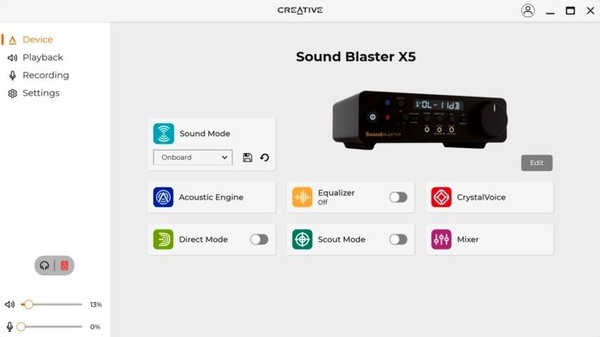
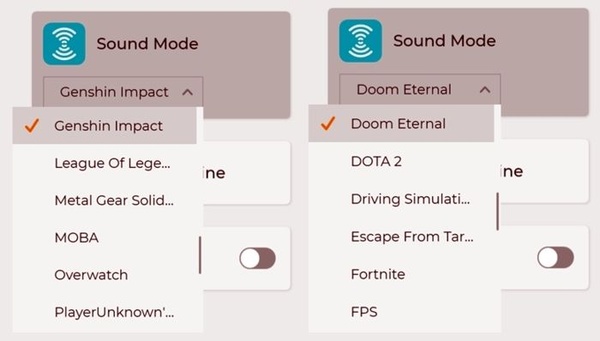
The Creative Sound Blaster app further expands possibilities, with a 10-band equalizer, microphone options, mixing functions, and Scout mode for gaming. Not all functions are indispensable – for example, the absence of Super X-Fi might be surprising – but the software ecosystem offers room for customization. Personally, the Direct mode remains the most convincing for music listening: it eliminates all processing and lets the hardware “speak.”
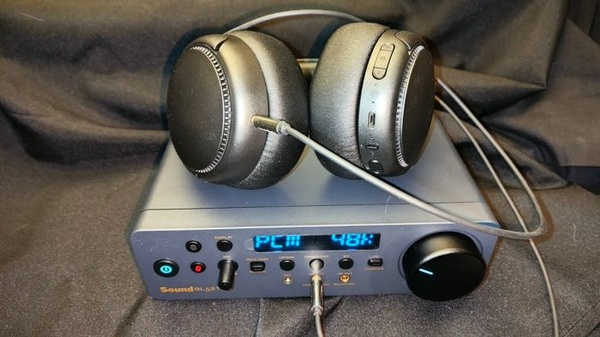
In terms of power, the X5 is surprising. The declared numbers might not impress at first glance, but practical experience tells another story. Even demanding headphones, both dynamic and open-back planar magnetics (from 1 Ohm up to 600 Ohm), are driven with authority, especially through the balanced output. It's precisely the latter that makes the difference: compared to the single-ended, the sound gains more impact, more energy, and a superior sense of control. With particularly sensitive headphones like in-ear monitors, in extreme cases, a very slight hiss might emerge, but in most situations, the experience is clean and stable.
Sound Blaster X5 - Broad connectivity, some shadows
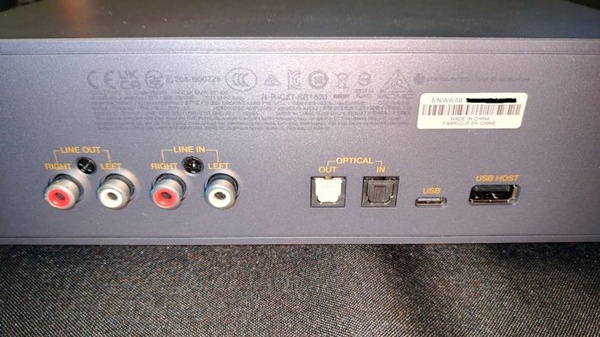
Broad connectivity, but one of the few real limitations emerges: Bluetooth only supports the SBC codec and stability is not impeccable. However, it's not necessarily true that a wired connection is always superior; some have experienced difficulties with their hardware chain, from the PC to the X5 via USB A/C, then out via RCA to the amplifier and from there to the speakers, also connected via cable.
In this specific case, background noise occurred when listening from audio streaming platforms and delays in video playback, with excessive desynchronization between images and sound. Despite a firmware update and cable changes, the solution was to switch to Bluetooth, which for the X5 is version 5.0. The optical input is a different story, performing excellently, for example, when connected to a game console or media player.
Its use as a preamplifier is also interesting. Connected to external amplifiers or power amplifiers for speakers, the X5 maintains coherence and quality, proving it can be the center of a more complex system.
As for the sound, using Direct mode and the balanced output, the X5 surprises with its balance and musicality. Bass extends deep with authority, without invading the mid-range. There's energy but also control and good texture definition. The mids are engaging, with natural voices and well-articulated instruments. They are neither recessed nor overly prominent: simply coherent. The highs are extended, airy, and never aggressive. When the track demands brilliance or incisiveness, the X5 responds with precision without becoming fatiguing.
Sound Blaster X5 - The listening experience
The soundstage reveals no artificial elements; the depth allows for perceiving different sound planes, and the separation between instruments remains orderly even in the most complex passages. Imaging isn't surgically precise to the millimeter, but it's sufficiently accurate to easily follow every element in the mix. For the X5's price range, the level of detail and resolution is remarkable, without harshness or unwanted veiling.
In comparison with competitors, such as the FiiO K11, the X5 doesn't always win in purely analytical terms or premium build, but it offers something different: a combination of versatility, power, and musicality that makes it more complete. The X5 can be considered an ideal bridge between those aiming for a DAC for critical listening without disdaining a gaming device and vice versa.
Ultimately, Creative has succeeded in creating a credible product even in the eyes of the demanding audiophile. Not perfect, not without compromises, but surprisingly mature in sound and rich in features.
Sound Blaster X5 - Hi-Res and compatibility
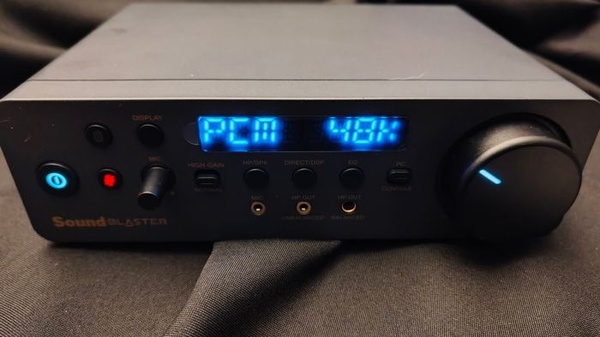
To use the device or software correctly, the system must meet certain minimum requirements. Below are the main specifications for each platform.
Windows PC
A computer with an Intel Core i3 processor or equivalent AMD is required. The operating system must be Windows 10 or Windows 11 (version 1703 or later), both 32 and 64-bit. At least 4 GB of RAM and 4 GB of free disk space are needed. A USB 2.0 or USB 3.0 port must also be available to connect the device.
Mac
The computer must have an Apple Silicon M-series processor. The required operating system is macOS 10.15 or later. In this case too, at least 4 GB of RAM, 4 GB of free disk space, and an available USB 2.0 or USB 3.0 port are needed.
PlayStation 4
The console must have firmware version 5.0 or higher and a free USB port for connection.
PlayStation 5
A system with firmware version 20.02-2.26.00.00-00.00.00.0.1 or later and an available USB port is required.
Smartphone and software remote control
To use the remote control via the mobile app, a smartphone with:
-
Android 8.0 or later, or
-
iOS 12.0 or later
The mobile device must also have integrated Bluetooth Low Energy (BLE) support.
Similar articles