
With Fatherland, Sandra Hüller Confirms Her Status as the Actress of 2026
After Rose and Project Hail Mary, Pawel Pawlikowski's film gives Sandra Hüller another masterful role, built entirely on subtlety, silences, and restrained tension.


There’s a very small, almost invisible moment in Project Hail Mary, where Sandra Hüller lets a fragment of her personal biography filter into the Hollywood blockbuster with Ryan Gosling. Her character recounts singing in an East German choir during her childhood, shortly before performing an improbable karaoke to the tune of Harry Styles’ “Sign of the Times.” It seems like one of those identitarian and metatextual easter eggs that Hollywood loves to scatter in its products to converse with the audience, but today it almost appears as an ideal bridge to Fatherland. As if within that hint of East Germany, tucked into the heart of an optimistic and spectacular film, an ideal bridge to Pawel Pawlikowski’s new work was already hidden. The Polish director, after all, also grew up beyond the Iron Curtain and for years has obsessively returned to questioning the wounds left by European division, the ghosts of the twentieth century, and the people trapped between political systems that promised salvation but instead produced new forms of oppression.
Sandra Hüller is once again exceptional
For Pawlikowski, this is certainly not his first foray into these themes. Indeed, Fatherland seems almost the natural culmination of a discourse begun years ago with Ida and then brought to completion with Cold War. It’s impossible not to read the film in continuity with those works, both thematically and aesthetically. The magnificent black and white cinematography by Łukasz Żal returns, as do the restricted formats (alternating between 1.37:1 and 4:3), and above all, those characters crushed at the edges of the frame, compressed against walls, ceilings, and architectural lines as if History itself were slowly closing in on them.
This time, however, Pawlikowski pushes his work of subtraction even further. Fatherland is an almost rarefied, sparse film, yet continuously traversed by images of rigorous and devastating beauty. Every shot seems constructed like a photograph capable of telling, by itself, the collapse of an entire European civilization. The hotel rooms, corridors, dining rooms, theaters, and restaurants that the characters move through become mental spaces even more than physical ones: places where post-war Germany desperately tries to reinvent itself while already slipping into a new form of ideological control.
At the center of the film is an elderly Thomas Mann, now transformed into a living cultural monument, recalled to Germany, fresh out of Nazism, for a celebratory tour that should symbolically sanction the country's moral rebirth. Mann, however, is also a deeply ambiguous figure, too cumbersome and complex to be truly absorbed by either the American West or the nascent Soviet bloc, both of whom desire an explicit endorsement of their ideological cause from him. And it is precisely this ambiguity that interests Pawlikowski. On one side is the West of the CIA, the Associated Press, and capitalist reconstruction; on the other, East Germany, rapidly taking on the contours of new Soviet oppression. In between is the Mann family, upper-class and influential, but incapable of taking a stand, paralyzed by the weight of their own intellectual authority.
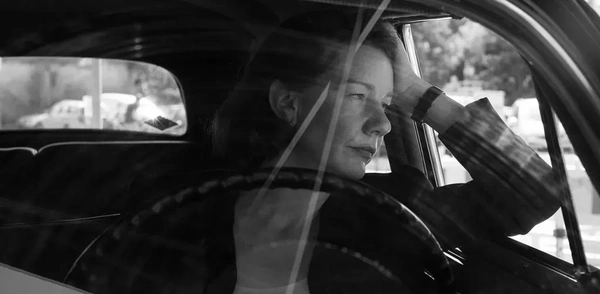
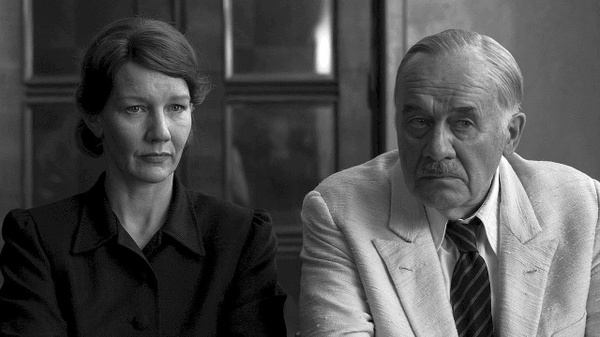
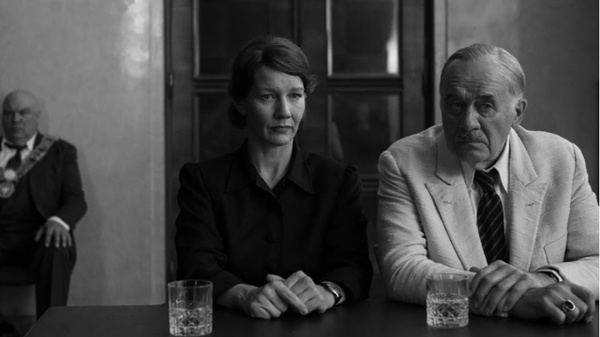
Sandra Hüller plays Erika Mann, the most devoted daughter but also the one who most lucidly understands her father's moral failure. It's an impressive performance precisely because it's built almost entirely on control. Hüller works on minimal cracks: a gaze held too long, a pause, a smile that immediately dies on her face, animated only by that dry, dark irony that seems a distinctive trait of the family. Erika experiences her relationship with her father as a continuous tension between veneration and emotional suffocation, between authentic love and repressed anger.
The great ghost hovering over the film is her brother Klaus Mann, played by August Diehl, who imbues him with an almost spectral character. Having fled Germany and unable to forgive either Nazism or his father's emotional detachment, Klaus becomes in the film the fracture that reveals national and familial failure. The Mann family thus transforms into the perfect metaphor for Germany itself: highly cultured, brilliant, internally devastated, wearing the clothes of defeat with casual irony, while being traversed by ideological, emotional, and identity fractures impossible to mend.
Pawlikowski's extreme subtraction
Pawlikowski continually suggests more than he explicitly states. References to the queer identities of Mann's children and father remain almost always lateral, hinted at with elegance and discretion, but ultimately become an integral part of the film's discourse on the impossibility of living openly and freely within political and familial systems where the primary value is the repression of emotional truth. Here too, the director avoids any didactic explanation: a gesture, a barely hinted phrase, an exchange of glances suffice. One of the film's most extraordinary moments occurs during an official lunch where a children's choir sings the anthem of the new East Germany. It is a profoundly Pawlikowskian scene: music used not as accompaniment, but as an emotional and political detonator. Those familiar with Cold War immediately recognize in that moment the first symptoms of a new oppression already tightening its grip on the population.
The film makes explicit the handover between Nazism and Soviet repression in a very harsh scene where a dissident manages to reach Mann in his room to tell him that in Buchenwald, Jewish prisoners have been replaced by political prisoners unwelcome to Stalin. The most devastating aspect is not so much the revelation itself, as Mann's inability to truly react, because another detonation has just occurred in that same room: the first and only time Erika breaks with his authority, verbally expressing her disgust at how his literary tour continues after an event has shattered the last glimmers of family unity. Also beautiful is the parallel with Klaus, who reproaches his father for his lack of affection, only to cruelly inflict the same lack on his sister and mother, who quietly discuss it on the phone. A family trait that Erika decides not to carry on, even at the cost of jeopardizing her relationship with her father.
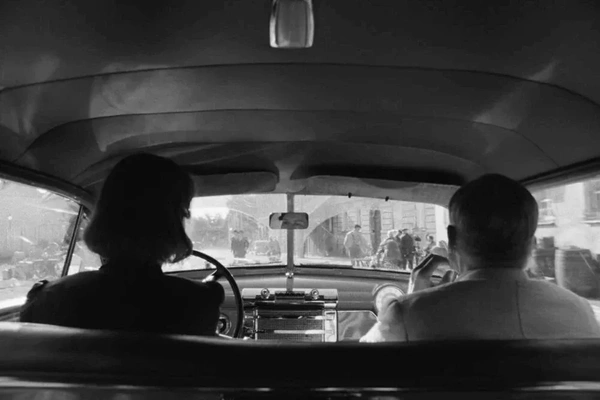
For much of the film, father and daughter seem to communicate through omissions, unspoken understandings, and silences. They speak quietly and wittily, but never truly confront the news that shatters their difficult attempt to hold together the last glimmers of family. Theirs is a family united by intelligence and separated by the inability to openly express emotions and vulnerabilities. Even the mother remains off-screen for almost the entire film, evoked only through phone calls and indirect conversations, as if the entire Mann family now exists only as a collection of fragmented presences.
On a first viewing, Fatherland might even seem less ambitious than Cold War, more subdued and reduced. But then it continues to settle in the memory in an impressive way. Pawlikowski works by extreme subtraction, as Michelangelo and Kawabata Yasunari did in the later stages of their careers, obsessively returning to the central works of their production, remaking the Pietà or rewriting Snow Country in an increasingly reduced, essential manner. In the same way, the director here eliminates everything he does not consider strictly necessary and lets absences speak. Every scene seems incomplete only until the film ends; then suddenly everything finds its place in the viewer's memory.
It is impressive that the director manages to construct such a monumental work in just 82 minutes. There isn't a single superfluous scene, not a single dialogue that doesn't serve to build the emotional and political collapse that the film portrays. Even Joanna Kulig's musical cameo (the director's historical muse) is not just a nostalgic concession, but a further distant echo of Cold War, almost a ghost that once again traverses Pawlikowski's cinema.
The director also takes an enormous risk: building practically the entire film around its final scene. It is there that Fatherland plays out its ultimate meaning, and it is there that the film definitively decides whether or not to become a great film. Fortunately, the ending is extraordinary, of an almost paralyzing emotional power, capable of rewarding all the rigor and discipline that Pawlikowski imposed on himself up to that point.
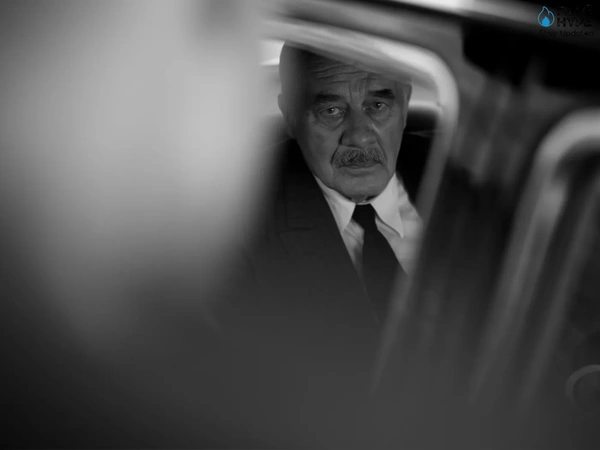
From a visual standpoint, Fatherland is also impressive. The set designs are highly refined, rich in objects, furniture, and historical details that convey a Germany suspended between ruin and cultural monumentality. This is the only concession to what is not essential. Pawlikowski manages to transform every space into a psychological extension of the characters. A minimal camera movement, an actress crossing a corridor, cleaving shadows at the edge of the frame, is enough to generate images of an old-world elegance.
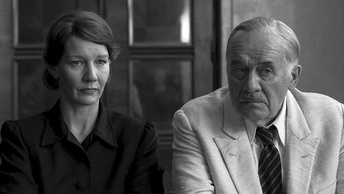
Sandra Hüller simply seems destined to work with this kind of cinema. Her approach to acting, built entirely on restrained tension, controlled pain, and the ability to suggest enormous emotional contradictions without ever explicitly stating them, is perfectly mirrored by Pawlikowski's direction. Actress and director seem to continuously reflect one another, further amplifying the final result.
Score
Editorial team
With Fatherland, Sandra Hüller Confirms Her Status as the Actress of 2026
It must be said clearly: Fatherland is auteur cinema in the most rigorous sense of the term. It demands attention, concentration, a willingness for silence and contemplation. But those who embrace its subdued emotional frequency are immensely rewarded. Pawlikowski tells the story of a nation and a family that barely survived a first despot—Hitler for Germany, Thomas Mann for his children—only to discover with horror that pain and oppression are simply changing form. The advice is to catch up on or rewatch Cold War before viewing: the two films continuously converse with each other, like mirror works born from the same reflection on 20th-century Europe, on exile, on memory, and on the impossibility of truly feeling free.
Similar articles