Good Luck, Have Fun, Don't Die: The Grand Return of Gore Verbinski, Boomer and Proud of It
Gore Verbinski isn't too fond of social media and smartphones, but he criticizes them with wit and irony in an entertaining and finely crafted film.


Calling Gore Verbinski a boomer, rather than an insult, is a statement of fact: the American director was born in 1964, the last year of the generation of children born during the economic boom. He's a "young boomer," in short, and in his latest film, he perfectly embodies a certain anti-technological approach that part of his generation instinctively opposes to our present. He has good reason to, one might think in the most successful scenes of Good Luck, Have Fun, Don't Die, a delightful Groundhog Day-esque film in which Sam Rockwell keeps returning from his apocalyptic future to our present, bursting into a diner armed with an explosive belt, a raincoat, and a mission: to form a team among the diner's customers, trying every possible combination until he completes a task that will save the future of humankind.
What went wrong in the future depicted in Good Luck, Have Fun, Don't Die we soon discover, and it's not too dissimilar to the fears of our present: artificial intelligence singularity and the human population's almost zero capacity to react, totally subservient to the technological, emotional, and practical aid of smartphones. With considerable courage, Gore Verbinski includes in the list of villains (or what he sees as an incomprehensible generation) teenagers, a cross between zombies and particularly aggressive advertising should an adult dare to touch one of their screens.
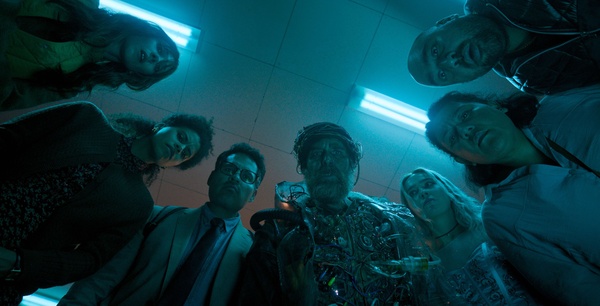
Gore Verbinski is back to tell us how much he dislikes today's tech world
Presented this way, the film appears hostile and retrograde, but nothing could be further from that empty nostalgia for ancient times, both bitter and bucolic, perhaps from those who have never gotten their hands dirty in the earth or on an assembly line. Verbinski does not subscribe to a critical view, a critical view of our progressive dependence on technology at an individual and social level, indicating a return to society and the problems of when the Internet didn't exist as the only solution. Good Luck, Have Fun, Don't Die is so incisive because, before criticizing technology, it explores and deeply understands it. The film doesn't have a solution, but its mission is to point out some critical points of the present that could lead to an even darker future.
Another rarity that looks back at cinema from an increasingly distant past: it is a completely original story, penned by Matthew Robinson, fourteen years younger than Verbinski. A generational leap reflected in writing that works in its comedic aspect precisely because, through paradoxes, grotesque exaggerations, and reversals, it highlights all the horror and decay of much of the content we consume online. In its best passages, the film succeeds in the not-so-simple task of showing us all their horror where, having become familiar with them, we take for granted how grotesque they are.
The film is so current that it also contains a delightfully disgusting passage that perfectly captures that strange intersection of cuteness, vulgarity, and gratuitous violence in which AI slop content increasingly moves, capable of transitioning from pregnant women to cute animals that suffer unheard-of violence and then perpetuate it in a crescendo of nonsense that seems to be appreciated by consumers of this content. In the advanced stages of the film, we see a gigantic cat-shaped monster (and this already highlights the script's deep understanding of social media tastes), a centaur with a body made of thousands of meowing kittens, with an enormous virile member that emits glitter. It's a very ugly vision, but functional to what the film wants to say, which is that for our own good, it would be wise to deeply reflect on how much time and energy we surrender every day to the Internet, smartphones, and social media, of which we are deeply dependent, if not subservient.
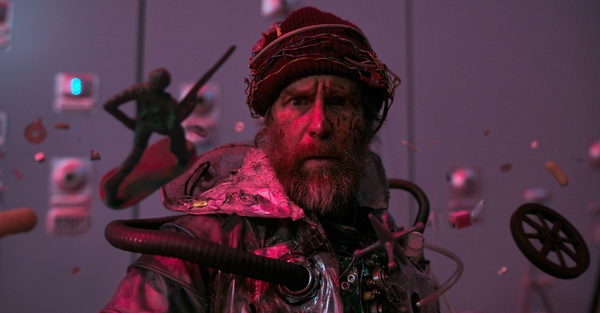
Accustomed to creating well-made entertainment films, about ten years ago Gore Verbinski stumbled into the monstrous flop of A Cure for Wellness (which has since become a minor cult) and disappeared from the scene. Good Luck, Have Fun, Don't Die is proof that he hasn't lost any of his touch: from the way he tells a myriad of stories by framing hands, plates, watches, and microscopic details of the diner where the story begins, it's clear that Good Luck, Have Fun, Don't Die is the expression of an old-school director, for whom good directorial craftsmanship, careful composition of shots, and meticulous editing work to visually tell a story are not an extra but a starting point. While the themes narrated are very current, the film's craftsmanship deliberately looks back to the '80s and '90s, even implementing car models from that era in a film that, despite being divided between cell phone screens and artificial intelligences, aesthetically and directionally recalls the commercial titles of that era.
Verbinski stumbles in a second half not up to the start
Unfortunately, however, Good Luck, Have Fun, Don't Die fails to maintain the excellent level expressed at its beginning in the second part of the film. After acutely portraying the embarrassed and anxious confrontation between generations that don't understand each other technologically and humanly, the film gradually loses its way, becoming a bit repetitive and less focused. Most of the gags are funny (even if one doesn't share Verbinski's marked critical stance, who perhaps would do without the Internet, the entire Network, as a whole) but some fall a bit short, as they say. When the time for resolution comes, the film is then weakened by a plot twist that is a great homage to the science fiction genre but is also a terribly predictable convenient solution. Precisely when it should dare even more to imagine the dystopian future foreshadowed from the start, it shows a lack of inventiveness in imagining the future it seems to fear so much. The ending, however, with that final thrill, that last scratch, is truly perfect.
Score
Editorial team
Good Luck, Have Fun, Don't Die: The Grand Return of Gore Verbinski, Boomer and Proud of It
Good Luck, Have Fun, Don't Die delivers solid entertainment with filmmaking so precise and punctual it's almost startling. It's an original story that relies on premises we know by heart (a day repeating infinitely, a man from the future with a mysterious mission, not to mention the plot twist about who the person he's looking for is) to express a strongly critical, if not anti-technological, stance on our present. Certainly, it should have been much shorter and found a way to be as incisive in its ending as it proves capable of being at the start. In recounting the recent past of the diner patrons recruited by the protagonist, small cinematic stories within the story, the film perhaps writes its best pages, transfiguring into a comedic-horror key all the discomfort of Verbinski's generation when encountering young alphas or Generation Z. Even if one doesn't share his views on the internet and social media, Good Luck, Have Fun, Don't Die remains a solid film in terms of writing and brilliant in its direction, proving that certain talents can make excellent entertainment cinema.
Similar articles