Buen Camino, review: this Christmas, even Checco Zalone has become kinder, unfortunately
After the gamble of Tolo Tolo, Zalone chooses a more cautious path: Buen Camino looks to the past and speaks primarily to the comedian's historical audience.
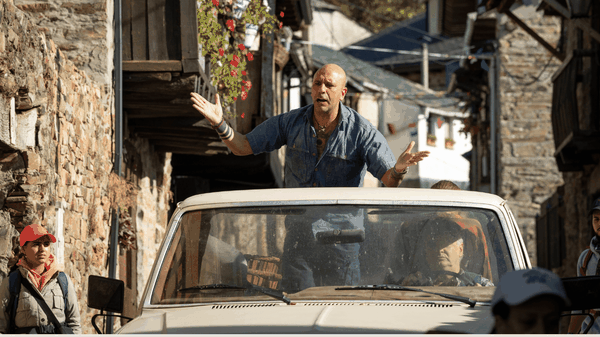


The crown of box office king weighs on everyone's head, even on someone like Luca Medici, who with 6 films in 15 years has brought in some 220 million euros at the box office. Unlike his American colleague James Cameron, whom he will face in a direct clash at the holiday box office, Medici has a filter between himself and this responsibility: that of his comedic persona Checco Zalone, a character-mask he slips in and out of both during the film and during press conferences, to extricate himself from the most critical passages.
The main difficulty in navigating Buen Camino is that, to be generous given the Christmas spirit, it is a return to origins after Zalone's most audacious cinematic endeavor. In 2019, with Tolo Tolo, the comedian from Bari had distanced himself from his long-standing partnership with cinematic companion and neighbor Gennaro Nunziante, directing himself and bringing to the screen a much more political and sharp script than usual, in which the contribution of Paolo Virzì was distinctly felt, from whom the subject and the proposal to write a film together originated. Tolo Tolo was Zalone's coming-of-age test, an attempt to ferry his popular audience towards a product stronger in tone and more refined in construction, hiding less than usual behind the shortcomings of his characters to avoid taking a clear stance.
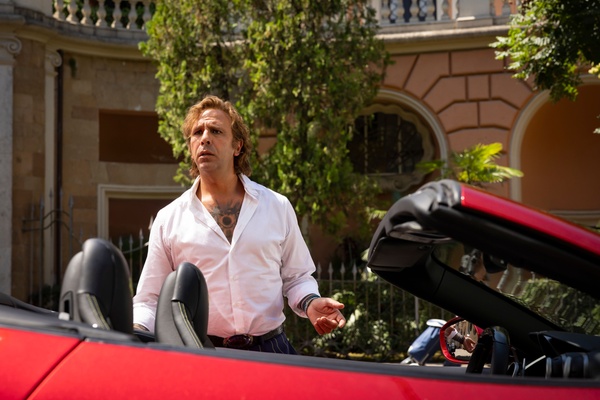
Critically and commercially it was a success, though not as overflowing as previous ones. From the trailer, Buen Camino goes in the opposite direction, presenting itself as a family and family-oriented film that centers on the relationship, entirely to be rebuilt, between an absent and vain father and his daughter who seeks something more authentic and spiritual on the cusp of adulthood. The two films share a very high budget for Italian comedy standards, over 20 million euros, and are largely shot abroad: the first in Morocco, the second in Spain, on the English Way of the Santiago pilgrimage. At the center is always Medici, in the role of Zalone, who in turn is in the role of an alter ego of himself.
Checco becomes a Scrooge Zalone
In Buen Camino, the only substantial first is linked to the character played by the comedian: not a cunning southerner well-versed in the art of getting by, but a very rich son of an industrialist who, idle and without merit, has made ostentatious and arrogant wealth his style and creed. Buen Camino's first misstep is its lack of true malice in portraying this contemptuous and ignorant rich man, or perhaps it's the very premise of Zalone's narrative framework that makes it impossible. Despite his Mexican trophy-girlfriend, the servants treated with condescension, and the money hard-earned by his father squandered on many follies, this Scrooge Zalone is anything but unpleasant. It's clear from the start that he only needs the right spiritual path to be forgiven for his excesses by us even before his daughter.
A sharper script, more like Zalone from five years ago, would not have taken his attachment to his daughter for granted, or would have found a particularly mean reason to convince him to follow her on the journey, making the film both funnier and more consistent in its malice. What Buen Camino lacks in incisiveness, however, is not missing in Luca Medici as an actor and creator, capable of sensing the prevailing mood in time and acting accordingly. The artistic and vindictive ambitions of Tolo Tolo have been wisely set aside to follow the climate of the times, with what is effectively a product tailored to the moment, its uncertainties, and its sentiments.

Dear, old Zalone
The challenge, says Zalone, is to bring young people into theaters and keep them still for 90 minutes in their seats, contending with the very fast, fragmented, and “clippable” comedy of social media where they spend much of their time. Buen Camino, however, is none of this. On the contrary, it is exactly the opposite in terms of the rhythm of joke delivery and their nature, which draw from the usual and worn-out pool of stereotypes about homosexuals, young and older women, rectal exams, snobbish artists, and Asians who can't cook pasta without overcooking it. There's the return of the Michelin-starred chef, this time championed and understood by the connoisseur Zalone, and there's a gentle touch of irony about obesity without ever truly cutting deep.
The only two political jokes, on the themes of the occupation of Gaza and the gas chambers of concentration camps, are neither truly scandalous nor truly sharp. They are crafted for the use and consumption of newspapers and the well-meaning, merely nudging at that increasingly less latent nostalgia for being able to say what one thinks and wants with the right not to face the consequences. They are quite gratuitous precisely because they say nothing more about the character, are not particularly inventive, nor do they manage to say anything strong and incisive about the themes they refer to.
After all, in terms of things to say, Buen Camino resembles more a standard Italian commercial comedy, even a bit like a “cinepanettone” (Italian Christmas comedy), than a Zalone film, starting with the theme. The film is shot in Spain, in the real places of the pilgrims' path, but the view of this reality is very superficial, almost blandly promotional. There is no malice in investigating the “fad” of going on the path, there is no great distance between characters with deep and authentic spirituality and those who are on pilgrimage because they don't know how to find themselves or what to do with themselves. Indeed, the “mystery” concerning the character of the Spanish walking companion played by Beatriz Arjona is only such in the eyes of the protagonist, so predictable it is.
Not only are the comedic masterstrokes that made Zalone who he is today missing, not only is the film practically devoid of that highly enjoyable ferocity in depicting Italian vices that sustained previous works: Buen Camino is simply a sloppy film in its writing, with very weak narrative connections, such as the omnipresent pilgrims who disappear when a character suffers a minor injury to allow for a plot-necessary encounter, and other lazy solutions of this type. There is really little to say beyond the inevitable, predictable, and insipid rediscovery of a father-daughter bond.

Buen Camino is a serenade for Zalone's old audience
Even considering the foreign shoots, it's hard to understand where the 26 million budget for this film went, as it never truly has a moment capable of eliciting appreciation for the direction or the cinematic quality of the footage. Nunziante's approach is unstriking and, in fact, the most it evokes is a bit of the old Medusa Film school, that mix of visual elements immediately traceable to the Mediaset television universe, which aligns well with the past that this Zalone evokes. Buen Camino is a superficial and somewhat intangible film, a viewing that flows quickly thanks to a strategic 90-minute runtime. It's hard to see any attempt to attract a younger audience, to consider their formats and emotional uncertainties, given that the daughter's character is clearly filtered through a paternal lens both within and outside the story.
No, Buen Camino is rather a love serenade for Zalone's old, loyal audience, those who perhaps felt a bit neglected or even betrayed by the ambition of Tolo Tolo. It's a film that gives the general public looking for quick, easy, and painless entertainment exactly what they want, a product packaged as it was 10 or 20 years ago, seeking out that audience that desires precisely that kind of approach and perhaps even feels nostalgic for that time. Buen Camino, in short, is a safe bet from a Zalone who is more firefighter than arsonist, more careful than usual not to displease anyone.
Score
Editorial team
Buen Camino, review: this Christmas, even Checco Zalone has become kinder, unfortunately
Buen Camino is the weakest film made by the Nunziante-Zalone duo. It clearly looks to the past, ignoring the passage of time and the evolution Zalone's filmography has undergone, with few rather trivial ideas brought to their natural conclusion with little verve and much caution. It's not a bad film, but it's certainly uninspired, because it failed to retrieve from the past the verve, the malice, the hunger to laugh and make people laugh of the Zalone who stormed the cinema. The approach is that of someone who has built an empire and is now engaged in maintenance work. And those who had glimpsed in Tolo Tolo the possibility of building something bigger, more ambitious, and bolder, well, they'll have to come to terms with it.
Similar articles

NBA 2K27 PS5 Review: Even Smoother, Even Deeper, Still with the Same Microtransactions

Valor Mortis: The Napoleonic Soulslike Has Personality, But Needs to Become More Legible - Preview

Is This Thing On?, review: doing stand-up comedy to rediscover yourself