Zero Parades: For Dead Spies. Heart is there, but the head is missing – PC Review
The new RPG from the studio behind Disco Elysium. An improved gameplay formula doesn't balance a narrative far from its glorious past.


If you are familiar with Disco Elysium and ZA/UM, you have probably heard about the internal disagreements within the Estonian studio, which led a good part of the development team, including several prominent figures, to move on. Whatever your position on the matter, we will not delve further into the topic, nor will we use it to diminish Zero Parades: For Dead Spies. The title was born under unfavorable circumstances, but it does not deserve sideways glances. Nor do those who stayed on track and contributed to its creation deserve them. Perhaps it even has what it takes to stand up to its predecessor. Is that perhaps the case?
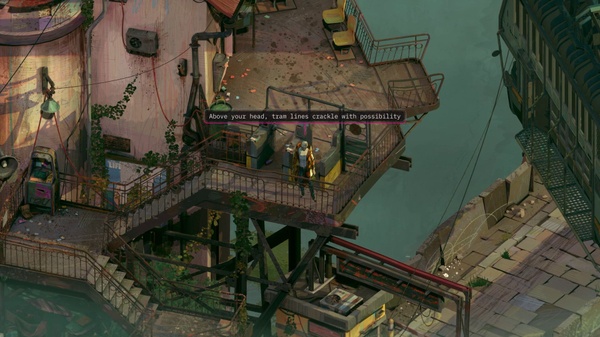
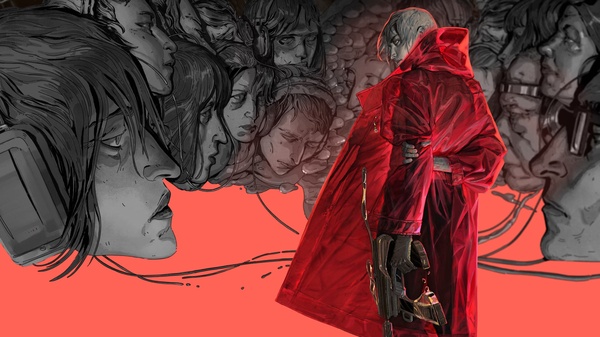
In Zero Parades, we will accompany Cascade, or Hershel to her friends, a communist spy back in action after years of inactivity. She has been assigned a mission in the port town of Portofiro, but things immediately go wrong: her informant has been “zeroed” and lies inert in his hideout. Our goal will be to retrace his last movements to understand what the mission actually is, and then complete it (or mess everything up).
Comparisons with Disco Elysium are plentiful, yet Zero Parades tries to distance itself, proposing a new setting and cast. The emphasis remains on narration, made up of long, colorful, and elaborate dialogues with a string of characters as eccentric as they are pompous. They always seem eager to spill the beans and tell you about their lives, deaths, and miracles, their pasts, ideologies, and bizarre theories, facts and rumors surrounding them. Our ability to relate to them, however, will be influenced by the “voices” in Hershel's head.
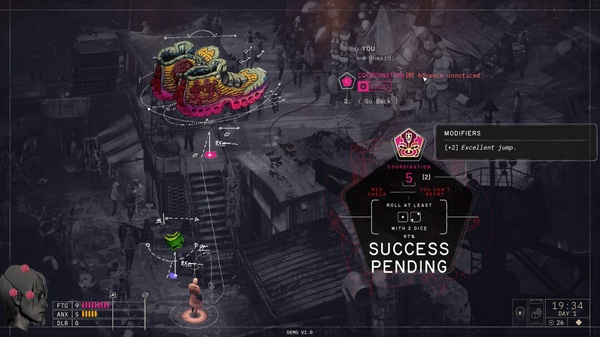
As in the past, each voice embodies a statistic, and their “assertiveness” will increase as you invest skill points to enhance them. The success of their intervention is determined by a dice roll, which will provide us with more details or an advantage in negotiations. Failing will not compromise the event too much (usually), except for the most difficult actions, for which we can “force” ourselves to add an extra die to the result in exchange for the protagonist's physical and mental degradation. Fatigue, anxiety, delirium: if one of these conditions reaches its limit, we will be forced to permanently reduce a parameter in the relevant category. Some dialogue options will also tend to aggravate them, so we will have to keep an eye on them, resting or consuming comical amounts of caffeine, nicotine, and more or less “legal” medicines.
The voices analyze the surrounding environment (sometimes revealing secret hiding places), and occasionally we will take part in turn-based “combat” that adds a touch of dynamism. In any case, we will spend most of our days grilling passersby in search of information. Portofiro is not particularly large, but it is dense, hides a lot of interactions, and each will take you a good amount of time to grasp everything, especially if you are assigned one of the many secondary (or primary, the line is not well defined) missions.
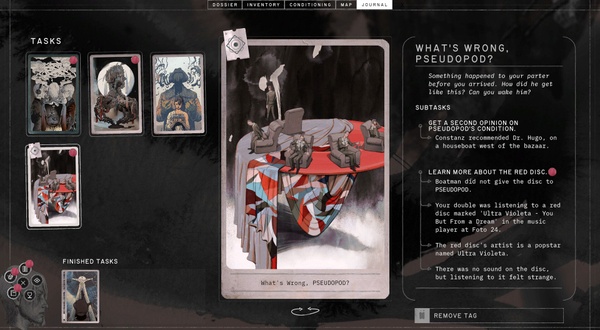
The experience works and the story is entertaining. Often one gets the impression that not much is happening, yet it only takes a moment to get caught up and spend hours hunting for clues. This is because the individual pieces of the plot work, revealing good care in the characterization of the characters and the role they play. It is the overall picture that did not convince me. I appreciate that the game world's background is well explored, but perhaps there is a bit too much on the plate. Every conversation introduces avalanches of concepts, terms, dates, curiosities, and there is no moment to breathe and assimilate them. Reassembling the puzzle along the way is certainly pleasant, but there is so much background noise that it is impossible not to lose pieces and not even notice.
Our mission can be approached from multiple angles. This is why the cast elaborates on several fronts, so as not to leave us stranded in case of failures (and there will be some) or depending on our starting kit. If you are the type to aim for one objective, you probably won't notice, but if, like me, you want to exhaust all options and pursue every lead (also because they provide experience points, and those come in handy), it is quite exhausting to keep up with yet another rambling monologue from another random guy.
Wrong approach? Perhaps, but there's no one rushing us, nor will we ever have clear directions to follow, so we might as well look around. Cascade, unfortunately, is not a very charismatic protagonist. The direction keeps hammering on how lesbian, drug-addicted, and tormented she is by what happened to her old team, but there's very little beyond that, and we won't have much input on it. The voices in her head, in turn, range from didactic to random and inappropriate comments, making many exchanges pompous and lacking substance, merely repeating things already said in a more cryptic and/or “extravagant” way. Okay, the romanticized writing, but some of the fluff could have been removed, also because searching for information in a sea of aphorisms is not easy.
It's a spy story where very little actual spying happens, but I think that's intentional. Instead, there's a lot of talk about culture, the old versus the new, consumerism, and globalization. Politics remains in the background, or at least there's always an attempt to skirt around it, for a still-relevant theme. In short, the only village idiot is Hershel, who after five years undercover seems to know nothing anymore, save for rare flashes of genius. This would justify the sardonic and bored tone adopted by the vast majority of our interlocutors. However, I would have expected a bit more liveliness, at least from the children watching cartoons or the rabid fans of the current idol.
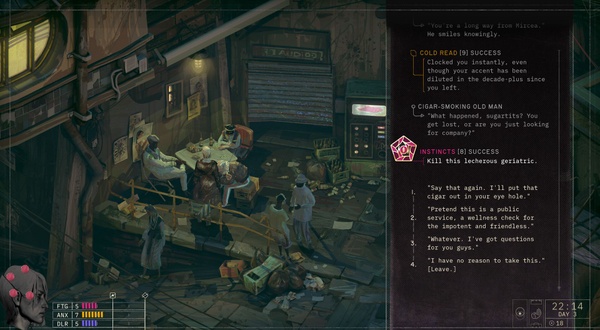
In any case, the performances are excellent, with good dialectics and natural pauses. Expressiveness sometimes lags, but it is fitting for the decadent atmospheres. Special praise goes to the narrator, who manages to give a touch of personality to all fifteen inner voices. Unfortunately, it often happens that dialogue lines do not match the subtitles, or are missing entirely, and the voice actor can even change abruptly. For some reason, the descriptions of gestures during lines are not voiced, creating strange silences. Just a few days ago, a patch was released that solves some of these problems, but the game should not have been released like this.
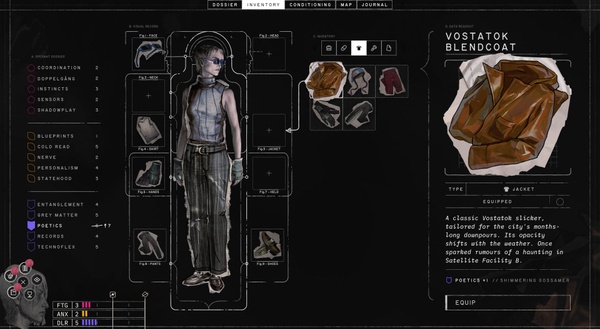
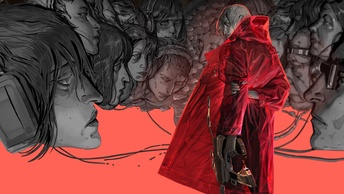
The art direction of Zero Parades echoes that appreciated in Disco Elysium, an impressionistic moving canvas full of colors and nuances that perfectly describe the context. Character portraits are more defined, in line with Cascade's more stable (relatively speaking) mental state. Menus and interfaces, however, are clear and legible, without losing style. Occasionally, on-screen texts cover clickable areas. The abstract illustrations of the conditionings are beautiful.
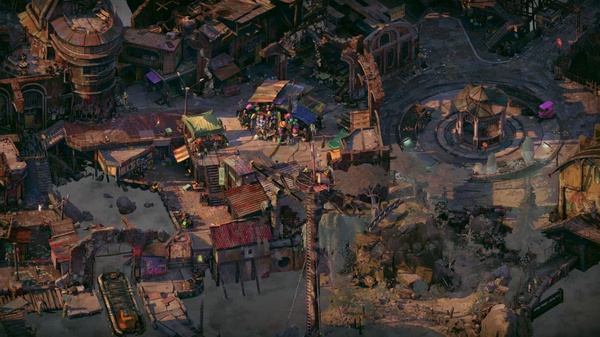
Waiting times are few and short, except for the first one at startup. Performance is good, no bugs to report, except for the dice roll result window that remains stuck after a loading screen. Yes, I abused quick save to re-roll certain events, it was worth it. The soundtrack is weak, with barely perceptible ambient tracks. Most of the time it feels like complete silence. A few tunes to emphasize our escapades would not have hurt.
Score
Editorial team
Zero Parades: For Dead Spies. Heart is there, but the head is missing – PC Review
A strong desire to emerge and be noticed, Zero Parades: For Dead Spies often seems to shout "look, I've still got it." A phrase attributable to both the protagonist and the development team, who managed to craft an intricate and intriguing adventure, with an eclectic and colorful cast. The gameplay is of excellent quality and will captivate you from beginning to end, however, the story is not entirely convincing. The characters are indeed memorable, but too much mannerism for its own sake ends up weighing down the narrative and the player's attention, which must support an impressive amount of superfluous details. If you enjoyed Disco Elysium, you will surely have fun with the debut of the revamped ZA/UM, but don't expect the same splendor.
Similar articles