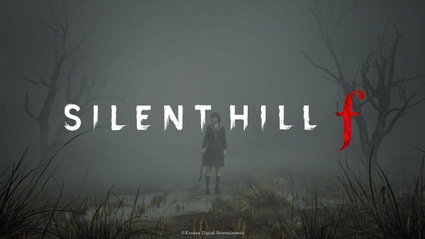
Silent Hill f, a review of a courageous and divisive survival horror
The saga raises its head with a chapter that breaks the mold, making its voice heard.


Silent Hill f is preparing to enter the video game market not without a certain pressure: on one hand, we have the return of a historic saga with a finally unreleased chapter, on the other, the remake of Silent Hill 2 has brought the best chapter of the saga back to the attention of fans and new players, thus setting a more or less voluntary bar for the new game to surpass. Neither is an easy task, but at least the second challenge can be viewed with less importance: it's not a competition of which Silent Hill is better, while the real goal remains to revive a series of which the memories are not the best. Excluding The Short Message, a taste that I personally appreciated in its extreme brevity, we have to go back to 2012 and Silent Hill: Downpour to find the last main chapter – an entry that I cannot say was of great merit. Many expectations therefore weigh on Silent Hill f.
I had the opportunity to play it from beginning to end, and before delving into the actual review, I feel compelled to say that it will most likely be a divisive chapter. It has already garnered some antipathy for the choice to set the game in a different location from Silent Hill, in a sense "betraying" the soul of the saga – inevitable, sooner or later, if you want to change things up a bit but have made that city the identity as well as the name of the brand. If we add to this that Silent Hill f is an experience with a bit too much emphasis on action, but above all with a narrative that expresses itself mainly through allegories, less intimate than previous ones and more tied to social themes, the risk of it being easily dismissed is high. Nevertheless, despite some flaws, it is precisely at the story level, in particular, that it proves to be truly a child of the saga whose name it bears, and the different setting from the usual matters little.
Horror in Beauty
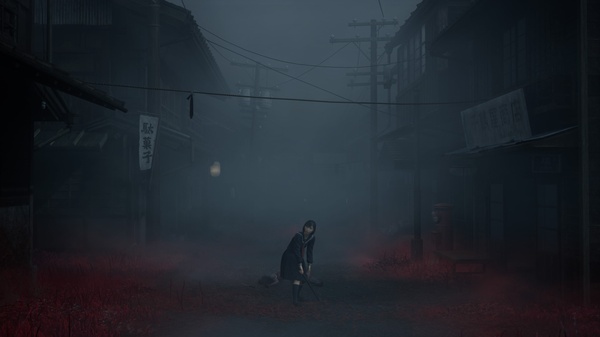
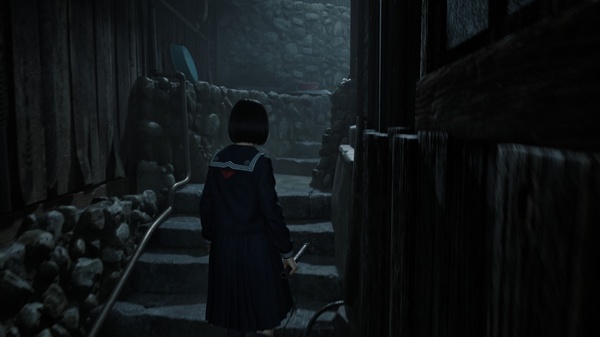
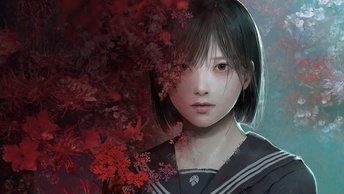
The story of Silent Hill f stars Hinako Shimizu, a girl living in the rural town of Ebisugaoka during the 1960s. A period characterized by tension between tradition, represented by the "ie" system (a patriarchal system that placed the family above the individual) and consolidated gender roles, which nevertheless also marked the beginning of modernization and a progressive, albeit slow, emancipation. Hinako is inserted into this context, crushed by the weight of both family and social expectations: we see her, from the very first moments, showing impatience both towards her father, whose risky investments have led the family into poverty, and towards her mother who does nothing to rebel against the situation, instead scolding Hinako for her reactions. The only form of comfort the protagonist seems to have is in the moments spent with her friends, particularly Shu with whom she shares a special complicity. It is precisely during a meeting with them, however, that the nightmare comes to life and Ebisugaoka becomes an open-air horror from which to seek salvation.
If you know the Silent Hill saga, you know better than me that one cannot go further in terms of narrative, because anything could reveal more than it says. I therefore refrain from adding anything else regarding the events, the characters involved, or anything else, confirming however that the plot, as a whole, perfectly fits into the series' unique way of telling horror from a psychological point of view. As I anticipated at the beginning, however, Silent Hill f in particular is not immediately readable: it is distributed on different levels, all cryptic in their own way. We have the in-game documentation, which contains a substantial part of the narrative, the various allegories, the secrets hidden even in the smallest details and, last but not least, the final revelation. That makes all the pieces fall into place, giving meaning to what has been experienced up to that point and striking the player with all its force.
In the case of Silent Hill f, even this revelation is not bombastic, direct, or strong, if we want to say, as it was, for example, with Silent Hill 2. Until after the credits, we are not really sure what happened, and even when we are given that last, vital piece, we don't immediately grasp all the levels that make up the narrative. If James's tragedy is thrown in our face at a certain point in the game, without escape, Hinako's is more subtle, it is to be unfolded to discover all the horror of a life crushed by the weight of a social structure that affects not only her but above all those around her, cruelly transforming even potential allies into antagonists. I use Silent Hill 2 as a benchmark not only because it has been recently (re)launched, but because I consider it narratively the highest of all; the suitable work not so much to make comparisons about which is better, because the two stories are so different that they cannot be compared, but rather to show two distinct ways of telling the protagonists and the tragedies that characterize them. Where Silent Hill was James's purgatory, a reflection of his psyche with all the relevant connections, Ebisugaoka is Hinako's hell: no longer a mirror of her psyche but a cage within which the society of the time wanted her confined, and which slowly fills with her inner torments, sparing no one in the process.
Perhaps, as happened to me, at the end of Silent Hill f you will feel that you haven't understood much; you won't perceive the same emotional impact as the second chapter and maybe you will find yourself wondering what you have experienced, with a hint of bitterness because things are not clear. This is because we are faced with a story that hits with all its force when you have a clear mind, when we take the final piece and from there proceed backward, reviewing the events, the characters and even certain details under the right, terrible light. It is a delayed punch to the gut, in which we gain a growing awareness of what Hinako had to endure and the solitude in which she fought this battle. I tell you right away, one playthrough is not enough to have an absolutely complete picture of everything and, here lies the charm of the game, during the second playthrough you will not only experience an almost totally different game but you will start to notice many more details, how the developers worked to push you in a direction without you being aware of it.
To give another example, do you remember Clair Obscur: Expedition 33? Played a second time, despite being the same game as always, you notice so many pieces of evidence that escaped during the first playthrough for obvious reasons. Well, Silent Hill f has the same effect but even more pronounced, because the experience truly changes on the second playthrough, it's not just a figure of speech: dialogues, puzzles, visited rooms, everything is different, a second descent into horror and nightmare during which Hinako's diary continues to update compared to the previous playthrough, adding further details. The first playthrough, therefore, despite offering a story that is still understandable, is only part of the experience, which can only be considered complete when you face it a second time.
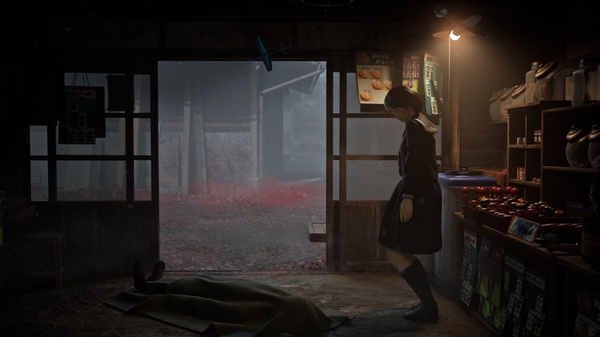
Narratively, Silent Hill f is courageous. It deals with delicate themes, not at all concerned with being disturbing in communicating its message, and it does so through characters that are largely sketched but precisely for this reason strong in their characterization, when we finally understand their narrative implications. The choice to set it in a precise historical-social context, as well as in a different but much more congenial setting for the developers for clear reasons, allows it to draw heavily on folklore and symbolism, playing on different levels of ambiguity. Its courage opens up the possibility that it will divide the public, however, it cannot be denied that it is an excellent return for the saga, the demonstration that one can "cut ties" with the past, with a name that for too long has mainly tied the setting, without forgetting it. Because Silent Hill is indeed present in this new chapter, just not as obviously as one might have expected. It's up to you to discover this connection.
Surviving Ebisugaoka
From a gameplay perspective, Silent Hill f adopts a slightly more action-oriented approach without abandoning its survival horror nature. In fact, some choices accentuate it, however, I cannot deny a bit too much emphasis on the presence of often forced combat; this is undoubtedly the aspect I liked least, but don't expect an action deviation like that of Resident Evil 4 back in the day. We are light years away from this concept, because fighting always remains a reasoned process and very often avoidable (unless, like me, you want to explore in peace); where the game excels is in the quantity of encounters, not in their nature. Especially in the final stages, I found them excessive, a tedious obstacle I would have gladly skipped. While it's true that the game itself suggests that confrontation is not necessarily the only choice, on the other hand, we are often forced to get rid of enemies: the latter are persistent, and although we can give up the chase, we must move away a bit or use the environment to hide from sight and make them desist. If we consider that blindly running away risks attracting the attention of others and chaining multiple fights, many times it is more practical to take that minute or so to clear the area.
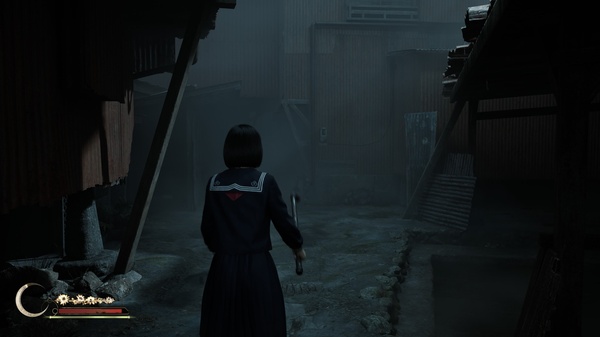
There are different types of enemies. Not too many, but they fall within the typical quantity for the series, and they are all a triumph of body horror; in this regard, Silent Hill f does not disappoint at all and presents grotesque creatures that I will leave you the pleasure of discovering. There are both common enemies and a more armored type, and finally what we could consider the game's bosses, unique and well-designed in terms of design and gameplay. Hinako defends herself from each of them with improvised weapons she finds around: we go from the well-known iron pipe to the sickle, the crowbar, the hammer, the axe, up to a no less effective baseball bat. All objects we can expect to find in a rural place like Ebisugaoka, overall easy and quick to manage with the exception of the hammer and axe, which as heavy weapons are very slow and tend to break quickly.
Yes, in Silent Hill f there is weapon durability, a mechanic introduced to encourage more careful management of encounters but which at the same time clashes with the large, often mandatory, presence of said encounters. Every time we hit a creature, resistance drops, and once the weapon breaks, it is no longer recoverable; however, there are repair kits, rather rare, with which to fully restore it. Overall, I must say I never found myself short of weapons, which we can carry up to a maximum of three, because the game distributes them quite well along with the aforementioned kits. We can land light, fast, and easy-to-chain blows, or heavy, slow, and higher-damage ones, but in my opinion, the best approach is dodging and/or counterattacking. Hinako can dodge enemies, a movement that I admit seems very abrupt, not beautiful to look at but very useful in practice, and doing so with timing activates the so-called bullet time to give us a few moments' advantage over enemies. Alternatively, there are more or less rapid attacks that creatures prepare and for which they expose themselves: if at that exact moment we press the heavy attack, keeping close enough, we land a very powerful counterattack capable of stunning them and leaving them at our mercy.
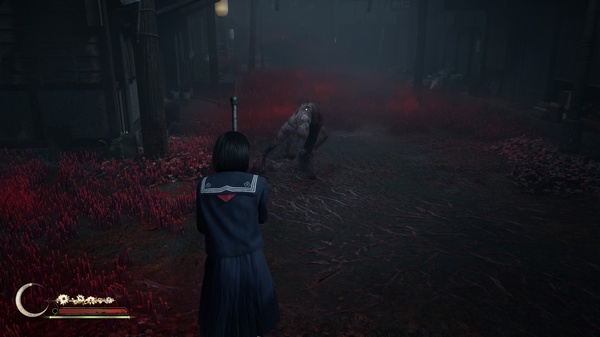
These opportunistic attacks, let's call them that, are "telegraphed" by a very brief aura surrounding enemies when they are preparing the blow that leaves them exposed; however, it doesn't take too long to learn to recognize them by the pose they assume. Although it is, for me, an excellent strategy because it allows you to maximize damage and minimize weapon durability consumption, it is also a double-edged sword both because it requires a lot of concentration and because not all contexts allow it easily. Furthermore, enemies can attack in various ways and may take time before exposing themselves; conversely, aggressively attacking them leads to very rapid reactions from which it is not easy to escape and which risk inflicting considerable damage. For this reason, despite recognizing the action component of the combat system, I still consider it slow and reasoned. The foundations for it are there and I find them well integrated; the only problem, I repeat, is the quantity of encounters that are not as easily avoidable as stated. One must also not forget that Hinako has a delicate stamina bar, which empties after just three dodges, and considering that both evading and attacking consume stamina, it goes without saying that one must carefully balance defense and offense to avoid finding oneself out of breath and exposed to brutal enemy assaults.
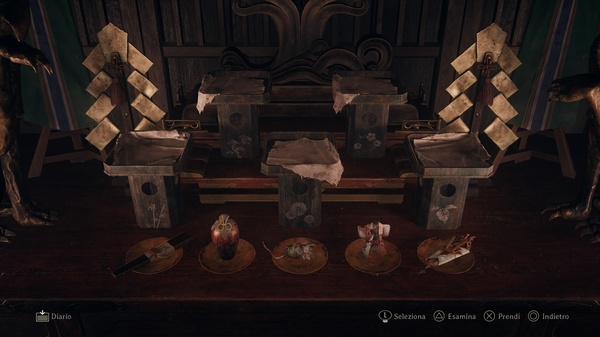
In addition to weapons and healing items of various kinds for both health and sanity, Hinako can also carry a certain number of Omamori which, depending on the type equipped, help her face dangers. These amulets are well hidden around, or can be obtained randomly at the shrine by spending a precise amount of Faith. The latter is a new mechanic that, however, does not deviate from the concept of in-game currency: it is used to, precisely, purchase Omamori or enhance Hinako's abilities along with Ema tablets. These improvements are quite expensive, and the only way to obtain Faith is to make offerings at shrines, offerings that can be either objects designated for this sole purpose or our own resources. Each of these objects has a precise Faith value, and it is not easy to collect enough to upgrade as we would like; these are investments to be made carefully, but it is clear that to maximize all stats, one needs to play multiple times.
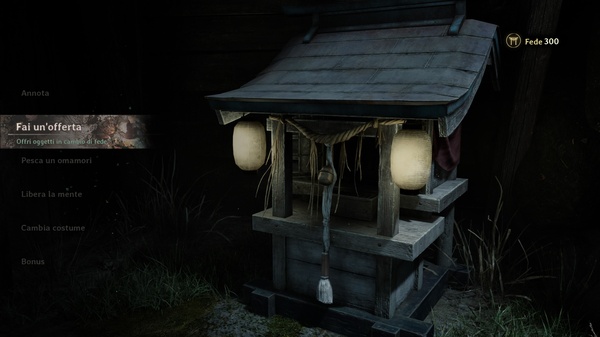
Both healing items and actual offerings are stored in an expandable inventory, provided you find the bags to do so, but it is extremely limited. The initial slots are few, and I found its management a bit cumbersome: each item consumes one slot and can be accumulated a certain number of times before occupying another, while offerings always occupy one regardless of how many similar ones we find. We also have two quick menus, interchangeable in real-time, from which to draw to heal ourselves or repair weapons in and out of combat. Hinako cannot heal herself from the menu, which is used to manage the distribution of items in the quick menus, but we are free to pause and rearrange the latter if we notice any problems. Despite not always intuitive inventory management and very limited space, the positive aspect is that key items are kept in a dedicated section, so we will never have to worry about micro-managing the inventory to fit them in. Documents also have their own dedicated section, and those useful for solving a puzzle can be conveniently recalled while solving it, thus creating a seamless process. Finally, the diary is a very important section narratively and very beautiful to look at, with hand-drawn illustrations of characters, monsters, and even the tutorial mechanics themselves. It updates quite often, so don't forget to check it to keep up with Hinako's reflections.
Having mentioned puzzles leads to discussing another core element of Silent Hill f, as well as the saga in general. Along with combat difficulty, they can be set before starting the game; I chose the "Challenging" difficulty, which is not the maximum, and I found them to be of average complexity. There aren't many, it must be said, but one must consider that the entire game unfolds over two playthroughs, and in the second, the puzzles are also different, so by combining the two experiences, you end up with an adequate overall quantity. There was one in particular that didn't seem very clear to me, but generally, they require the right investment of brainpower and are all well integrated into the setting. The locker puzzle was quite fun, but I won't add anything else to avoid spoiling the surprise.
Everything I've just told you applies to Ebisugaoka but also to the dimension Hinako often finds herself in. It's not exactly the Otherworld as we're used to knowing it in Silent Hill, but it's still another reality, a suspended place and time where Hinako embarks on a different kind of journey and where the rules are slightly different from the outside world. The most obvious, in reality, is that weapons are unbreakable and, precisely for this reason, given by the game itself at specific moments; we don't have the same variety as outside, however, the fact that they don't break is a considerable convenience (which is why combat here is almost entirely unavoidable). Furthermore, these weapons will not be Hinako's only offensive means: the game adds several other mechanics, specific to this reality, on which we will eventually have to rely entirely. Without giving too much away, I could say that the more Hinako becomes familiar with the environment and accepts its "rules," the more she will be able to draw on powers that go beyond simple physical strength. Don't expect magic or anything like that; we are still in the realm of melee combat, just slightly different from what we are involved in on the streets of Ebisugaoka.
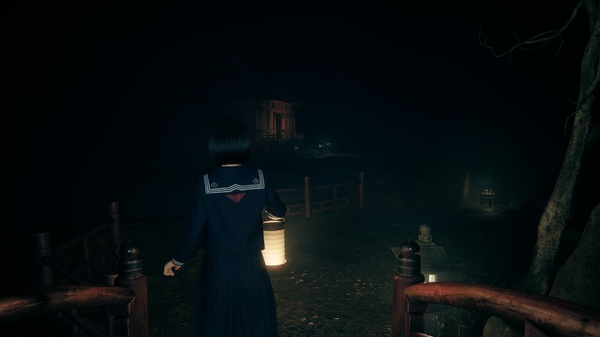
These two settings are extremely distinct from each other. While Hinako's hometown works well in generating, especially at the beginning, a sense of claustrophobia due to its extremely narrow streets, the other dimension is awe-inspiring due to its very nature, although the dangers it conceals are not so different from those of Ebisugaoka. Both places are very well rendered, but the most impactful remains the town, which is slowly corrupted by the ever-growing presence of the red flower that proves particularly lethal and invasive for everyone. The other dimension is cleaner, so to speak, and has an obvious religious connotation – an aspect more thoroughly discussed and explored during the second playthrough.
Technical Aspect and Art Direction
From a technical standpoint, Silent Hill f boasts evident attention to detail, excellent graphics, and equally valid lighting; however, at times I had the sensation that the faces, particularly of secondary characters (Hinako's friends), were stiffer than hers, almost plastic-like. Furthermore, on a couple of occasions, but only during cutscenes, I noticed evident frame rate drops, nothing that a patch couldn't fix. As for the art direction, as already anticipated, the game relies heavily, and well, on body horror: there aren't many enemy types, but they are all grotesque and detailed, especially when some of them show signs of the red spider lily infection. From this point of view, both Ebisugaoka and the creatures present an unsettling beauty, which becomes more pronounced as we progress through the story. On the voice acting side, I didn't listen to the English one, but for immersion purposes, I suggest using Japanese, if only for the fact that some words, if you take the trouble to look up their meaning, convey the meanings much better than the translation you will read.
In terms of gameplay, I didn't encounter any bugs, however, I did not appreciate the lack of invincibility frames during actions outside of our control, such as climbing or descending ledges, or overcoming obstacles. Although it is a very rare occurrence, it can happen that you want to escape from a fight, and if you give Hinako the input to perform one of these actions, it would not prevent her from taking damage if an enemy decided to attack her. Again, this is something that a potential patch could resolve, and in any case, we are talking about very specific situations.
Score
Editorial team
Silent Hill f, a review of a courageous and divisive survival horror
Silent Hill f is a courageous chapter from a narrative perspective: it breaks the mold, choosing a different setting than the usual Silent Hill and opting for a less intimate approach, more tied to social dynamics and framed within a specific historical period. It takes this risk and passes with flying colors, with a story that is understood with a clear mind, putting all the pieces together after the first epilogue and even more so after a second playthrough, to draw a strong overall picture both in message and execution. From a gameplay perspective, I particularly fault it for a bit of an excess in the number of fights and an inventory that is neither easily readable nor manageable, while the execution of the combat itself is interesting because, despite its "action" nature, it remains preferably measured – or at least, this proves to be the best approach. The lack of long-range weapons and their durability aims to place greater emphasis on the decision to, at times, avoid combat, yet very often they are mandatory for convenience or by the game's own decision. Beyond these aspects and very minor technical flaws, Silent Hill f proves to be an excellent restart for the series: a chapter, as mentioned, courageous, divisive, which may not find favor with purists of the series but charts a potential new future.
Similar articles