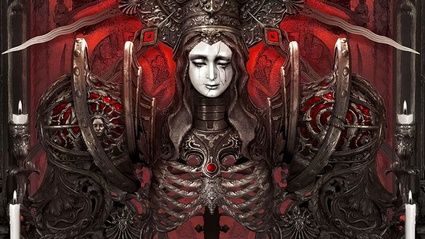
Painkiller (2025) Review: A Technically Solid, But Spiritually Lost Reboot
A well-packaged stylistic exercise, where rhythm, cooperation, and technical solidity hold the scene, but are not enough to evoke the fury and identity that made the original name legendary.
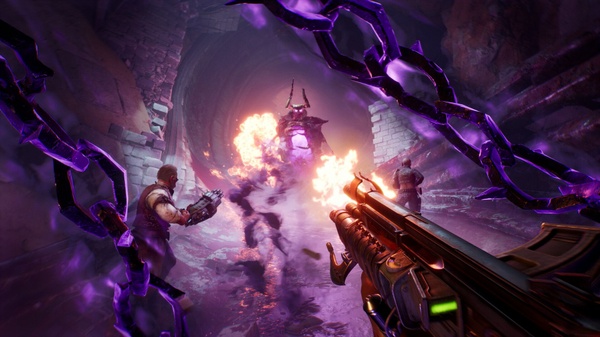


Twenty years after the gothic nightmare by People Can Fly, Painkiller rises from the flames of Purgatory with a reboot by Anshar Studios and 3D Realms. The return of the legendary shooter does not go unnoticed: technically solid, visually refined, and capable of delivering a decent dose of adrenaline, this new chapter manages to entertain, but struggles to evoke the same disturbing, sick, and iconic aura that consecrated the 2004 original as a true cult of the genre.
A polished revival, but soulless. This is how we could define the new Painkiller: a shooter that works, but has lost that infernal charm and visceral madness that made it unique.
- The Plot: A New Hell, With Old Weapons
- Fun Co-op and Lost Identity
- Technical Aspects and Art Direction
- Rogue Angel and the Promise of Variety
- Conclusion
Painkiller's Plot: A New Hell, With Old Weapons
The plot is little more than a pretext: four damned souls are forced to face Azazel's demonic hordes in a desperate attempt to achieve redemption. Who they really are or what led them to Purgatory matters little: Painkiller (2025) doesn't want to tell a story, but to blow up everything that moves.
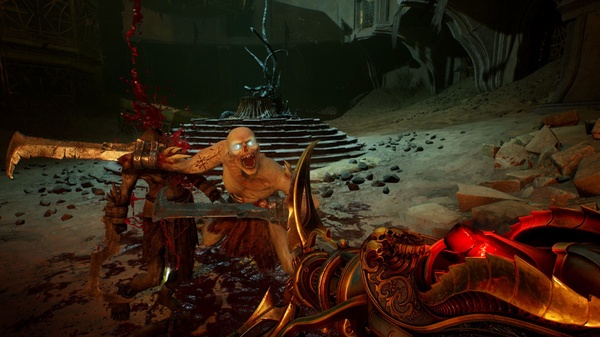
The main missions, divided into three biomes, offer a continuous flow of frantic clashes and vertical arenas where you run, jump, grapple, and tear apart infernal hordes in a vortex of visceral chaos.
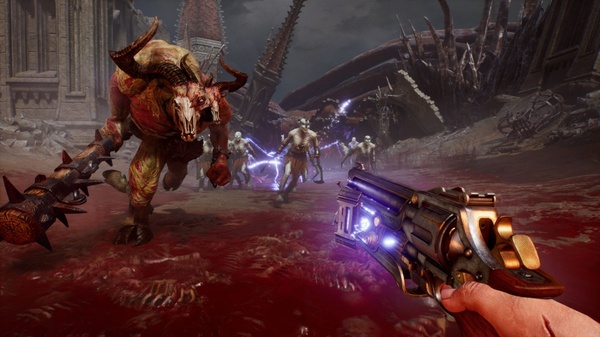
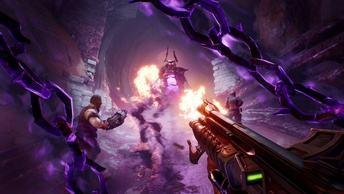
The beating heart of the experience is the cooperative mode: up to three players (or bots, if you prefer solo) face quick raids that closely resemble the pace of DOOM Eternal or Warhammer: Vermintide. The pace is relentless, weapons respond with surgical precision, and the arsenal, enhanced by the return of the legendary Stakegun, Electrodriver, and the Painkiller spinning blade, remains the most charismatic element of the entire project.
Each firearm can be upgraded and customized with elemental effects or through a Tarot card system, which grants offensive and defensive bonuses, adding a minimum of strategic depth to the carnage.
Yet, after the first few hours, the initial enthusiasm begins to fade. The cycle repeats without surprises: waves of demons, mini-bosses, gate opens, new arena. Blood flows freely, but the adrenaline isn't enough to mask a fundamental repetitiveness that ultimately weakens the pace and engagement.
Painkiller: Fun Co-op and Lost Identity
From a purely mechanical standpoint, the new Painkiller works. The movement is fluid, the controls respond with precision, and the cooperative mode delivers moments of authentic coordinated chaos, where the action transforms into an infernal dance of bullets and dismemberment. However, the choice to impose bots in offline mode ultimately breaks immersion and reduces the challenge: too often, artificial allies eliminate enemies before the player can even enjoy doing so. Anshar Studios' goal is clear: to make Painkiller more accessible and shareable. But in doing so, the team has lost what made the original great: its disturbed and sacrilegious identity.
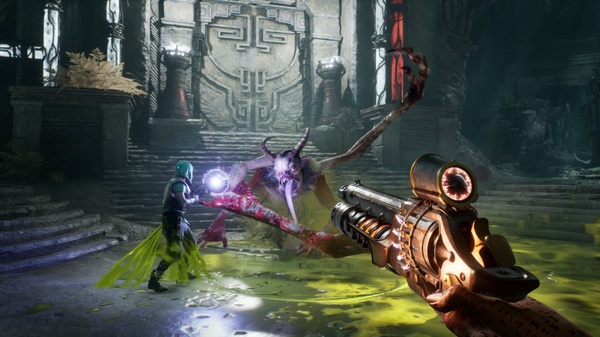
That sense of mystical brutality, the baroque madness of the levels, the almost liturgical contrast between violence and sacredness—everything that defined Painkiller's essence—dissolves into a "DOOM-like" hell, technically impeccable, but devoid of mystery, charm, and wicked poetry.
Painkiller's Technical Aspects and Art Direction
Visually, Painkiller (2025) impresses at first glance. Gothic architectures intertwine with bridges of flesh and metallic cathedrals, creating a coherent and evocative infernal atmosphere where sacred and profane merge into a single visual delirium. However, the technical rendering is not always up to the artistic ambition: uneven textures and irregular lighting occasionally betray the production's "mid-budget" nature.
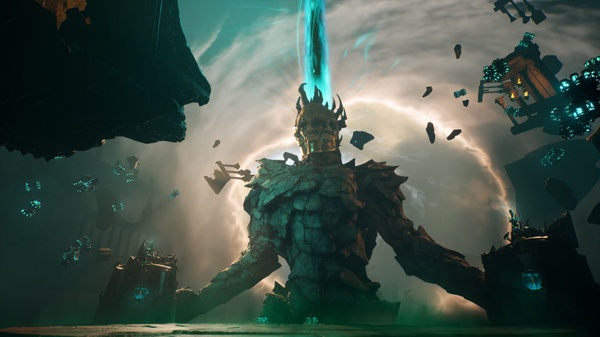
On consoles, the title maintains a stable frame rate at 60 fps, with good particle effects and intelligent use of haptic feedback, which amplifies the impact sensation of every shot fired.
The soundtrack, an industrial-metal hammer that leaves no room to breathe, perfectly accompanies the carnage on screen, although it lacks the epic and compelling component that made the original chapter's tracks unforgettable. The overall audio department is less convincing: dialogues often drowned out by sound effects and fluctuating equalization dampen some of the immersion.
Rogue Angel and the Promise of Variety
Alongside the main missions, Painkiller (2025) introduces the Rogue Angel mode, a roguelike experiment that procedurally generates arenas to offer an ever-new challenge. On paper, it's an interesting addition, designed to extend longevity and break the campaign's repetitiveness.
In practice, however, the promise of variety largely remains unfulfilled. After a few runs, the structure proves to be predictable and lacking real evolution, with a scarcity of enemies and bosses (which are also uninspired) that nullifies the replayability potential. Here too, the feeling is that of a well-packaged hell, but stripped of surprise, where mechanical action prevails over tension and atmosphere.
Review Conclusion: Painkiller is a Reboot That Doesn't Know What It Wants to Be
The new Painkiller attempts to merge the dark soul of the past with the demands of the present, but remains trapped in an identity limbo. It's not wild and disturbing enough to win over nostalgics of 2004, nor sufficiently deep and innovative to stand out in the modern FPS landscape.
For what it is, it works: an honest and enjoyable co-op shooter, with solid gunplay, refined art direction, and a contained duration that avoids becoming exhausting. But the fun quickly fades, leaving behind the feeling of having seen everything too soon.
Anshar Studios shows good technical mastery, but a limited creative vision: the result is a pleasant title, but lacking bite. Painkiller does return from hell, but without that spark of madness and sacrilege that made it immortal. In an infernal landscape of revivals and clones, this reboot revives... but without a soul.
Score
Editorial team
Painkiller (2025) Review: A Technically Solid, But Spiritually Lost Reboot
Painkiller (2025) is a title that makes an immediate impact, but dissolves as soon as the screen turns off. A well-packaged stylistic exercise, where rhythm, cooperation, and technical solidity hold the scene, but are not enough to evoke the fury and identity that made the original name legendary.
Behind the metallic flames and the storm of bullets, something essential is missing: a pulsating heart, a vision, a damned soul capable of leaving its mark.
Metal in your ears isn't enough to bring a demon back to life: it also needs a heart. And unfortunately, that's not here.
Similar articles
Echo Generation 2: Review of a game that tries... but doesn't innovate

Rainbow Legends: Review of a Card Game with Good Premises but Mediocre Representation

The Alters: Last Variable turns time into a sentence, but reduces its variables - Review