MIO: Memories in Orbit, an excellent package for seasoned explorers – PC Review
A review of Douze Dexiémes' metroidvania, a magnificent interpretation of the genre that stands out for its atmosphere and level design.
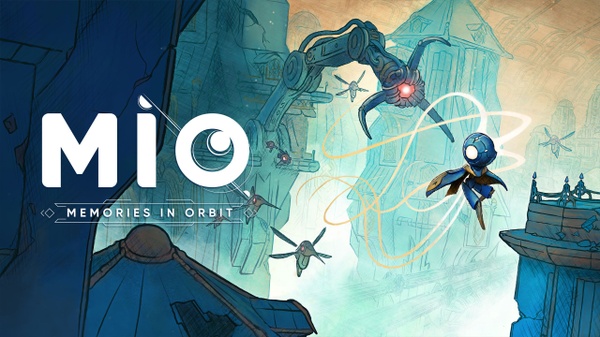


We live in a post-Silksong reality. The metroidvania genre is as saturated as few others in the indie sector, and now that what many consider its “magnum opus” is finally available, it’s not at all easy to make a mark on the market. That’s why I can already see people clicking away when I announce that today’s title is another exponent of the genre, with soulslike dynamics and a cryptic story.
Describing MIO: Memories in Orbit this way is certainly a disservice, but I wouldn’t know how else to present yet another adventure that tries to carve out a niche by leveraging a formula explored and adapted by hundreds of aspiring killer apps. However, the Douze Dexiémes production has an extra gear, and knows how to delight veterans looking for non-linear exploration and epic combat, showcasing commendable attention to detail. But let’s proceed in order.
As the little robot MIO, we awaken in the depths of a space station adrift in the cosmos. The enormous structure, a kind of ark, is in ruins and infested with deranged robots that attack on sight. Without goals or reference points, it won’t be long before we are shot down by the hostile environment, losing all the “mother-of-pearl” (the souls of the moment) accumulated. No, we won’t be able to recover it, because it will be channeled into the central hub, the Nexus, lighting up one of the ship’s “organs,” the Eye, which will provide us with the first directives and access to the map.
The initial stages of the adventure will therefore see us shuttle back and forth, willingly or unwillingly, to reactivate the Eye’s functions, and it’s a shame that, once completed (after a few hours), this mechanic completely fades into the background. We can indeed crystallize the mother-of-pearl to save it in case of death and then spend it at the shop for various upgrades (there’s no leveling up here), but what remains in our pocket is lost forever. It’s not a rare resource and not much is needed to clear the shelves, but it’s a pity that it has such limited use. In any case, the goal is to find the other organs and reconnect them to the network.
Relying only on our intuition, we will wander around looking for clues, making the most of the available kit and noting dead ends and suspicious areas, until we find the next ability that will allow us to expand our search radius. MIO starts with a double jump (a luxury these days), then acquires useful gadgets like a grappling hook, the ability to float, and even to walk on walls, which will allow it to go more or less anywhere. The developers have skillfully built dozens of challenges that use every imaginable aspect of the arsenal and always demand the maximum from the player.
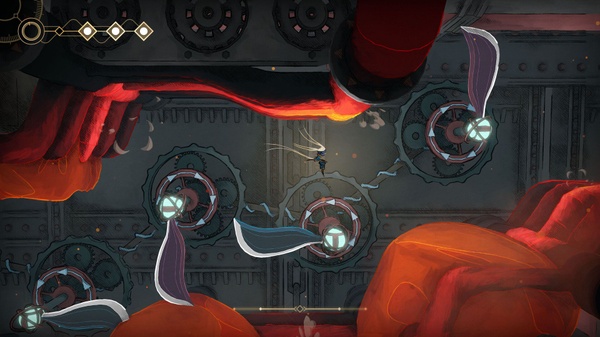
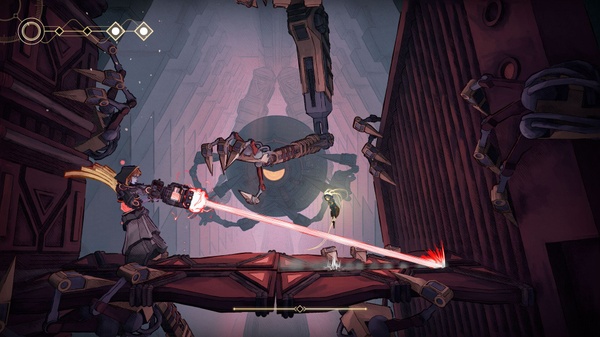
Whether it’s a platforming section or a boss fight, precision and reflexes are constantly under stress, and it can be quite infuriating at the moment, however, I never found the game particularly unfair. Some points need to be repeated ad nauseam before finding the solution, but by carefully analyzing the surrounding environment and the target’s movements, you can (almost) always break the pattern and formulate a winning strategy. The main annoyance is having to retrace the path from the checkpoint to the scene of the crime every time, given that MIO is not that fast and the corridors are very long, especially if there’s an elevator involved. The satisfaction in case of success, however, is immense.
MIO: Memories in Orbit remains, however, a very challenging experience, make no mistake, and can be a source of frustration. There’s no way to “farm,” and often the only solution to proceed is to roll up your sleeves and crash for hours against that tangle of chained mid-air jumps or that pair of bosses with a habit of making the arena disappear mid-battle. It’s possible to rearrange MIO’s equipped chips (not too dissimilar to what was seen in Nier: Automata) to give yourself a boost, but nothing epic.
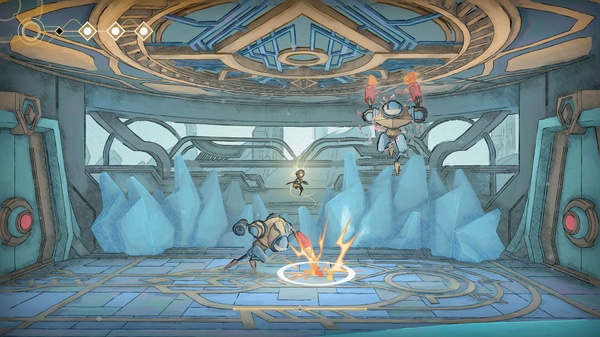
Lingering in search of alternatives isn’t a valid option either. Every now and then, the ship’s “Heart” will have the equivalent of a heart attack, causing a permanent loss of a portion of health for all inhabitants of the ship. Weaker enemies and the few remaining friendly characters die, bosses lose a fraction of their enormous health bar, while the player loses an entire notch of the 4-5 we carry around. It happens rarely and at what I believe are scripted moments, but the impact is felt. However, if you’ve had enough, there’s a hidden menu in the settings that allows you to activate a series of additional aids, such as adversaries who “remember” damage taken after each death and passive recovery when you’re on the ground.
It’s fortunate that MIO is a joy to control. The controls are precise and intuitive like few others. Frequently, you have to input long chains of commands to navigate the levels, with extremely tight windows, by the way, but not once did I find myself blaming latency or shoddy collisions for any failures. The game often tends to exaggerate, but that’s another matter.
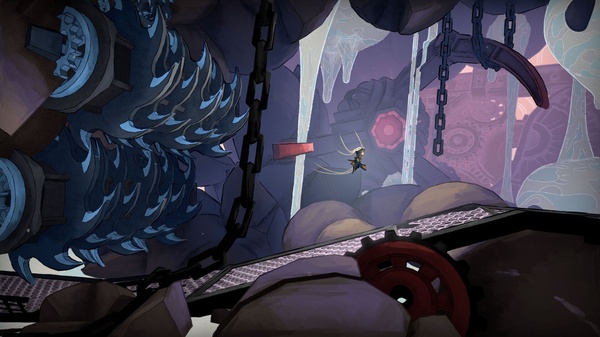
Even without a shred of indication, by scanning the map you can more or less figure out where to proceed, completing the adventure in about 10-15 hours, sweating on several occasions and with a bittersweet epilogue in line with the overall tone of the story. Well, the “tutorial” is over, now we aim for the true ending. Loading the last save, no warnings or new leads are received, yet something is off: the inventory is half empty, there are still closed doors, gaps in the logs and in the survivors’ accounts...
MIO: Memories in Orbit accustoms the player to the presence of hidden nooks and secondary paths to slip into to unlock rewards and shortcuts, but you truly have no idea what lies beyond the frame or literally inside the walls. The space station seems cohesive and well-interconnected, but there is literally a second universe hidden from most, where the most complex challenges and interesting backstories await. Again, zero clues on how to proceed, so the only advice I can give you is: climb every wall and jump into every hole; you usually find something.
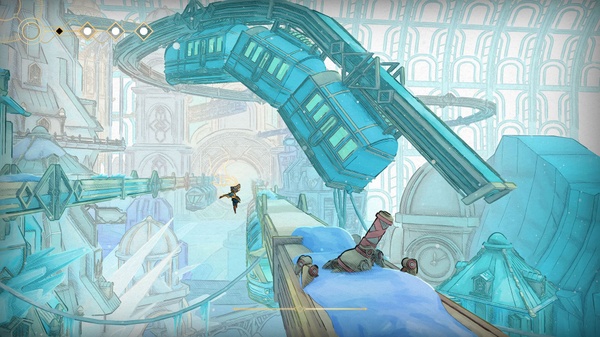
Curiosity and imagination go a long way, but the line between exploration and aimless wandering is thin. The first forays are satisfying and reveal fascinating locations, but after a while, the novelties run out and you start going in blind. It’s nice to uncover the mysteries of this world yourself, but some extra guidance wouldn’t have hurt, and some areas could have been better connected. The longevity for 100% thus extends to around 25-30 hours, but a lot of time is spent disconsolately staring at the map.
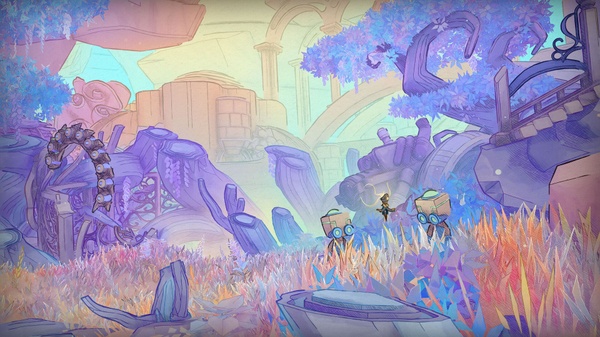
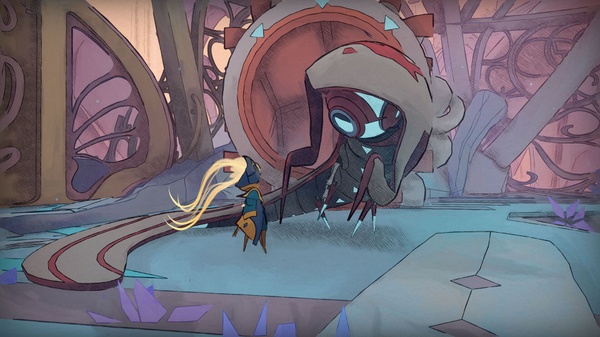
The excellent, though at times too labyrinthine, level structure of Douze Dexiémes’ title is accompanied by evocative and varied environments, including icy caves, abandoned cities, overgrown gardens, gloomy swamps, and industrial complexes. The designs are refined and nod to art nouveau without betraying the sci-fi nature of the work, alternating warm and cold tones for pleasing contrasts and striking vistas. All characterized by a comic-book style that emphasizes shadows and outlines, further enhancing the visual appeal and avoiding any undermining of the action’s readability.
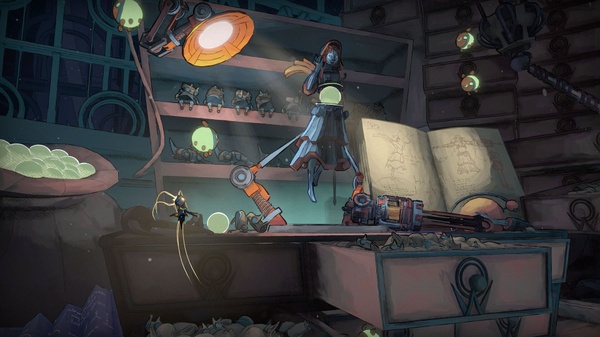
The soundtrack favors lo-fi themes and soft choirs in moments of calm, creating dense atmospheres and that sense of abandonment typical of the genre, but with a touch of nostalgia, in line with the story and our objective. However, the music picks up when bosses appear, with electronic tracks that are as original in composition as they are catchy, and a pounding rhythm that marks each phase of the combat.
On the technical side, the game shows a couple of mood swings. On my 2070 Super, the frame rate usually fluctuates between 120 and 140, but it sometimes drops without warning into the 60-70 range. Nothing that affects the experience in my case, but more modest configurations might stutter more noticeably. The developers had already optimized the demo some time ago, so expect future improvements. No bugs or other anomalies to report.
Score
Editorial team
MIO: Memories in Orbit, an excellent package for seasoned explorers – PC Review
MIO: Memories in Orbit doesn't reinvent the wheel, yet it stands out for its rock-solid foundations, impeccable presentation, and a challenging, multifaceted gameplay formula. The somewhat verbose navigation in the second half of the adventure and some dizzying difficulty spikes don't make it a must-have for all metroidvania fans, but the most tenacious cultists will find a gratifying challenge and a memorable journey in this little French gem.
Similar articles