Lord of Hatred Shows No Mercy: The End of the Saga and the Warlock's Debut
Lord of Hatred concludes three years of saga with Diablo IV's most solid campaign, introduces the roster's most ambitious new class, and redesigns an endgame that finally stops spinning its wheels.


There are games that demand to be loved before they deserve it. Diablo IV was one of them from its launch in 2023: an action RPG built on excellent foundations but covered in layers of live service that didn't yet know what they wanted to be, with seasons that opened promises instead of keeping them, and an endgame that rewarded patience much more than enthusiasm. Yet something in the core loop, in the physicality of combat, and in the silent density of the world-building, continued to hold a certain category of players.
Lord of Hatred is the expansion where Blizzard decides to take responsibility for that unformulated promise and honor it. Not through a technical twist or a system overhaul, but with something rarer: coherence. Every element of the expansion seems to stem from the same design philosophy. The campaign is built around a countdown that never lets up. The endgame stops being an antechamber and becomes a project. The Warlock (the new class, the most ambitious since release) is not just an additional slot in the roster but a reimagining of what it means to build a character in this game.
Three years after its release, Diablo IV stops being a work in progress and becomes something resembling a complete work.
The Prophet and the Eclipse: Where We Left Off, Who Mephisto Really Is
To understand Lord of Hatred, we must return to the ending of Vessel of Hatred, which concluded with an image suspended for months: Mephisto possessing the body of Akarat, the founder of the Zakarum faith, the man who in Sanctuary's cosmology occupies the place that in Christian tradition belongs to figures like Moses. A real prophet, genuinely revered, capable of still holding an emotional grip on the population of Sanctuary centuries later. That choice of incarnation is not accidental: Mephisto is not Diablo; he does not act through direct terror or visual brutality. He is the Lord of Hatred in the subtlest sense of the term, and his preferred instrument is division: sowing distrust among allies, turning doubt into resentment, using human despair as fuel for his plans. Taking the body of a messiah to perform miracles before crowds is, in this character's logic, the most elegant move possible. Armies are not needed when faith alone suffices.
When Lord of Hatred begins, Mephisto (as Akarat) has already convinced much of Sanctuary that salvation has arrived. He has led his followers to Skovos, the sacred islands that in the series' lore represent the oldest and most protected place in the known world, and there he is carrying out his corruption with the slowness of one who knows he has already won. Our alter ego, Lorath, and Neyrelle find themselves in a paradoxical position that the series had never constructed with such clarity: they know exactly what is happening, but no one wants to listen to them. The short circuit is deliberate, and it produces a tension that structurally (though not in tone) recalls Planescape: Torment, where the conflict between what one knows and what one can prove was the true narrative center. In Diablo IV, that tension is not resolved intellectually but discharged in combat, and this choice, which might seem like an escape, is actually consistent with Mephisto's philosophical thesis: humans resolve everything with force, because it is the only thing they know how to do. The player's violence unintentionally becomes proof of the villain's point.
The campaign uses an impending eclipse as a pacing device: each section is delimited by an implicit deadline, every deviation weighs on the sense of urgency. The result is that for the first time in Diablo IV, the story does not get lost, and the six to eight hours needed to complete it flow smoothly in a sequence from island to island that maintains rhythm without sacrificing lore density. Lorath is the most successful character in the cast, and Kirby's novel is its natural complement (if you like reading, it's currently only available in English and is titled The Lost Horadrim): those who come to the expansion having read it already carry the weight of the story between him and Adreona, understand the nuance of that reunion, and perceive in the old Horadrim something more than a supporting character. Those who haven't read it still receive the substance of that relationship through dialogue, but with the feeling of having entered in the middle of a conversation that had already begun elsewhere.
Lilith returns from the Void not as an antagonist but as a necessary ally: her presence in our alter ego's blood becomes the mechanism through which a definitive answer to Mephisto can be conceived, not just another temporary defeat. Her reintroduction is narratively consistent with the series' philosophy, which has always treated the boundary between good and evil as a matter of perspective rather than nature, but it comes at the cost of diminishing Mephisto as an autonomous antagonist: confronting him requires the cooperation of the other Great Evil, and this dependence lessens the sense of solitary endeavor that the climax could have conveyed.
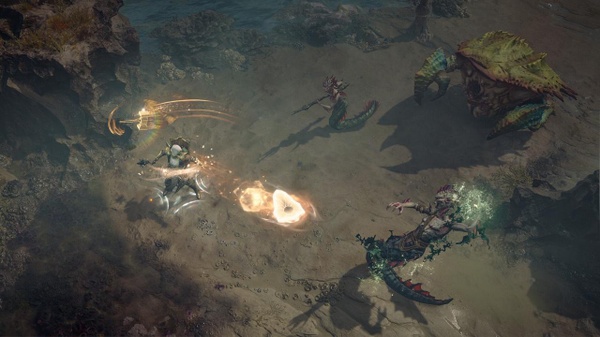
Skovos, in terms of lore, is the densest contribution that Lord of Hatred brings to world-building. The islands were mentioned as far back as Diablo II; they were the homeland of the Amazons and Oracles, and in the series' cosmology, they represented the origin point of humanity as well as the land where Lilith and Inarius lived before their fall. Blizzard built the expansion by retrieving the names of the islands (Philios, Lycander, Athulua, Atonos, Celestia) directly from the original Diablo II manual, honoring promises the franchise had left open for almost twenty-five years. The thirty Sanctuaries of Creation scattered throughout the archipelago tell the genesis of the world through lore fragments more direct than any cinematic, and those who have already read The Lost Horadrim recognize deliberate references to the expedition recounted in the novel in the names and structures—named islands, visited temples, encountered Oracles.
It's a level of transmedia coherence rare for a franchise of this size, and it works precisely because the novel was written simultaneously with the expansion, not as a derivative product written afterward. On the Amazon front, however, the judgment remains ambivalent: their lore is rich and well-constructed, but Adreona in-game comes across more as a spokesperson than a character, whereas Kirby's book had given her a much clearer presence. It's a dissonance that those who have read both perceive with particular clarity.
The Heaviest Class in the Roster: Anatomy of the Warlock
Blizzard described the Warlock as the game's "heavy metal" class, and the definition is more accurate than it seems. It doesn't just refer to the aesthetic, to the fact that the character summons demons, hurls shadow claws, and can transform into an infernal being: it refers to the physical weight of the gameplay loop, to that quality of impact that distinguishes the Warlock from anything else in the Diablo IV roster. Where the Necromancer orchestrates their armies with distance and precision, where the Barbarian is pure kinetic force, the Warlock builds a symbiotic relationship with the creatures they summon, and that symbiosis is the heart of all their mechanics.
The Warlock is a class with no direct precedents in the series. In previous games, Blizzard had explored the demonist territory in a fragmented way: the Warlock of Diablo II is conceived as the primordial version of the class, a novice demonologist. The Warlock of Diablo IV is the adult, mature version, who has completed their journey and already knows the price of every pact. This conceptual difference translates into a skill tree built on stratification: each choice adds a layer of complexity to the character, and the Warlock obtained at the end of the campaign has a depth that few other action RPGs would be able to sustain.
Where previous classes manage only one primary resource, the Warlock manages two in parallel: Wrath and Dominance. Wrath fuels demonology abilities, those that summon infernal creatures or empower them, while Dominance fuels abyss abilities, the shadow repertoire that includes claws, curses, and transformation into Shadowform. The two resources are not interchangeable and do not scale in the same way: Wrath regenerates quickly through basic abilities and decays slowly out of combat, while Dominance is slower to build but reacts more predictably to increments. The practical result is that the Warlock constantly demands reasoning about the management of two overlapping economies, and this creates a gameplay rhythm that distinctly sets it apart from any other class in the roster.
The Warlock's most original mechanism is the Soul Shards system, unlocked through the series of class quests that open after the first acts of the campaign. Soul Shards are fragments of demonic souls that the Warlock can equip to gain permanent passive effects and, most importantly, to invoke specific entities tied to the chosen Shard type. The most relevant is the Mastermind Shard, which summons Laalish, a shadow worm that follows the character and autonomously attacks nearby enemies. Laalish is not simply a familiar: its Shard grants a 30% increase to abyss ability damage when the character is in Shadowform, plus a movement speed bonus for each stack accumulated. Activating the Command Laalish ability generates an area of effect around the creature where the Warlock can stand to easily gain Shadowform, which transforms Laalish from a simple minion into a central node of the gameplay loop for shadow builds. The Subjugation Fragment, an optional upgrade to the Mastermind Shard, further empowers the Profane Sentinel by 1.75% for each point of Dominance at the time of invocation, with a potential maximum of over 50% additional damage if the cast occurs at full resources.
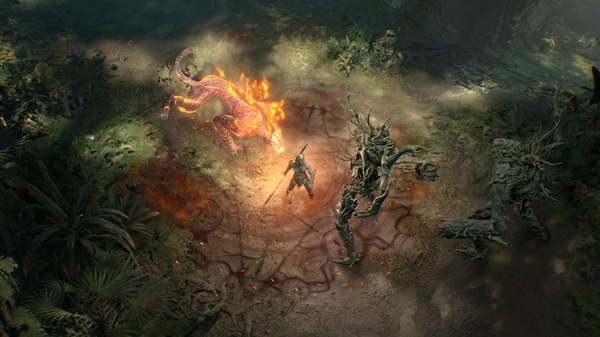
The heart of shadow builds is Dread Claws, an ability that projects a series of smoky claws capable of hitting the same target multiple times during a single execution. The basic mechanic is already powerful, but the true strength of Dread Claws lies in its upgrade tree: available nodes allow choosing whether to project the claws in a cone in front of the character (greater coverage, less maneuverability) or to make them orbit around it as a continuous damage area (less coverage, but possibility of using them while moving). This binary choice is not just aesthetic: it determines optimal combat positioning, synergy with movement abilities, and the type of enemies against which the build performs best. Orbiting claws, for example, work magnificently against tightly packed groups of enemies but lose effectiveness against bosses that remain at a distance, while cone claws reverse the profile.
Shadowform is the state that fuels almost the entire abyss branch. It is not invisibility in the traditional sense: it is an active condition that the Warlock maintains through specific skills, which boosts shadow ability damage and interacts with a chain of modifiers in the tree (the Night Terror node, for example, increases damage by 25% for each active Shadowform stack). Building and maintaining Shadowform during combat is the most important technical skill for those who want to master this branch, and the fact that it is achievable through multiple channels (Laalish, Nether Step, Metamorphosis) leaves enough freedom in character building without removing the demand for attention.
Metamorphosis is the Ultimate that closes the loop of the shadow branch: it transforms the Warlock into Demonform, a state that automatically generates Shadowform every second, increases maximum life by 20%, and has a significantly shorter cooldown than any other Ultimate of the class. In Demonform, Dread Claws automatically becomes empowered, meaning that the ability which in the early stages of the campaign required careful management of the shadow state simply becomes devastating with a single button press. When full control of this cycle is achieved, the Warlock can traverse the most densely populated Nightmare Dungeons without ever truly being in danger.
The picture is completed by some abilities that do not define the class's identity but reveal the logic with which Blizzard built the Warlock as a response to every combat situation. Wall of Agony fuses living demons into an impenetrable wall, a field control tool with purely defensive or tactical funneling use. Fiend of Abaddon is an alternative Ultimate to Metamorphosis: it summons a gigantic demon that emerges from the ground and mows down everything around it, with a visual impact unmatched in the roster, but with a narrower use profile (bosses and high-density close-range encounters). Nether Step is the class's primary movement: a rapid burrowing that passes the Warlock through the ground, useful both as evasion and as a setup for builds that require precise repositioning before a Dread Claws cast. Finally, Terror Swarm is an ability that generates a swarm of shadows capable of attracting enemies to the center and growing in size by feeding on victims, making it exceptional for generating dense concentrations to exploit with claws or invocations.
Skovos as a Play Space, War Plans, and the New Language of the Endgame
The Skovos Islands are Blizzard's answer to the most recurring criticism leveled at Vessel of Hatred: that Nahantu, while visually successful, was an environment that didn't produce enough contrast with the already known world. Skovos is built on opposition. It's a Mediterranean archipelago with clear waters, colossal temples, dense forests, and active volcanoes: a place that in Diablo tradition should have been an anomaly, a corner of Sanctuary that had not yet seen corruption. The effect works precisely because the expansion works on its progressive violation. The Wanderer doesn't arrive in an already corrupted place: they arrive as corruption advances, and each district traversed provides a measure of the speed with which Mephisto is operating. Burned libraries, forests invaded by animated thorns that assimilate the fallen bodies of Askari warriors, ports where the Drowned emerge from the sea in continuous waves. Corruption here has a procedural quality that Diablo IV had never rendered with such environmental effectiveness.
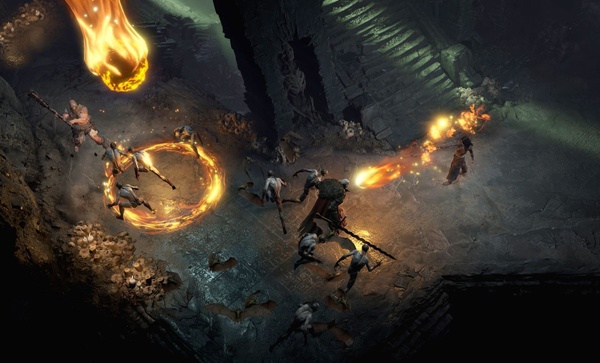
On the Amazon front, the judgment is more ambivalent. The team worked on their lore with evident care: the names of the islands come from the original Diablo II manual, the structure of the Oracles and their connections to the story of Inarius and Lilith enrich the series' cosmology. In-game, however, the Askari warriors remain in the background. Adreona, the queen, is functional to the plot but does not emerge as an autonomous character. The Amazons of Diablo II had their own "voice" while those of Lord of Hatred tend to follow events rather than orient them, a dissonance from the expectations that those familiar with the series brought to the expansion.
The endgame is where Lord of Hatred changes most profoundly. War Plans structure post-campaign progression through the construction of a sequence of activities (up to five, chosen from Nightmare Dungeon, Pit, Helltide, Infernal Hordes, Kurast Undercity, Lair Boss, and Tree of Whispers), with automatic transport to corresponding zones and supplementary rewards for each completion. The most interesting mechanic, however, is that of the activity trees: each format has its own progression path that unlocks with the number of runs performed, opening modifiers capable of changing the behavior of the activity itself, such as empowering the Fell Council in Infernal Hordes in exchange for superior drops upon completion, or transporting elements of one activity into another. It's a system that approaches the logic of Path of Exile's Atlas without reaching its depth, but which marks a long-awaited direction.
The Horadric Cube is the most radical change to the loot circuit. Any item, including common and magic items that previously disappeared from the map as soon as the character exceeded a certain power threshold, can now carry a "greater affix," a property normally reserved for legendaries. That item can be worked in the Cube: affixes are added, removed, and reformulated, or three copies of the same unique item are combined to create one with different stats. The final step (transfiguration) applies a permanent bonus effect but makes the item no longer modifiable. The result is that every piece of equipment has potential value: one stops waiting for the perfect item and starts building it. Even a common glove found on the ground can become the piece that completes the build. Psychologically, this inversion is the most significant contribution the expansion brings to the quality of the daily experience.
Echoing Hatred completes the picture with a key-gated activity, rare by deliberate design, in which continuous waves of demons are faced until the character's death: the rarity is structural, intended to be an event and not a farm. Rewards scale with waves survived up to materials for Mythic Uniques. Talismans (up to six equipable slots with bonuses from small percentages to set effects) add an additional layer of customization without radically impacting those not already in the deep endgame.
Lord of Hatred Shows No Mercy: The End of the Saga and the Warlock's Debut
Lord of Hatred is not just the conclusion of a saga: it's the first time Diablo IV functions as a complete system. The campaign is no longer a tutorial for the endgame, the endgame is no longer a void after the campaign, and loot is no longer passive grinding but active construction. The Warlock is the class that best synthesizes this change: it's ambitious, deep, requires time to understand, and generously returns that depth once internalized. It's not yet perfectly balanced, and the reliance on invocations in the most extreme demonological builds remains an unresolved tension. But it's the most interesting class Blizzard has added to the game, and perhaps the most interesting they've ever designed for Sanctuary.
Similar articles