Grime II, Abstract Art, Concrete Challenge – PS5 Review
Clover Bite's metroidvania refines and expands upon the original work, without compromising its brutal difficulty.
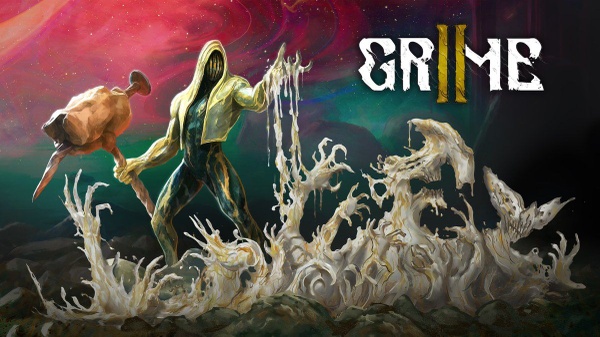


The first Grime was released during the boom of "metroidvania soulslikes". Dark, methodical, and uniquely difficult, Clover Bite's title stood out for its peculiar presentation, made of surreal landscapes and irregular shapes. The experience itself might not have offered particularly original ideas, but it was solid and very challenging, securing it a decent following among genre fans.
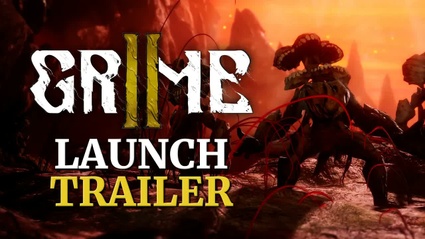
Available in a few days on PC and consoles, Grime II reinterprets and evolves the cornerstones of its predecessor, refining less successful aspects and introducing new ones, for a larger, more complete, and certainly no less arduous package. We tried it on PS5, here's what we think.
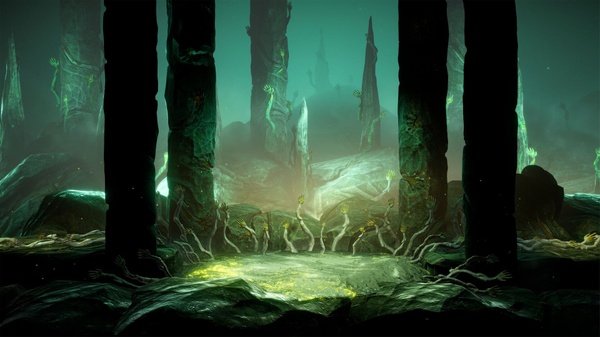
If Grime's designs alluded to abstract art, Grime II has made it its raison d'être, building its story and mechanics around it. The world in which the game is set is in fact the "canvas" of four artists, the "Fragile," who with their powers have sculpted the territory and infused life into its inhabitants. There was a war that disrupted its balance, and we are the last arrivals. Alone and aimless, we can only summarily reconstruct the events of an already cryptic story, but our mysterious creator will simplify everything with a rather eloquent objective: go and consume.
As a "Formless," we can absorb the essence of the creatures we defeat (literally the paint that composes them), not too dissimilarly from post-Aria of Sorrow Castlevania games. This is true both for common monsters, which we can deploy alongside us during battles, and for the many bosses guarding strategic points or rare materials, who will instead provide the abilities with which we will expand our offensive and logistical repertoire.
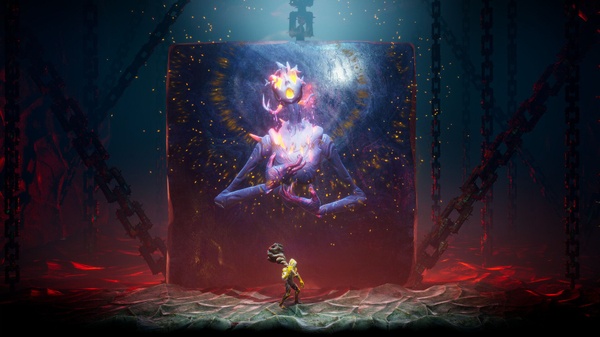
The first part of the adventure is probably the one I appreciated the most. Few deviations, an overall fair challenge, and a lot of interactions with a very interesting cast, despite the minimalist approach. Here the game presents gameplay fundamentals and nuances with character, ingenuity, and an eclecticism that is both visual and practical, encouraging players to persevere and explore every nook and cranny of the traversable zones.
We complete the "trial period" and Grime II opens up, slapping three indicators in remote corners and leaving the player to figure out how and where to move to reach them. A decidedly metroidvania solution, but it's also where I got a bit lost. No, not geographically. The map is gigantic and deeply interconnected, full of forks, shortcuts, and assorted secrets, but it's a pleasure to navigate, thanks also to the ability to teleport around (provided you've unlocked a certain altar in the relevant region). I'm referring to everything else.
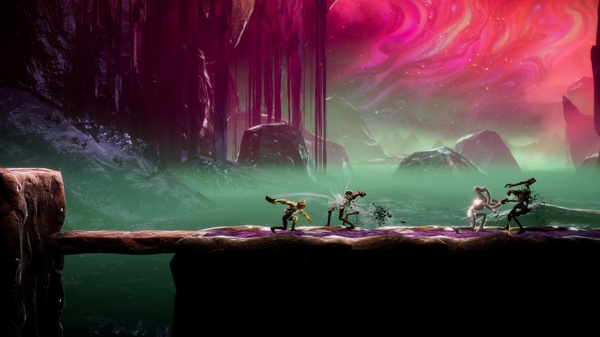
Perhaps it's the clear change of location, the difficulty that takes off, the checkpoints and rewards becoming scarcer, but the game loses its grip in its second, more substantial half. The tone is the same, however, color and variety are lacking, as we will mostly venture underground. The larger rooms and boss arenas boast impressive backdrops, but usually, we will find ourselves traversing narrow, dark corridors, accompanied by atmospheric but too faint tracks to be memorable. The enemies, on the other hand, become increasingly tough, with cryptic patterns and a plethora of health points, and are often hidden at the edges of the screen in mandatory sections, ready to swarm us. They can be bypassed but are so stubborn that escaping unscathed is not a walk in the park, and they consistently deal a lot of damage, which is difficult to recover, by the way. In case of death, nothing is lost, but retracing your steps over and over again can become annoying, especially if you haven't yet obtained the map of the area.
Grime II offers no respite, and that's the least of it. Scattered here and there are long platforming marathons that combine all the abilities acquired so far. One centimeter out of place during the maneuver and you end up in thorns or toxic sludge, and you have to start over. The designers have exhausted their creativity (and malice) to set up trials capable of pushing a generally simple move set, made of wall jumps and mid-air dashes, to its limits. They are challenging, but quite fun, a good test of coordination and reflexes, and an excellent demonstration of the responsiveness of the controls. Some, however, are slightly unfair.
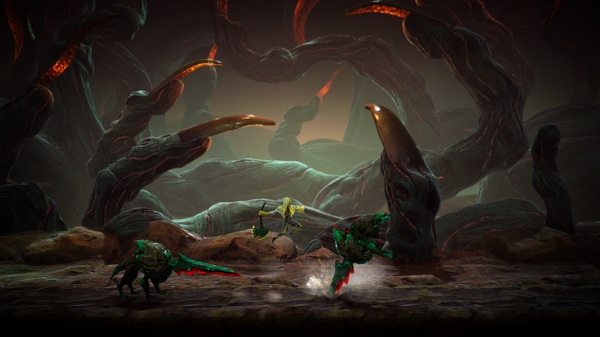
And then there are the bosses. Probably the highlight of the experience, beasts that challenge the game's abstruse aesthetics and the player's patience. Tons of health, multiple phases, and the habit of unleashing the most annoying attack at the least opportune moment. You die a lot, but each time you learn something new. And as before, the execution is mostly excellent, however, in a couple of cases, I wanted to punch the wall. It's okay to die because you didn't move carefully, less so when the opponent changes the rules of the game treacherously and without warning.
The combat system, at least, works to respond to the fire. There isn't the same emphasis on parries as in the past, although there are several depending on the context. If desired, you can also specialize in dodges, which are still fundamental, given that some things cannot be blocked. Weapons have a basic combo and a special attack with one or more charge indicators. There is no stamina, but if we keep the Force bar above a certain level, by timing our actions, we can inflict serious damage. Cures are limited to a handful of charges, with sparse opportunities to recharge them, but we can customize their speed, effectiveness, and secondary effects by finding specific artifacts. Summons and equipped "spells" are instead reserved for the amount of residual paint, which is obtained by beating up the local fauna.
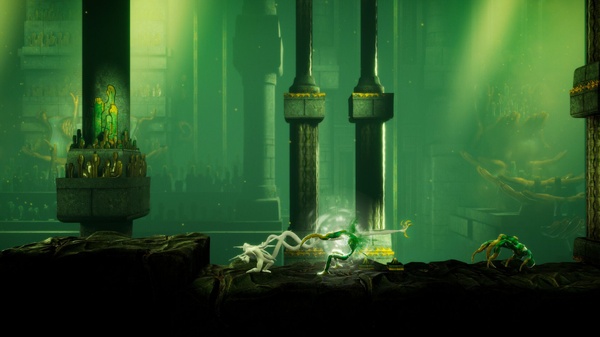
A lot of stuff, with a multitude of applications, but in my opinion, the game increases enemy parameters a bit too quickly just to keep us on our toes, breaking some balances. Despite the extensive arsenal, it's impossible to keep it updated, except for a small portion. There aren't enough resources, and grinding for credits is extremely slow. In addition to weapon stats, your own stats must also be considered, due to scaling. Every point is important, and without optimal offensive values, the output decreases significantly. For some reason, we can reallocate the skill points obtained by defeating numerous "minibosses" whenever we want, but not those for stats, which are tied to uncommon crystals.
Basically, then, we are cut off from using a lot of weapons, especially those obtained in later stages, and this is frustrating. The same applies (but less pronounced) to armor, which provides interesting set bonuses and further parametric boosts. Of course, if you dodge everything, the damage dealt doesn't matter; eventually, you win. Good luck. For an adventure that narratively relies on freedom of expression and the creation of one's own identity, it is rather rigid in how it wants to be approached...
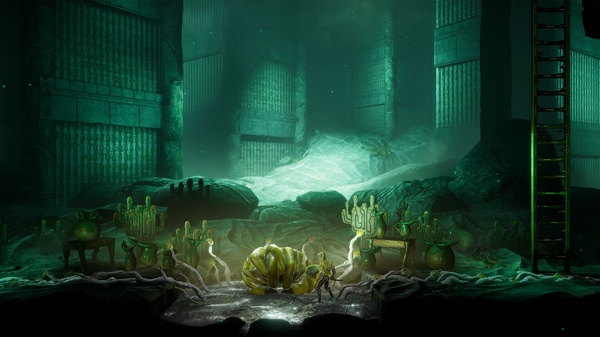
Regarding the presentation, I have already expressed myself previously: magnificent views, with mesmerizing glimpses and truly original designs, but also a lot of shadows (literally) diluting the graphics. Dark and decadent is fine, but it tends to get boring in the long run.
As for the technical aspect, the frame rate is mostly solid on PS5, but it has strange hiccups in some areas. Fortunately, this doesn't happen during boss fights. It's worth noting one crash, sometimes sluggish loading times, and several freezes during startup. Nothing that made me lose progress, but the scare was there. 30-plus hours of metroidvania are not easily recovered.
Score
Editorial team
Grime II, Abstract Art, Concrete Challenge – PS5 Review
Between excellent gameplay and moments of pure irritation, Grime II manages to keep the player's attention high thanks to a challenging, constant, and almost always manageable difficulty. Some ill-advised choices and a certain underlying inflexibility clip its wings, but the most seasoned fans of the genre will know how to tame it, especially if they appreciated the first chapter. The series is on the right track, it's almost a must-have.
Similar articles