Code Vein 2: Review of the New Bandai Namco Chapter
Code Vein 2 is the return of the action made by Bandai Namco


Code Vein, Between Past and Present
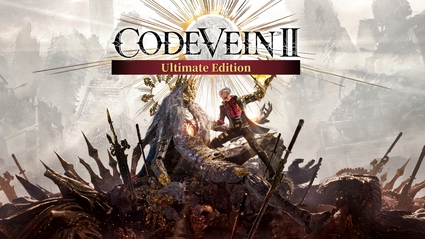
The plot of Code Vein 2 expands and enriches the universe built in the first chapter, while maintaining a completely independent narrative structure. The world in which the story unfolds is a ruined future, disrupted by two intertwined phenomena: the Resurgence, a distortion capable of altering the natural order of reality, and the Luna Rapacis, an entity whose influence is corrupting the Revenants and slowly transforming them into Horrors, creatures devoid of consciousness and consumed by the instinct to destroy.
The protagonist is a Revenant Hunter, a human brought back to life through a BOR Parasite, capable of regenerating almost infinitely but subject to memory gaps and an uncertain fate; when he dies during a mission, he is inexplicably saved by Lou, a young and mysterious Revenant endowed with a unique power: the ability to travel through time and share her heart to bring back to life those she has chosen to protect. This event establishes the bond that sustains the entire plot: a pact between two individuals called to intervene both in the present, now on the verge of collapse, and in the past a century earlier, where humans and Revenants were still trying to maintain a fragile social balance after the initial collapse of the world.
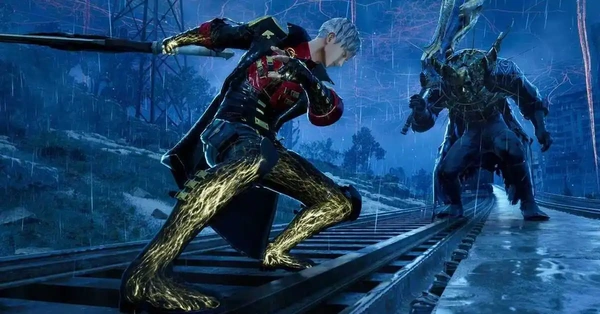
Time travel is not only intended to serve as a narrative device, but is clearly a means through which the protagonist comes into contact with key figures from remote history, including influential Revenants like Valentin Voda, a descendant of one of the most powerful houses, who studies ancient energies and forms to understand what is corroding the world and how to prevent its definitive collapse. The alternation between present and past highlights two profoundly different realities: a modern society already in an advanced state of decay, where Revenants are definitively losing themselves, and an older era where order was maintained with difficulty, but where hope, organization, and a type of balance destined to break still existed. Every encounter of the protagonist, in both eras, introduces fragments of a broader story: lost memories, forgotten heroes, distorted timelines, and the weight of choices that resonate through time.
At the heart of the narrative remains an emotional and dramatic journey: broken individuals seeking redemption; heroes of the past who failed to prevent the end of their world; protagonists of the present forced to confront what remains of those figures, often trapped in monstrous forms; and the constant question of how much destiny can truly be changed, even with the power to cross time.
I chose to spend several lines on the plot, which, by the way, is well described in various cutscenes, because in my opinion it is the only relevant element of the game that, even with some redundancy, manages to give the player a certain emotional leverage to continue and, above all, leaves a mark, especially given its genre, which often only sketches the story and lets the player fill the container with their own experience.
Hands-on…
Before starting, it's fair to say that we were given a code for PS5, of which I have the Pro version – yes, don't be mad, it won't serve any purpose, but it looks good in the living room – and already from the menu it's possible to choose whether to optimize fluidity or graphics, without ever indicating in detail what one or the other option implies. Obviously, I went for fluidity, but at the moment this presented quite a few flaws, with evident drops in a large number of situations.
It's not the game where this will ruin your experience, and I'm certain that patches will fix this flaw, but frankly I would have preferred something more solid, given that in some instances if you lose synchronization, you risk the life of your digital alter ego. We're talking about Unreal Engine, it's a "nail" for anyone, but there doesn't seem to be anything really so demanding to create these problems. The choice to make a semi-open world can be interesting, provided it doesn't represent, as it actually does, the construction of empty spaces or urban areas devoid of anything interesting to see.
The summary part of the level design does not improve in the interiors or in the dungeons, which have elementary labyrinthine structures, but are generally uninspired and not at all fascinating. An interesting note on this front is that this is also one of the few ways to die, given that some poorly marked areas or fighting near the edge of a corridor without a railing will make you fall off quite easily (wow!). However, we get to the crux of the matter, which is whether you like this genre – I've been careful not to say soulslike until now because saying it is a bit forced – which is the gameplay.
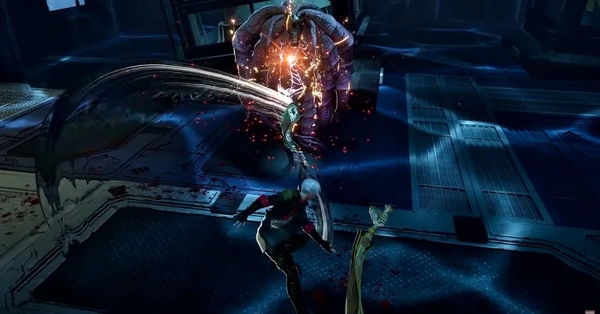
I won't delve into what I consider the chaotic and senseless logic of managing the stats of the weapons you'll wield, which offers dozens and dozens of data for each weapon, but perhaps a little less info and more substance on how to manage the abilities that can be attached to each to unleash lethal blows would have made more sense (this element is debatable, maybe someone will like it (I don't and I also find it not very functional)), but the sore point here comes when fighting. The enemy animations are terrible, almost always the same, and there's no real enjoyment of feedback to the action you produce on screen.
The monsters simply accept being beaten, doing nothing to counterattack you. With bosses, it's even worse; you'll often confuse them with standard enemies, they're either so easy or they'll be frustrating to the point of absurdity without giving a correct reading of their actions in other situations. If you then consider that dodging, due to input-lag or lack of optimization in management, is almost useless, it cannot be said that at the moment it is an optimal experience.
Therefore, while I believe it is right to highlight every shortcoming, especially for a premium product, there are debatable situations, such as combat feedback, which can vary from person to person; some moments can be enjoyable even without extreme precision, but the hope is that future patches will fix much of what I experienced, regardless of the fact that level design is a structural choice and the approach to combat is very generic.
Score
Editorial team
Code Vein 2: Review of the New Bandai Namco Chapter
I would have expected much more from this game, and I'm not referring to the graphics or the story, which nonetheless does an excellent job of outlining the reasons that push the player to investigate within the vast semi-open world. The simplistic gameplay and the lack of a more refined level design, combined with a combat system that certainly has a good variety of weapons, but these are not always able to reproduce the feeling that every player deserves, and for this reason, the developers have only partially achieved the goals they set for themselves.
Similar articles