Aether & Iron: A Retro-Futuristic Crime Story Review
Gangsters in flying cars: a 1930s New York with a sci-fi twist
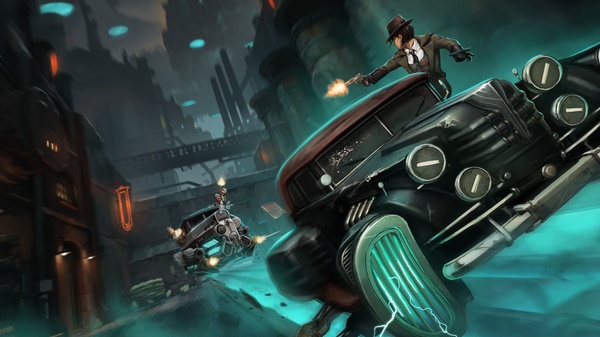


Aether & Iron draws on very distant themes: on one hand, we find the organized crime of 1930s America, with its gangsters and prohibition. On the other, science fiction that bends the laws of physics to its will with anti-gravity devices. The result of this unusual mixture is a New York that retains the appearance of a century ago, but whose districts are scattered across a multitude of floating islands.
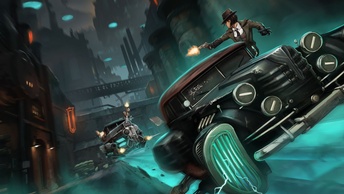
On the streets of this alternate Big Apple, criminals drive (and shoot from) vintage levitating cars. In this picturesque scenario moves the protagonist Giovanna Randazzo, known as Gia, a bootlegger of Italian descent who is going through a rather delicate period and who, forced by events, accepts a seemingly easy job. As expected, the assignment turns out to be much more complicated than it should be and drags Gia into a grand adventure.
The developer of Aether & Iron, the independent studio Seismic Squirrel, defines the game as a "Decopunk Narrative RPG". The first term obviously refers to Art Deco, the artistic movement of the first half of the 20th century that is reflected in the work's style. The rest serves to emphasize that Aether & Iron's nature is predominantly narrative, but not only: the long textual story is supported by a well-established role-playing framework.
The Importance of Narrative in Aether & Iron
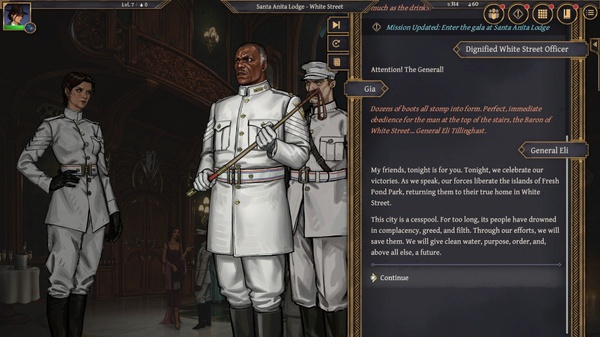
Aether & Iron's screens are essentially composed of artwork, and everything that happens is not shown directly, but rather meticulously reported in written form. Seismic Squirrel has strived to convey every nuance of the events, every detail, to the reader, showing a keen taste for descriptions. There is an atmosphere of contemplation of New York of yesteryear, with its noir contours.
A New York that, as we have seen, has been profoundly changed by the advent of anti-gravity technology, so there is also room for some fleeting sci-fi references. The story of Aether & Iron finds its habitat in the underworld of crime, so it will not hesitate to tell us even the dirtiest and nastiest aspects, sometimes forcing us to make unpleasant choices.
Not to mention the division of the city into floating islands located at different heights, an opportunity too tempting not to include the social pyramid in the discussion, with all that entails. The narrative therefore touches on a plurality of themes and takes on adult tones, although clichés and stereotypes are not lacking. The judgment regarding the story is highly subjective, largely linked to the extent to which the player feels involved in the events.
In short, in Aether & Iron you will spend a good part of your time reading, which requires us to make a clarification. The title is available in various languages including English, French, German, Spanish, etc... but as of today, Italian is missing. During the test, we found that a more than appropriate knowledge of the selected language (in our case English) is an essential requirement: if you lack this requirement, unfortunately Aether & Iron is not for you.
Aether & Iron Gameplay
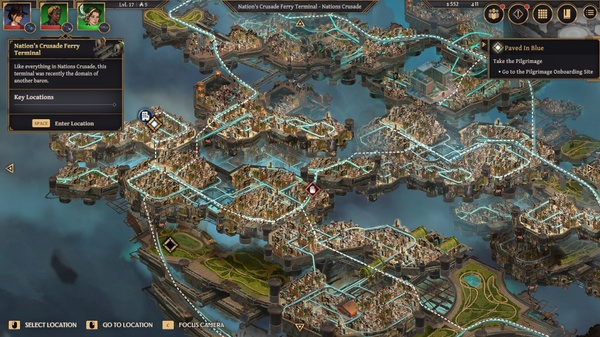
The campaign of Aether & Iron will lead Gia to visit some of the islands floating in the skies of New York. These macro areas will be visited one at a time: once you access the next one, you can no longer return to the previous one. In each island, a narrative arc unfolds, culminating in a clash with the Baron, the lord of that area, a political leader who exercises power akin to that of a small dictator.
Each island is dotted with points of interest, generally buildings, connected by a road network that must be traveled with the levitating car. As Gia moves from one point to another, surprise encounters can occur, such as stumbling upon roadblocks set up by the local Baron's forces, or encountering other New Yorkers (hostile and non-hostile), and it is on the road that battles take place, which we will discuss further on.
When Gia is at a point of interest, the gameplay takes on purely narrative connotations: the long story unfolds on screen, and the player is called upon to make a multitude of choices, some of which will determine the destinies of certain people or how events unfold. For these choices to have a successful outcome, it will often be necessary to pass a check, obtaining a certain score with a dice roll.
In perfect RPG style, Aether & Iron offers experience levels to climb and a dedicated skill tree. The tree has two functions: the first is to add extra points to a dice roll, thus increasing the chances of success. The second is to provide abilities to use in combat. The tree has three main branches, each subdivided into three secondary branches. Each secondary branch is associated with a specific statistic that can appear in checks and a set of four car abilities.
Gia will not be alone in her adventure: among the countless characters encountered, companions stand out, who, once recruited, can join her in battle, in cars that will be equipped with mechanical parts and weapons as desired. Allies also have a skill tree, which mirrors the protagonist's abilities but is smaller (it only has two out of three main branches). Under certain conditions, the bonus points obtained by companions in the skill tree can be used by Gia to pass checks.
Aether & Iron Combat System
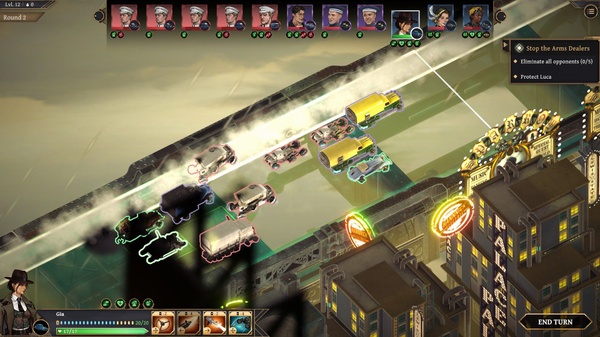
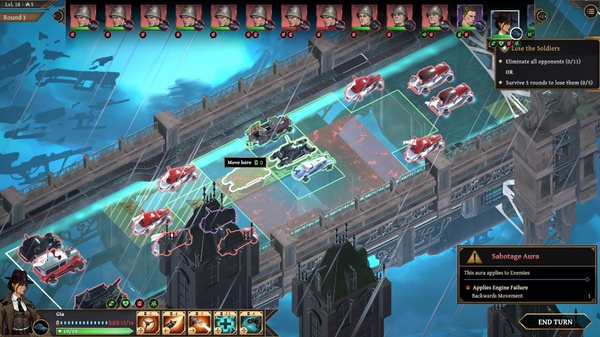
Aether & Iron features turn-based tactical combat on a grid. The battlefield is a straight road, on which Gia's car and two of her companions' cars, enemy cars, any friendly forces driven by the CPU, and even those of unfortunate passers-by who got caught up in the action, all travel. The road will prove to be a dangerous place, with environmental damage squares.
In each turn, all subjects on the road act, one at a time, performing a series of maneuvers whose number depends on the amount of AP (action points) available. These points are spent to move, as well as to use a weapon or an ability. Before choosing the move to make, a long list of factors must be considered.
For each controlled car, a tactic that considers the overall picture must be adopted: how to attack (if it's the case to do so), which enemies to hit, how to move, which weapons and abilities to use, etc... All while carefully evaluating the position of each vehicle, a fundamental element in Aether & Iron's combat, because the road is a constantly changing chessboard, on which moving can prove quite complicated.
Lovers of tactical combat systems will find plenty to enjoy and will experience many small pleasures, such as when a very effective sequence of actions is executed, or when enemy countermoves are successfully prevented, or when a clear positional advantage is gained on the road. Unfortunately, the balance of the clashes does not appear perfect, but one can make life easier by lowering the difficulty level among the three selectable (it goes without saying that it can also be raised, if a harder challenge is sought).
Graphics, Sound, and Longevity
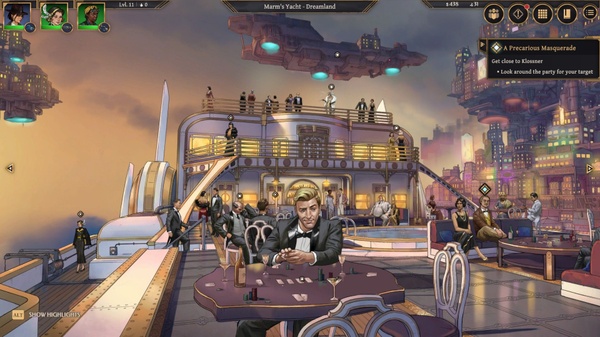
The images that make up Aether & Iron's screens evoke New York of that era, with lines openly inspired by Art Deco, especially concerning the interface. The successive artworks create an overall pleasant visual, but one that doesn't stand out because the style, despite the design efforts, lacks a bit of personality. The least convincing aspect of Aether & Iron's graphics, however, lies in its excessive static nature.
Asking the user to compensate for the absence of moving images with their imagination may be acceptable, given that it is, after all, a textual work, but only up to a certain point: the constant lack of animations makes the scenes much less impactful. In the battle phase, this static approach gives way to a 3D representation of cars and scenery, which is neither good nor bad.
Fortunately, the audio department is a different story: the music draws on appropriate swing sonorities, staying true to the 1930s theme, and can also change register when needed. But the most positive note is the English voice acting, which is very convincing for every dialogue in the game. Considering how much Aether & Iron relies on immersion, the characters' voices give it an extra edge, compensating at least in part for the visual shortcomings.
We stayed with Gia on the turbulent streets of New York for a good twenty-plus hours before seeing the credits. However, we didn't discover everything the Big Apple had to offer, having skipped many optional dialogues. Also, consider that Aether & Iron's longevity can vary significantly depending on the user's reading speed.
Conclusions on Aether & Iron
To truly appreciate Aether & Iron, one must accept being carried along the path laid out by the developers. It is a winding path, one that doesn't shy away from deviations from the main story to introduce the player to a wide variety of characters and places, but with the destination always in sight in the background; a path that is constantly embellished through emphatic descriptions.
Seismic Squirrel has crafted a retro-futuristic New York with a certain charm, whose quality, however, is not exhausted by the story: we think of the combat system, which, while not particularly complex, offers interesting insights into turn-based tactics. It's a shame about some too many limitations: by daring more, Aether & Iron could have aspired to greatness.
Score
Editorial team
Aether & Iron: A Retro-Futuristic Crime Story Review
Anyone with a soft spot for narrative-driven video games should take a look at Aether & Iron: the fascinating setting, the crime-tinged events, and the large number of characters encountered and places visited guarantee entertainment for the player. Plus, there's the tactical component, which, while not overdoing it, manages to offer a satisfying challenge. The work by Seismic Squirrel studio is certainly not without flaws; at times it feels a bit too "textual" and not "visual" enough, but it will win over those who are willing to get involved in its story.
Similar articles