Lunar Eclipse, a survival-horror that forgets it is one
Black Rabbit's Tales' debut title suffers from a clear identity crisis
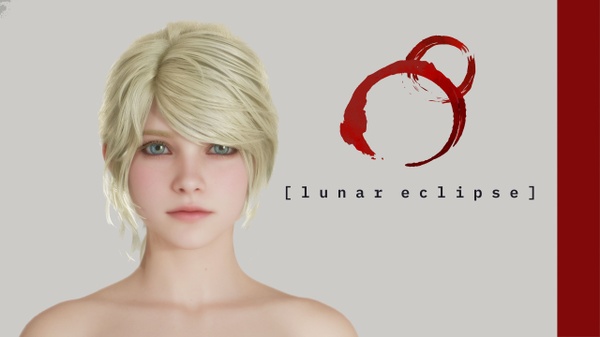


Lunar Eclipse, developed by the one-person studio Black Rabbit's Tales, is a difficult game to decipher – often as much as its puzzles. The intent, in the author's own words, is clear: to create captivating video games featuring beautiful characters. This translates into the first project, Lunar Eclipse: a "survival horror" that places more emphasis on the protagonist's attire (or, even more, the lack thereof) and less on the elements that should characterize the genre. The game is currently in Early Access, with two available scenarios that take approximately a couple of hours to complete, and despite some well-constructed puzzles, it still has a long way to go.
Let's start from the beginning. Ealish, the young protagonist, wakes up in a familiar place but, at the same time, different from how she remembered it. What strikes you from the first moment is her explicit nudity, covered with a few small tricks but still perfectly discernible; immediately after, we learn that Luna Eclipse has an option specifically for this, allowing the player to see Ealish's full nudity while playing (clothes are optional, we can even take them off), or to have her covered by underwear. In short, priorities are made clear from the outset. As I was saying, Ealish wakes up in what we soon understand to be a laboratory where experiments were conducted on her, without the then-child and later teenager having any objections. As we will understand step by step, Ealish was born for this, to be an unspecified hope for humanity, and she was happy to embrace this role – thanks to the genuine affection the team of scientists seemed to have developed for her. Nevertheless, at some point, something must have happened because Ealish leaves the incubator, from which she used to emerge with a certain frequency, after four years. The truth, or at least part of it, we will discover by playing, while trying to survive the zombies that infest the entire facility.
As I anticipated, Lunar Eclipse presents itself as a survival horror but, at least as far as the Early Access goes, it largely misses the mark. Combat, first of all, never gives the feeling of being in difficulty, and while it's true that we're talking about only two scenarios, that should be enough to establish the direction the experience wants to take. Ealish, after an initial period spent solving short puzzles, acquires a switchblade with which she will defend herself throughout almost the entire game (at least until she gets a kitchen knife, but it's still a short blade and a melee weapon). The zombies do not represent a real threat, almost more of a tedious chore to deal with because we have to calculate our attacks in such a way as not to be hit in the middle of a combo, taking into account the possibility of making a clumsy backward dodge.
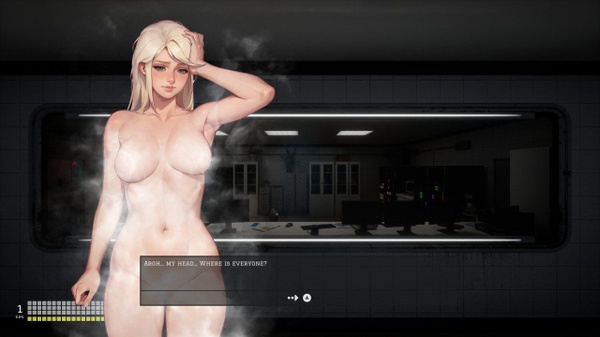
Throughout the first scenario, these will be the encounters, with at most a couple of zombies together, but this is extremely rare, because even if they are present in the same room, they don't notice that we are engaging another one of them and remain with their backs turned, ready to be hit with an advantage after we've dealt with the first. The survival element, for now, is limited to managing one's health, but there are so many cures, as well as the fact of recovering health every time you interact with a save point, that it's a non-issue. For the rest, having no firearms or enemies that would require their use, the "resources" are limited to materials to accumulate for sewing new clothes, more or less revealing, for Ealish. Mind you, there's nothing wrong with having various outfits available – even if they are only aesthetic and not practical in terms of gameplay – but in a survival horror, that's not exactly what I expect in terms of resources. For the rest, in the first scenario, there's very little to do, besides a few encounters, some puzzles, and figuring out what's happening.
The situation changes, and not necessarily for the better, in the second scenario, which sees us reach the residential area. This is a huge puzzle to solve piece by piece in order to reach Ealish's locked apartment. Here it seems the author has shifted into high gear and sped off with puzzles, cramming in as many as possible, scattering solutions, or parts of them, from one side to the other and forcing continuous back and forth through a residential neighborhood absolutely devoid of threats except for one – which is, moreover, telegraphed by a note found shortly before. Compared to the first, this scenario takes more time, sometimes to figure out how to solve the puzzles (not all solutions are clear, quite the opposite), other times to move around in search of various clues or pieces to put together.
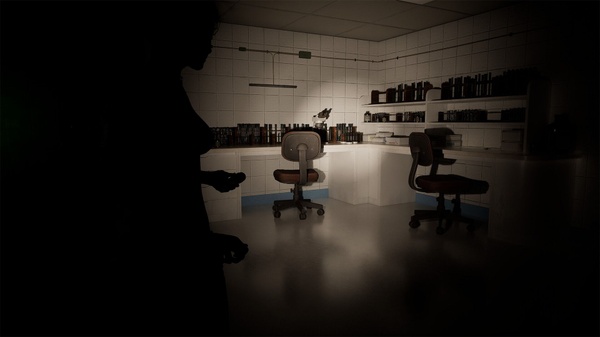
If it had had a more dynamic component, a sense of danger, something to break the very slow rhythm of this back and forth, it would have been an interesting section (albeit far too long); instead, one finds oneself traversing this area accompanied only by piano music composed of a handful of notes and quite out of place in the context. The time and effort spent opening Ealish's apartment door do not then reward with what we find inside: a single seemingly relevant but too cryptic piece of information to give the player a sense of satisfaction, after which we are called to move towards the laboratories, only to be blocked because, as mentioned, Lunar Eclipse currently consists of only two scenarios. The feeling, so far, is of being faced with a game that doesn't even know what direction it intends to take and what kind of challenge it wants to offer players. There is no real rhythm, which is completely stifled in the residential neighborhood scenario, and the survival component is also absent given the lack of danger from zombies and the general ability to fully heal every time you save the game.
From the point of view of the interface and interactions, some revision is also needed: first of all, it's inconvenient that interacting with an item (a healing item, in this case, the only ones present apart from key items) immediately leads to using it almost without realizing it. There's no audio effect, nor generally a clue to make you understand you've used it, and any information about the item is obtained simply by moving the cursor over it. Considering that, since the dawn of time, we are used to being able to interact in different ways with items in our inventory, the lack of this possibility is, paradoxically and I don't think intentionally, the only "survival" obstacle of the experience – that is, avoiding wasting items by accidentally clicking on them. The chests, or their equivalents, that we find around are not interconnected (this is not specified in the tutorials), so, although I never found it necessary during the game, it's important to hold on tightly to what you don't really want to abandon to avoid having to retrace your steps. Not that there's a reason to, but you never know.
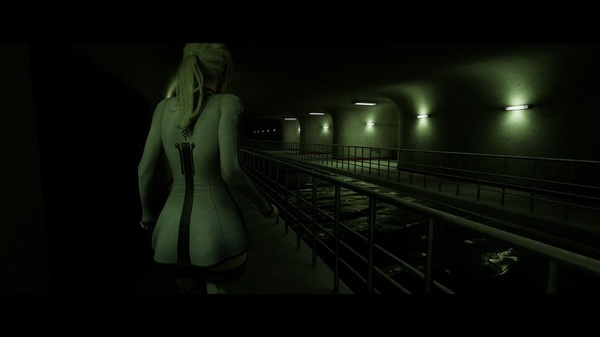
In short, in its current state, it's really difficult to recommend Lunar Eclipse, even considering its low price. The developer is committed to constantly improving the game, as seen from the updates on the Steam page, but failing to give a clear idea of itself, and considering how underwhelming both scenarios are, sticking to the demo for now might be the best option to understand what you're dealing with.
Similar articles