Deep Rock Galactic: Rogue Core, familiar faces hide an experience waiting to be discovered
Ghost Ship Games' new space dwarf adventure takes us back to Hoxxes IV. Constant action and fast pace, with room for improvement
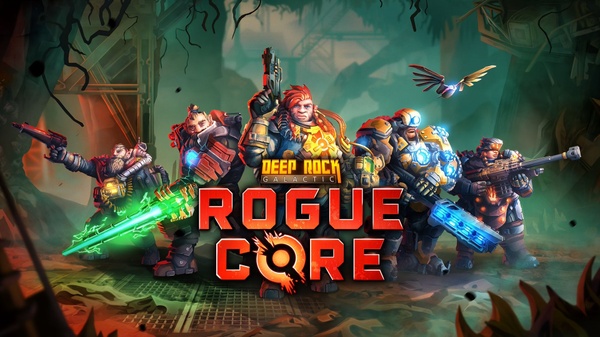


If it ain't broke, don't fix it, but sometimes it's good to look around. Ghost Ship Games has nurtured its Deep Rock Galactic for years, and the results have been evident, with excellent sales and a solid, passionate community. With Rogue Core, recently in early access, the Danish studio has opted for a more action-oriented approach, embellished with a roguelite component that never hurts in such contexts. The title looks like Deep Rock Galactic, from many points of view, but has entirely different priorities. Let's discover them in detail.
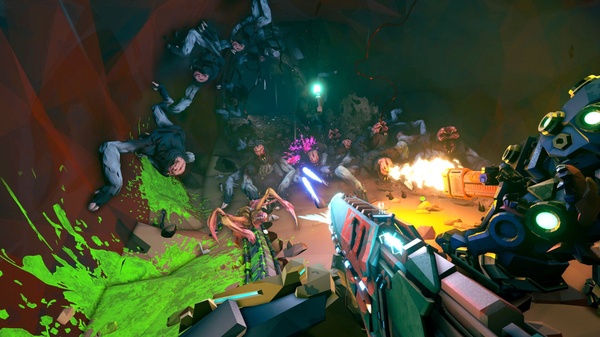
In Deep Rock Galactic: Rogue Core we won't be playing the role of miners, but rather "reclaimers," soldiers tasked with recovering rogue cores deep within the planet Hoxxes IV. This translates into more linear and compact levels, with fewer resources to mine and a higher frequency of combat with the local "fauna." Enough to make you miss the Glyphids from the first chapter (speaking of which, I miss Steeve). There's a less familiar atmosphere, without that sense of routine of someone clocking in for the umpteenth time. A detail that is reflected in our operator. Instead of the bored Mission Control, we'll be under the orders of Omega, a megalomaniac AI with a habit of rushing us.
Not that she's entirely wrong, given that each of our sorties will be timed, marking the arrival of enemy hordes and giant killer worms if we linger too long. There's little exploration and a lot of running, but without neglecting teamwork and camaraderie that distinguishes the series. In fact, here they are even encouraged. If in DRG each dwarf brought their own travel kit from home, in Rogue Core we'll have to find almost everything along the way.
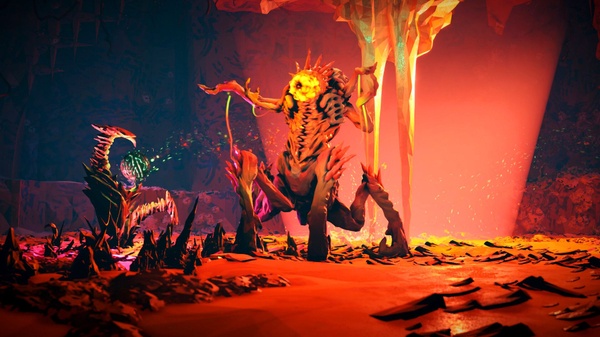
Each of the five classes starts with its own "glove," which determines its main abilities and combat style. Weapons, grenades, navigation tools, perks, and assorted bonuses, however, must be collected from crates and control consoles, generally as a reward for collecting enough raw ore or completing events that are very reminiscent of the predecessor's objectives, only in a "lite" version. There are no restrictions, anyone can use whatever they want, but they will have to coordinate with the team.
Several times during the session we will have to gather around the loot and players will take turns choosing one of the items from a shared and limited pool. It is one of the most "controversial" mechanics at the moment, despite attempts to make it as "fair" as possible. The priority order rotates, giving everyone a chance to pick first; a timer prevents less friendly players from blocking the game, and we can signal in advance the loot we are most interested in, hoping to convince our colleagues to leave it for us. Alone it's not a problem, for obvious reasons, and with friends it's easy to agree. With random people, however, it can be frustrating to know that you can't always optimize your build, especially when legendary artifacts or trinkets pop up and you're at the end of the line.
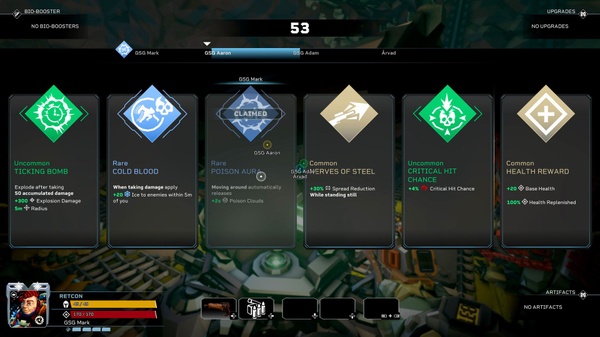
Learning to improvise and communicate quickly and efficiently, but above all to understand when it's best to huddle together to avoid wasting time, is part of the learning curve. Performance improves significantly once you get into the rhythm, which is much more frantic than Deep Rock Galactic, despite initial impressions suggesting otherwise. This is also thanks to accumulated experience, which will allow us to unlock passive buffs and slots to equip even more. They won't turn your day around, but they help.
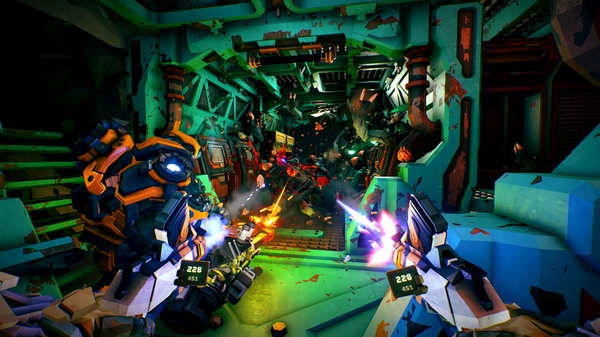
The objective of each mission is always the same: to arrive safe and sound, and hopefully well-prepared, at the top floor of the mining complex to retrieve the core, guarded by a tough boss. The first-person gunplay mirrors that of the first chapter, introducing for the occasion a perishable armor and the so-called "stone skin," to better tank the incessant, often treacherous, monster attacks. The weapons are mostly taken from the past, especially the heavy ones, but they still provide satisfaction. The new classes are fun to use, but they don't boast the same charisma as the old ones, probably due to the shared arsenal and few customization options.
It's true that the game has just begun its early access journey. There's plenty of time to flesh out the storyline, and in any case, the starting infrastructure is solid. Where would I start first? The rogue component: the selection of power-ups is boring. Don't get me wrong, there's no shortage of variety, and we can tweak a lot of parameters, but they are all numerical increases. More damage, more critical chance, less recoil, less cooldown, more effective healing, greater resistance... Even elemental synergies are reduced to extra DPS and occasionally a few explosions. There are a couple of nice perks, like leaving a trail of fire when running or emitting toxic clouds every few seconds, but they are rare and nothing to build around.
And nothing compared to DRG's overclocks, which allowed for completely reinventing one's builds. A similar mechanic would be needed, or something that provides incentives for imaginative players. I would then review the progression a bit: unlocking the same beard five times (one per dwarf) is a nuisance. Luckily, we don't have to do it for the pickaxe parts too. However, I trust Ghost Ship Games. New content is already on the way, and Deep Rock Galactic itself took a while to gain momentum. As it stands, I don't see myself spending over 400 hours with Rogue Core, but it's too early to tell.
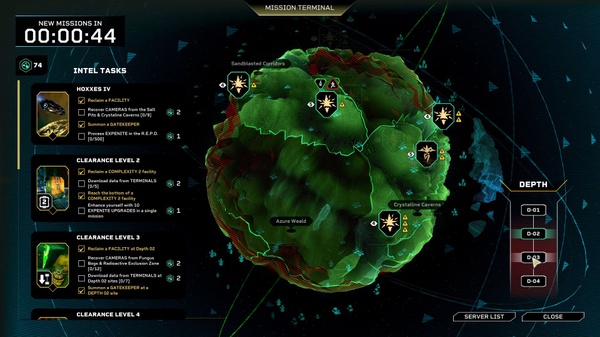
Overall, the gameplay experience is enjoyable. The procedural generation of levels doesn't seem to have caused any trouble, thanks to a less intricate and less vertical design. Load times are short and mostly tied to the party member with the least performant hardware. I don't recall any lag issues, collisions are always precise, and the servers are stable. The difficulty seems well-calibrated, both in single-player and multiplayer: enemies abound, but so do resources to get back on your feet. Occasionally, however, monsters pop up behind you or from inside walls, and that's not pleasant. The interface could be more functional: status information isn't immediate, and in some screens, there's a lot of wasted space. It also happens that icons don't appear or buttons don't press on the first try.
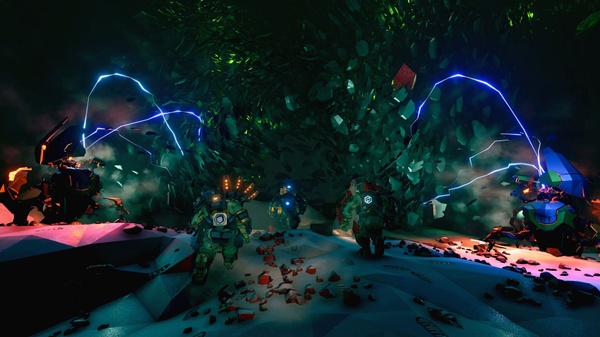
Performance is good, and doesn't seem to suffer from the technical improvements. The title boasts a more detailed graphical presentation than the original, with more defined models, more detailed and "furnished" environments, and decidedly more enemies on screen. All without compromising the typical atmosphere of the series, chaos, special effects everywhere, and, of course, the complete destructibility of the terrain, although digging tunnels is no longer as useful as in the past. In the commotion, unfortunately, there are few opportunities to focus on the excellent soundtrack, with dozens of fast-paced electronic tracks that better emphasize the adventure's tone. Remedy this by sticking to the jukebox.
Deep Rock Galactic: Rogue Core is trying to build its own identity using many of the cornerstones of its acclaimed predecessor as a framework. It still has many rough edges to smooth out and lacks the soul that allowed Deep Rock Galactic to win the hearts of fans, but it's on the right track. To veterans, it might seem like Ghost Ship Games doesn't quite know which direction to take, but in my opinion, it just needs time to take shape. As reiterated by its creators, Rogue Core is not Deep Rock Galactic 2 and doesn't want to be. Accepting that is the first step to coming to terms with a cooperative FPS with great potential and already very convincing. More than recommended if you have the right friends. Rock and Stone.
Similar articles