How Max Richter, a Former Punk with a Love for Classical Music, Changed Chloé Zhao's Hamnet (Including the Ending)
The composer discusses his work on Hamnet, his dialogue with Chloé Zhao, and the music that changed the film's ending, amidst voices, silences, and memory.


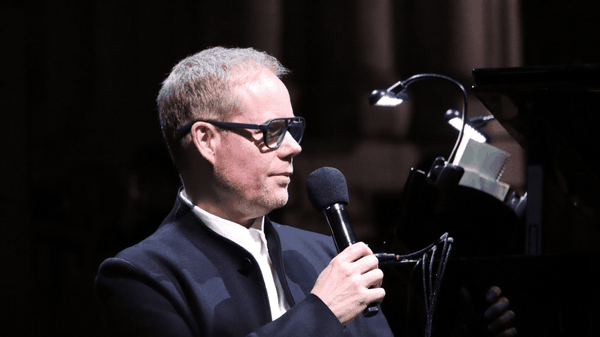
Raised on Bach, electronic music, and (unexpectedly) a great love for punk, Englishman Max Richter is one of the most recognizable contemporary composers in the dialogue between music and images, one of the few capable of bringing contemporary orchestral music to the charts. Part of his popularity stems from the incisiveness and recognizability of his compositions for audiovisuals: from TV series (the soundtracks of The Leftovers and My Brilliant Friend) to auteur cinema (Denis Villeneuve's Arrival), his work has defined a precise emotional imaginary, capable of uniting classical writing, electronic experimentation, and a strong political dimension.
Among the many accolades received in his career, he still lacks an Oscar nomination, a kind of affirmation in this field for those who don't have an exclusive career in this sector but, like him, move between contemporary music EPs and soundtracks. In a particularly competitive year in this category, Max Richter has a good chance today of securing his first career nomination for scoring Hamnet, the new film by Chloé Zhao inspired by Maggie O'Farrell's historical novel of the same name. A story based on the true life of the bard William Shakespeare, also told through the eyes of his wife Agnes, at a dramatic moment in both their lives: in the midst of his creative fervor, the couple finds themselves having to face the devastating death of their young son.
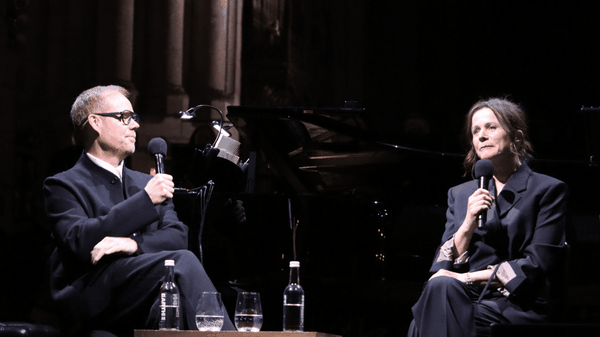
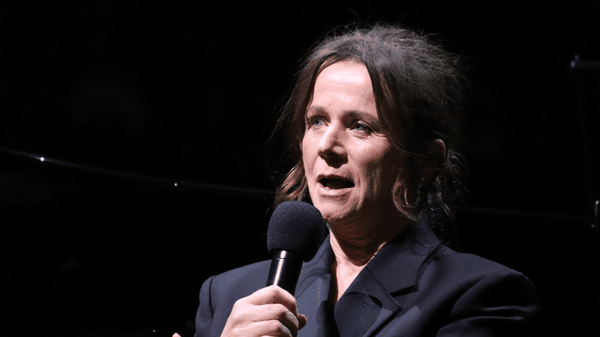
In an exclusive event held on Monday, January 19, 2026, at Southwark Cathedral in the heart of London, Richter performed the film's entire soundtrack live with an orchestra and choir: a special performance, recorded directly to vinyl, in the place where the bard's brother is buried and which William himself frequented.
The evening was preceded by a Q&A with Emily Watson, who gives face and voice to the protagonist's mother, Mary, in the film. A rare opportunity to speak with the composer about how the film's soundtrack came to be, in a direct comparison between music and interpretation, as well as to clarify why a previously composed piece by the author is used at a key point in the film. Richter focused on the soundtrack's production process, which began when he had the opportunity to read the script well in advance, even before the director found her film's locations and began shooting with the cast. Falling in love with the story and the themes explored, Richter immediately set to work, and his music, played on set, had such a profound effect that it led Zhao to even change the ending.
Max Richter Tells Emily Watson How He Developed the Hamnet Soundtrack
How did this collaboration come about, and how did you first get involved in the project?
I read the script and saw Chloé's name on the front page: it immediately intrigued and excited me, having seen and appreciated her previous films. I read the entire script, and it was incredible. Afterward, Chloé and I met for lunch and talked about the big questions the film addresses: interpersonal relationships, family, motherhood, grief. But also the broader connections, with the earth, with the cosmos, with the afterlife.
I immediately started making musical sketches, even before they had finished scouting locations. I composed about half an hour of music, which Chloé then used throughout the process. I think it really permeated the filming, especially while they were on set.
Can you talk about how you developed a musical voice that resonated with Agnes's experience?
The more time I spent with the script, the more I felt that the entire soundtrack should resonate through the prism of Agnes's experience. I created these sketches using many female voices, both in a traditional way and in a more abstract way, almost as if they were the ghosts of female voices. It was a “haunted” color, which I wanted to use sculpturally: a purer surface and texture. The more I delved into this idea (i.e., looking at everything through her experience), the more everything started to make sense. That material constitutes a huge part of the film: it's really the backbone on which everything else is grafted.
Nature has a very strong presence in the film. How did this influence what you created?
We were very fortunate to have Johnnie Burn handle all the sound work. The collaboration with him, and the dynamic between the textures of the natural world (the sound of the forest, the voice of the forest, the voice of the earth, of the wind) was fundamental. All of this is a huge part of Hamnet's psychological narrative, along with the music.
Of course, there's also a lot of dialogue in the film. Finding the right balance between all these elements was a very interesting process. In reality, for Chloé, Johnnie, and me, it was often about working on the edge of silence, creating fertile silences. Much of Johnnie's work, in particular, hovers on the edge of something. It's extraordinary.
Can you tell us something about the sound and musical “forms” of the film, especially in the London sequences?
The starting materials for the soundtrack are mainly vocal recordings. We worked with an extraordinary choir, specializing in Elizabethan period music: very pure tenor voices. I also worked with period string instruments, which we then transformed on the computer into a kind of ghosts of themselves. I used them abstractly to create something that, technically, is electronic music, but which sounds very organic. This material accompanies the character when she is in London. It has dark, pulsating colors: this is, in essence, the London palette.
There's a moment when the music truly sounds Renaissance. Was that a conscious choice?
Yes. It's practically the only moment when the music has a truly Renaissance flavor, and it's also the only time you hear male voices in the choir. I wanted to do that because, in a way, Agnes's entry into the world of theater is universal. I wanted to hint at that aspect. The choral material in that scene has a grammar familiar to the music of that period. It's really the only moment you hear something that recalls composers like William Byrd or Thomas Tallis.
Let's talk about the piece On the Nature of Daylight: how did its use in the film come about?
It's an interesting story. When I received the edit and saw that On the Nature of Daylight was already in the scene at the Globe, I thought: okay, I'll replace it, that's normal. I wrote a new piece for that scene, which is actually The Undiscovered Country, the one that then ends up in the credits. In this way, the piece effectively became foundational for the architecture of the film's ending. For her, it was clear: it had to be there, there was no alternative. It's her vision, and for me, it made perfect sense.

Where did On the Nature of Daylight originally come from? It's not a song you wrote for the film.
That piece comes from an album called The Blue Notebooks, released in 2004. It is, in essence, a protest album. We recorded it right at the beginning of the Iraq War, in fact, the week after the big anti-war demonstration in London in 2003. So yes, it's protest music, anti-violence music.
What music did you listen to as a child?
I listened to many different things. I was always drawn to classical music. The first piece I remember hearing was Bach's Double Concerto, when I was about three years old. I remember the sunlight coming through a window and blending with that musical experience. Later, I got into pop music and electronic music, and during my adolescence, I mainly listened to punk. It suited my mood and the politics of that period: those were the years of Margaret Thatcher. So, really, a bit of everything.
Similar articles