Super Mario Bros Wonder is the 2D Mario you've never seen before
How Super Mario Bros. Wonder's ideas and bizarreness make it the first true innovation in the two-dimensional series since 1990


What a paradigm shift Super Mario Bros. Wonder is. Something we had already seen, several times, in 3D Mario games: Super Mario 64 was the revolution of the platform genre itself, the game that took it to another dimension, literally; Super Mario Galaxy played with its stricter laws, with gravity no longer the player's main enemy and the rigid geometry of platforms taking a backseat to the roundness of planets of various shapes and sizes; the vastness of Super Mario Odyssey's worlds, all to explore, almost makes it difficult to define it as a true platformer, a categorization that feels decidedly too narrow for it.
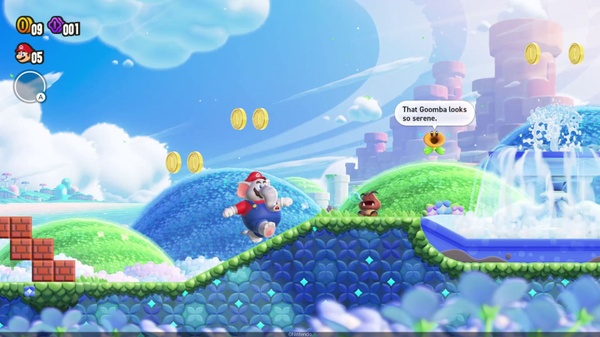
The same had never happened with regard to the two-dimensional installments of the series. Certainly over the years we had seen some pleasant innovations, such as the ability to explore increasingly complex and intricate maps, discovering their secrets through hidden level exits; we genuinely enjoyed and were surprised by always intriguing, delightful, and genuinely fun power-ups; we initially greeted with skepticism a multiplayer component that later proved to be brilliant. Yet, never anything that questioned and challenged the very rules of the platformer, which instead remained substantially unchanged.
Although this has never necessarily been a problem, given that these same rules underpinned splendid examples of level design, it is undeniable that there was a certain need for renewal, for something that would at least try to overturn the certainly enjoyable, but nonetheless monolithic rigidity of the gameplay. Since Super Mario World (and taking Super Mario World 2: Yoshi's Island out of the discussion, being so different from the series' tradition as to be almost unclassifiable within it), there has been no real evolution, never anything that bravely tried to flip the table. The games in the “New” series are only new in name, as playing them is an experience largely overlapping with that of their illustrious 1990 predecessor.
Super Mario Bros. Wonder is the first attempt to try and overturn the rules and dynamics of 2D Mario games. At first glance, it might seem to do so conservatively, that all its frills and flourishes are just expedients aimed at capturing attention and nothing more; admirable, certainly, lighthearted, but also a bit too superficial. Undoubtedly, that's what happens in some of its levels, especially the early ones, when the ideas behind them aren't so creative and strong, or perhaps have nothing to do with gameplay in the stricter sense. But as for the rest, and this is the most substantial part, the game manages to offer an alternative to its decades-long tradition of frantic runs and precise jumps.

To put it more simply and directly: millimeter-calibrated level design is no longer the most important thing; what is most important is to induce a continuous sense of wonder in the player, through situations that are appreciated for their bizarre dynamics and colorful events. And so perspectives change, with Mario even framed from above, time is overturned, slowing down and speeding up unpredictably, gravity changes, Mario himself changes, even transforming into some of his enemies.
Here is the true revolution. This time, level design, the cornerstone upon which the gameplay structures of all previous Mario games were built, is no longer the foundation. It's not important that it enhances the skills necessary to reach the end of each level, but that it characterizes each of them. The most challenging levels, which always put poor Mario in danger thanks to a combination of strategically placed traps, devices, and enemies, are those that most resemble past games; but in most cases, there is a different feeling that characterizes the experience, because the rhythm is different.
The focus is no longer on running and jumping across platforms and pits distributed with almost artisanal skill, but on reaching the moment when everything explodes and strangeness erupts. In some ways, the flow of the game has two sides: on one hand, the usual quiet platforming, on the other, the overload of bizarreness. Does it work? Yes, although when transitioning from one to the other, a subtle but perceptible stumble is almost felt.
There had already been games that tried to break the traditional dynamics of 2D platforming through curious twists: Rayman Origins and Rayman Legends, for example; or Donkey Kong Country Returns and its underrated sequel, Tropical Freeze (Sunset Shore is one of the best platforming levels ever, absolutely). They did so consistently, integrating such situations organically and fluidly within the levels. Super Mario Bros. Wonder does the same thing, but in a less deliberate and elegant way, since they are triggered by obtaining a specific item, the Wonder Seed; but there is an advantage, which lies in the fact that this way, unusual peaks of bizarreness can be reached, because the coherence of the level itself can be broken in any way.
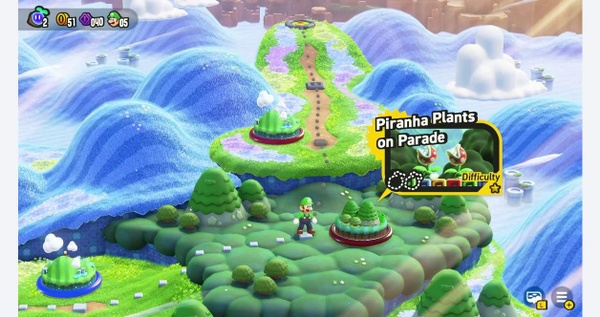
In some ways, the game's iconic power-up, the elephant transformation, is the perfect representation of its spirit: it's truly too big for levels designed for standard-sized Mario, it's far too powerful, but who cares! It's completely out of context, it's something that could have been born from some kind of hallucinatory dream, but it's perfect for the blatant bizarreness on which the game is built.
Make no mistake: Super Mario Bros. Wonder is by no means a bland platformer, even outside of its strange moments. The level design may not be the best in the series, but it is still at very good levels: simply, the focus and spirit of the game lie elsewhere. It is a production that, bravely, challenges the traditions of the series and joyfully grapples with them, and even if the result is not always perfectly centered, one thing is certain: it is a 2D Mario like never seen before, and one from which it will be impossible to go back. It is for this reason that it would not be wrong to define it as the first, true modern 2D Mario: that alone is enough to make it historic in its own way.
Click here to read the full review of the video game.
Similar articles