Creative XF1 – Desktop Compact Speakers Review
Desktop speakers aiming to offer a more complete listening experience, even beyond simple PC use.
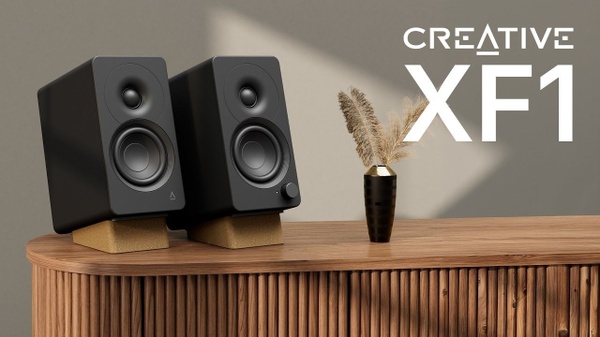


The Creative XF1 are 2.0 channel active speakers designed for those seeking a compact audio system to complement their computer, without sacrificing a good range of connections and the ability to adjust sound output. The project combines a total power of 72 Watts (RMS) with Hi-Res audio support, both via USB-C connection and in wireless mode. Completing the package is Creative Nexus, an application that allows you to customize the speakers' behavior through a parametric equalizer.
The list price is 159.99 euros, a figure that places the product in a rather crowded segment, where there are many interesting alternatives. The XF1s try to distinguish themselves primarily through their configuration flexibility and features not always found in desktop systems of this size.
Gallery
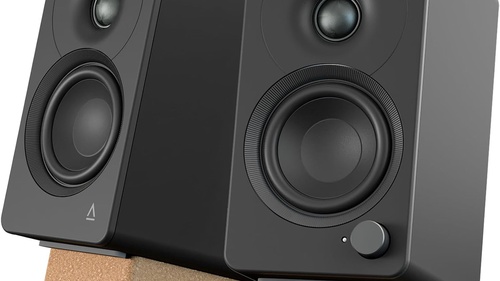
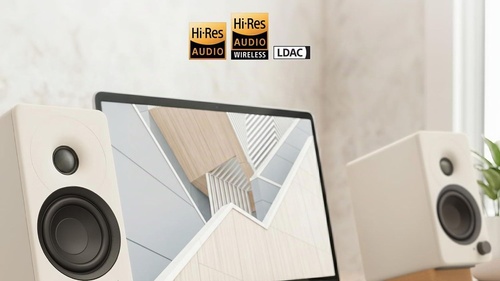
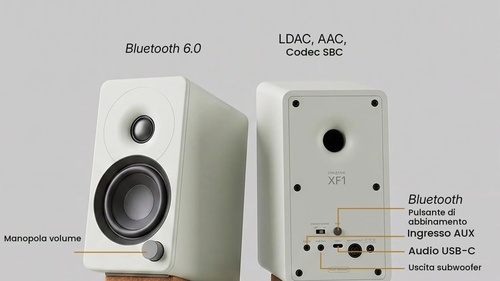
Compact Construction and Attention to Placement
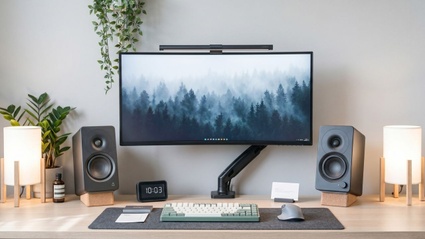
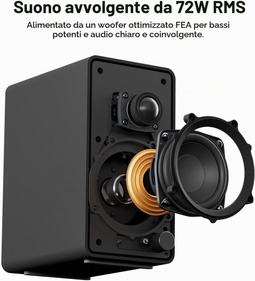
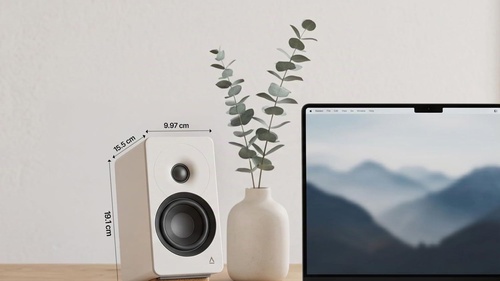
Each speaker measures 155 x 99 x 191 mm and features an MDF cabinet (medium-density fiberboard). The acoustic configuration includes a 3” woofer and a ¾” tweeter for each unit. The compact dimensions allow the XF1s to be placed even on not-so-spacious desks. The package includes inclined cork stands, designed to better direct the sound towards the listening position. It's a simple but useful trick in a desktop context, where the height and distance of the speakers from the listener can significantly affect the output.
The declared frequency response ranges from 55 Hz to 40 kHz, values that describe the theoretical capabilities of the system, but do not alone tell the actual behavior at different frequencies, where the overall balance between mids, highs, and lows is obviously most important.
Rich Features for Music and Entertainment
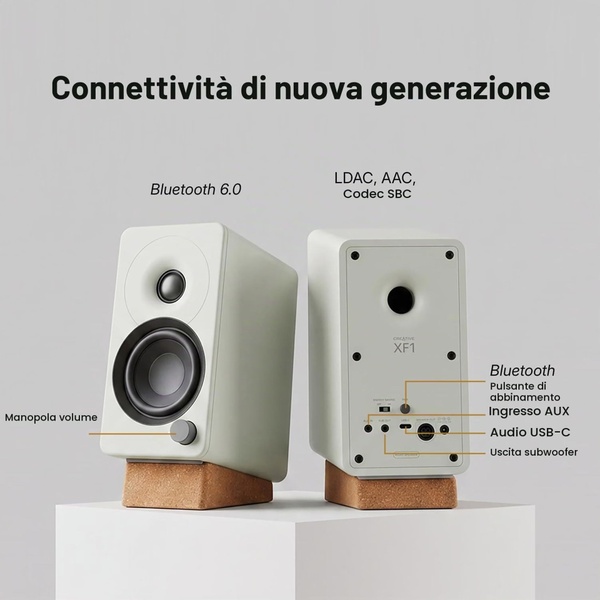
In terms of connections, there is 1x USB-C port with support up to 24 bit/96 kHz, 1x 3.5 mm analog input, and Bluetooth 6.0 connectivity. SBC, AAC, and LDAC codecs are included, with the latter being particularly interesting for those who use compatible sources and want to take advantage of higher quality wireless transmission.
There is also a dedicated output for connecting an external subwoofer, expanding the possibilities for those who want to achieve a deeper low-frequency response. The 2.0 configuration therefore does not prevent subsequent intervention, remaining a standalone solution or evolving into a more articulated system.
Sound Performance is Particularly Convincing in the Mids
When listening, the Creative XF1s demonstrate a good ability to reproduce voices and instruments located in the mid-range. Speech is intelligible and well-distinguishable, a valuable characteristic especially when watching movies and series. The stereo soundstage is convincing for a system of this size, with separation that prevents different elements of the audio signal from overlapping. High frequencies might be a bit too aggressive. As is easy to imagine, the low-frequency range reveals its limitations: the woofer cannot guarantee the depth and pressure of systems equipped with larger transducers or a separate sub. The result remains adequate for close-up listening, but those seeking a pronounced impact in action scenes or electronic music may consider a dedicated unit.
At high volumes, DSP processing also intervenes, which helps to contain the speakers' behavior, preventing reproduction from getting out of control. It's a useful protection, but it can make the response less natural when trying to push the system beyond its intended use at medium volume. From streaming tracks via Spotify, through YouTube, and streaming platforms, the feeling is that the output is always enhanced. It performs better with physical media, including CDs, DVDs, and Blu-rays, where even reducing lossless tracks to a more "modest" 2.0 listening still provides significant levels of speech comprehension, even amidst music and effects. The inclusion of an external subwoofer would be ideal, especially for video games. Just a few minutes of Cyberpunk 2077 or a couple of laps of Forza Horizon 6 are enough to deliver a dynamic and rich soundscape, even if limited to just 2 channels.
Creative Nexus Expands Adjustment Possibilities
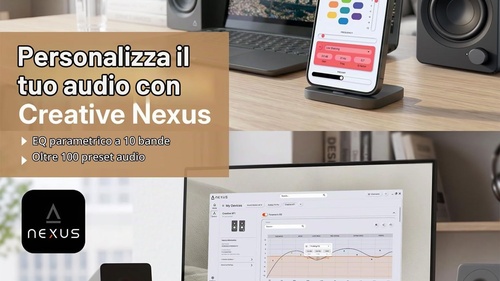
One of the most interesting features of the XF1 is its integration with Creative Nexus, an application that provides a 10-band parametric equalizer and over 120 presets, offering rather extensive control over the speakers' response.
There are profiles dedicated to various uses including music, movies, and games. Those who prefer to intervene manually can instead modify the equalization to adapt it to their workstation and the characteristics of the environment. It's a concrete possibility, not just an accessory addition: the response of a desktop speaker is affected by the distance from walls, the support surface, with associated vibrations, as well as the position relative to the listener.
The availability of a parametric equalizer is an advantage over many compact systems that only offer a few preset profiles. It doesn't transform the XF1s into professional monitors, but it allows their behavior to be adapted with greater freedom than the average for the category.
Many Competitors, But the Creative XF1 Hold Their Own
The Creative XF1s compete with several active desktop speakers, some of which adopt a similar philosophy albeit with different characteristics. The Edifier M60 are probably the most immediate reference: here too there's a 3” woofer and dedicated tweeters, although the declared power drops to 66 Watts. Bluetooth, USB-C, and analog input allow for broad connectivity to computers and mobile devices. The XF1s are more flexible and powerful.
Another competitor could be the Audioengine A2+, particularly compact speakers that focus primarily on music reproduction. Their construction and stereo output make them interesting for those who prioritize close-up listening, also with USB-C and Bluetooth. The price is generally higher.
For a workstation also dedicated to gaming, there are also the SteelSeries Arena 3. The stereo configuration and 4” full-range drivers prioritize PC entertainment, with reproduction capable of adequately filling a desktop space. However, the features are more essential compared to the XF1s, especially regarding USB audio and expansion possibilities.
Staying within Creative's own lineup, the T100 constitute another point of comparison. These are 2.0 multimedia speakers with Bluetooth, remote control, and analog and digital inputs. Their versatility makes them suitable for daily use, but the XF1s introduce a more modern platform, with Bluetooth 6.0, LDAC, high-resolution USB audio, and more in-depth adjustments through Creative Nexus.

Final Thoughts
The Creative XF1 have proven to be versatile desktop speakers, with a superior technical endowment than one might expect from such a small 2.0 system. Connectivity is one of its strengths, especially thanks to LDAC support and USB audio up to 24 bit/96 kHz. Creative Nexus also adds a concrete element, providing adjustment tools that allow you to adapt playback to your preferences.
The limitations emerge mainly in the depth of the low frequencies, which can be resolved with an external sub, as well as when trying to reach high volumes. These are not speakers designed to fill large rooms, nor do they pretend to replace higher-end systems. For a desk, they offer a complete and customizable solution.
Similar articles