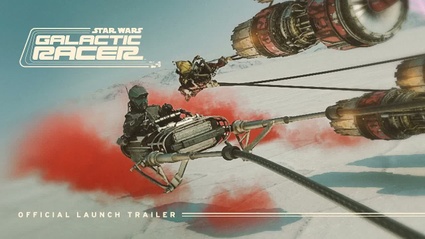
Star Wars: Galactic Racer PS5 Review — Fuse Games Revives Burnout and MotorStorm in a Galaxy Far, Far Away
Fast repulsorcraft, spectacular crashes, a roguelite Galactic League, and a chilling Gordy Haab soundtrack: the spiritual successor to Episode I Racer
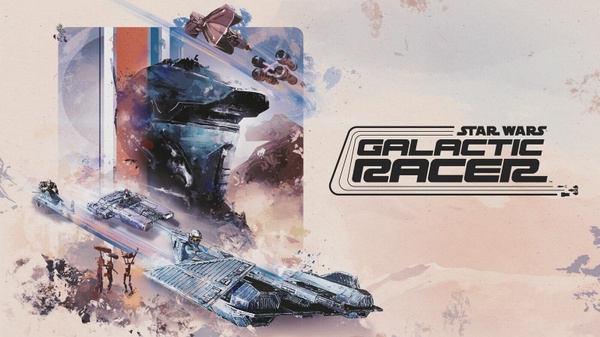


There was a moment, at the end of the nineties, when Star Wars managed to transform one of the most spectacular sequences from The Phantom Menace into something perfectly suited for a video game. Star Wars: Episode I Racer, published in 1999, took the madness of Mos Espa's pod races and converted it into a blazing fast arcade game, made of enormous engines, dangerous circuits, absurdly fast cornering, and that constant feeling that a single mistake could turn your podracer into a pile of scrap. In 2002, Racer Revenge tried to pick up its legacy, further accentuating collisions and aggression, after which this particular video game branch of the galaxy remained substantially silent for over twenty years. Star Wars: Galactic Racer is born precisely from that void, but intelligently commits what we could call a necessary betrayal: instead of merely being Episode I Racer with a modern graphical overhaul, it takes that concept of extreme speed and drags it through more than twenty years of arcade racing evolution.
The DNA of Star Wars Galactic Racer: Burnout for Crashes, MotorStorm for Brutality
Galactic Racer seems to come from an alternate timeline where that particular way of conceiving racing games, typical of the PlayStation 3 and Xbox 360 era, never truly disappeared. It's a noisy, fast, aggressive game, little interested in the composure of simulation and much more attracted to the idea that every race should turn into a spectacle. There's something of Burnout in its DNA, and it couldn't be otherwise: Fuse Games was founded by Criterion veterans who worked on the Burnout series and Need for Speed, in addition to having previous Star Wars experience through Battlefront's vehicle sections. Galactic Racer is the studio's debut, but it hardly gives the impression of being the work of an inexperienced group. The legacy of that racing school emerges especially in the way speed, physical contact, and crashes become parts of the same language.
If Burnout can be evoked primarily for its aggression and destruction, the other great ghost accompanying Galactic Racer concerns the nature of the races. MotorStorm belonged to a wonderfully brazen period of racing games, when it was absolutely normal to put different vehicles on the same track, create hostile courses, and convince the player that arriving at the finish line intact was almost as important as arriving first. Galactic Racer recaptures precisely that feeling. There is no impression of participating in sterile competitions held within racetracks built only to be functional: the course is part of the opponent.
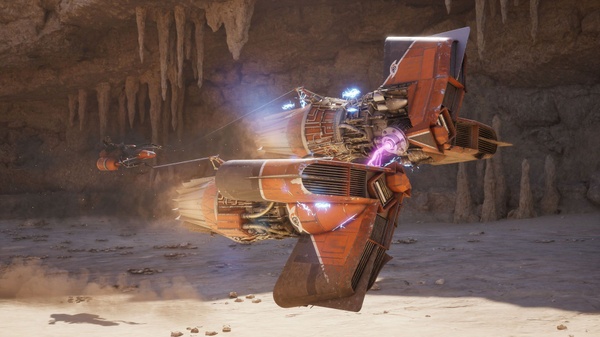
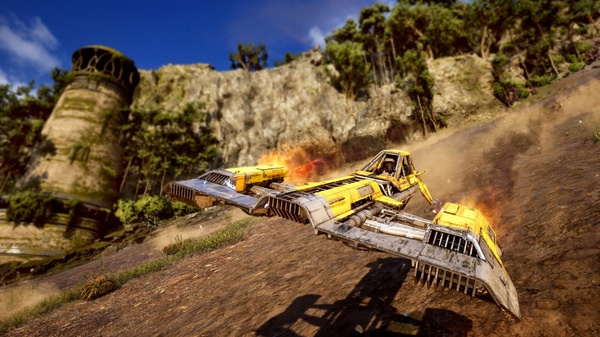
The different categories of repulsorcraft reinforce this philosophy. Changing vehicles means altering your relationship with the track, with different acceleration, braking, and handling characteristics that force you to reinterpret corners and situations. Speeder bikes, for example, favor very aggressive braking accompanied by violent accelerations when exiting a corner. It's a setup that brings to mind those MotorStorm competitions where the choice of vehicle changed how you viewed the track. And precisely through collisions, dangers, and vehicles capable of being destroyed or exploding, the race takes on that almost brutal physicality that has become much rarer in modern racing games.
The Roguelite Campaign: The Galactic League, Shade vs. Kestar Bool, and Six Planets Including Jakku
The campaign features a roguelite structure built around different paths and upgrades, introducing unpredictability into the progression. We are after the events of Return of the Jedi, in a galaxy where the collapse of the Empire has created new opportunities even for unsavory characters. Thus, the Galactic League is born, a clandestine competition around which pilots, mechanics, sponsors, and less transparent interests revolve. The protagonist Shade is recruited by Darius Pax with a precise objective: to end the dominance of champion Kestar Bool.
Don't expect the narrative component to try to compete with the great Star Wars stories. Its role is different and, above all, more intelligent than it might seem. The paddock provides a physical location for progression, allowing you to talk to characters between races and giving the championship the feeling of being a lived-in environment rather than a succession of menus. Even the flashbacks bring podracing back into play and build a direct bridge to those races that started it all. Italian translation is present through subtitles, but there is no Italian voice acting.
The perception of speed is fundamental; it constantly tries to communicate it through the environment, the narrowness of some passages, the sudden approach of obstacles, and especially through the vehicle's behavior. At higher speeds, the circuit seems to almost shrink. A relatively innocuous curve becomes a decision to be made in a few moments, and an impact that at low speed would be a simple correction can quickly escalate. Here, a quality that Episode I Racer understood splendidly more than twenty-five years ago re-emerges: in Star Wars, speed must feel slightly irresponsible. A podracer should never convey the tranquility of a car glued to the asphalt. These are machines that seem designed by someone convinced that installing an even more powerful thruster was a perfectly reasonable solution to any problem.
Crashes consequently become an integral part of the spectacle. When a vehicle definitively loses control, the scene possesses that choreographic brutality that made Burnout's crashes memorable. Seeing opponents involved in collisions or vehicles exploding also brings back that MotorStorm-like unpredictability where chaos could suddenly change the course of a race. It's a decidedly arcade philosophy, where realism gladly gives way to readability and excitement. It's not about knowing if a certain collision would be physically plausible: it's about how spectacular it is to experience its consequences at full speed.
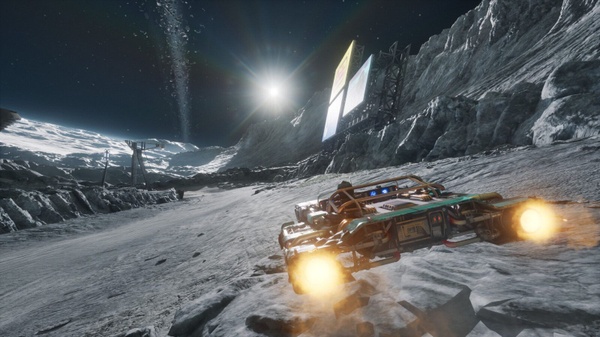
The environments also perfectly understand their assigned task. The game traverses six planets during the campaign and utilizes the Star Wars universe without turning it into mere furniture. Jakku and the tracks built around the remnants of the galactic war are the perfect example of the work's visual philosophy: traversing scenarios dominated by wreckage at insane speeds conveys the scale of the galaxy much better than simple background decoration. The tracks become adventurous places even before they are circuits.
The game often manages to combine this clarity with the monumentality of the Star Wars universe. Gigantic wreckage, industrial structures, hostile environments, and worn technology contribute to a sense of clandestine competition much more interesting than a polished galactic championship.
Sound Design and OST: Fuse Games' Repulsorcraft and Gordy Haab's 21 Galaxy-Scented Tracks
The sound design, then, is one of the decisive elements of the experience. Fuse Games worked with Lucasfilm Games to build the acoustic personality of the repulsorcraft, starting from the sound legacy of podracing in The Phantom Menace. This is a very important choice because few cinematic universes have such a strong relationship between machines and sound. A Star Wars vehicle should almost be recognizable with your eyes closed. Thrusters, hisses, accelerations, and impacts therefore don't just represent sound accompaniment: they become information about the machine's behavior. When accelerating, the sound works with the image to amplify the sensation of power. The engine's progression makes the increase in speed perceptible, and crashes violently interrupt that crescendo, creating an alternation between control and chaos that magnificently supports the races.
This is precisely what made the original podracers unforgettable: those machines didn't just seem fast, they seemed dangerous just by listening to them. The soundtrack deserves equally important discussion. The music is by Gordy Haab, a composer who knows the Star Wars universe very well, and the OST includes twenty-one tracks for a total of just over an hour. Titles such as "The Soul of Racing," "Journey to Jakku," "Star Destroyer Speedway," "Galactic Gauntlet," and especially "Memories of Podracing" already make clear the intention to merge racing and galactic imagery. Musically, the game faces an enormous difficulty: accompanying Star Wars inevitably means confronting one of the most recognizable orchestral identities in popular culture, while accompanying an arcade racer requires rhythm, tension, and propulsion.
The music supports the race without letting you forget you're in the Star Wars universe and, at its best moments, orchestra, percussion, and crescendos accompany the increase in speed, giving the race something heroic and at the same time sporty. It's not just music placed behind a race: it contributes to the construction of the spectacle. The roar of the repulsors remains the protagonist, the impacts possess the necessary violence, and the soundtrack occupies the remaining space, amplifying the adrenaline without suffocating what's happening on the track.
The Limit of the Roguelite Structure: Those Seeking a Classic Career Will Find Something More Elaborate Than Necessary
Not everything necessarily works with the same effectiveness. The roguelite choice makes Galactic Racer more original than a traditional career, but it inevitably introduces a component of repetition. The progression built through sequences of events and upgrades can be stimulating when it produces different combinations and decisions, less so when what the player desires is simply to tackle a long, classic-style automotive career. This is probably the element that will divide the audience the most: those who wanted a direct successor to Episode I Racer might find the structure more elaborate than necessary, while those who accept the experiment will discover a racer that actually tries to do something personal.
And it is precisely this personality that makes Star Wars: Galactic Racer interesting far beyond the weight of the license. In an era where high-budget racing often divides itself between simulation, simcade, and large open worlds, Fuse Games rediscovers a language that seemed to have progressively been lost. That of the arcade race built as a spectacular event. One where ramming a rival is fun. Where surviving a crash by a hair is memorable. Where a vehicle can explode in front of us and instantly change the ideal trajectory. Where going faster is not just the way to win, but constitutes the very essence of the game.
Score
Editorial team
Star Wars: Galactic Racer PS5 Review — Fuse Games Revives Burnout and MotorStorm in a Galaxy Far, Far Away
Aside from the aesthetics, Star Wars: Galactic Racer doesn't (minimally) attempt to erase Episode I Racer from memory. It takes the original idea of crazy galaxy races, infuses it with the destructive DNA of Burnout, absorbs something of MotorStorm's environmental brutality and multi-vehicle competitions, and brings it back into that arcade philosophy that grew during the PlayStation 3 and Xbox 360 years. The result has a flavor that has been missing for a long time. Blazingly fast, noisy, deliberately exaggerated, and as enamored with crashes as it is with overtakes, Galactic Racer reminds us why for many years racing games didn't just try to reproduce driving: they tried to transform it into a spectacle. And perhaps this is its most important success. The logic is to go beyond the world of Star Wars, beyond the world of racing, but to remind us how much fun it could be to destroy a vehicle at insane speed and immediately want to start over.
Similar articles