Forever Ago Review – The Future Cannot Be Programmed
A bit Mixtape, a bit UP, with a dash of Life Is Strange, Third Shift's debut title aims high


Most of the stories we hear and watch from childhood tend to end with the classic “happily ever after”. Whether it's a fairy tale, a movie, a TV series, or a book, this formula is a kind of narrative comfort zone that always works and offers a fitting conclusion to the vast majority of stories.
Over time, an increasing number of directors, authors, and writers have decided to move away from this formula with the aim of offering more structured plots and different narrative threads, with the consequence that “happily ever after” has gradually been relegated to children's stories and early 2000s romantic comedies.

In 2009, Pixar released UP, a film that in just over 4 minutes not only managed to show adults and children what happens years after “happily ever after,” but more importantly, what happens when happily ever after ends.
Forever Ago, the debut title from software house Third Shift, attempts to retrace UP's steps, but removes the family-friendly veneer typical of an animated film and offers a more adult, structured, and profound narrative.
A story that isn't afraid to punch the player in the gut and aims to tell already discussed themes, but from a new perspective: that of an elderly person.
The result is a story that, in its simplicity, manages to convey powerful and too often underestimated emotions.
Between Places and Memories, the Plot of Forever Ago

It's 1974 when two students, Alfred and Audrey, go to Woolson Falls for a school project.
From their conversations, it's immediately clear that this isn't their first adventure, but also the differences in their personalities are evident: Audrey is a rebellious and adventurous young woman, while Alfred is a rule-abiding and quiet boy.
Perfect ingredients for the prelude to their outing: their first kiss and the promise to return to that place in the future.
No sooner had that moment of sweetness been savored than Forever Ago delivers its first punch to the gut.
Alfred is back at Woolson Falls, in the same spot where he first kissed Audrey, but now he's alone, his hair is white, and the smile that accompanied him in his youth seems to have vanished.
The game doesn't even give time to process what happened before showing us the pages of a diary, which we discover was given to Alfred by Audrey to guide him on a journey to a series of places that have accompanied their lives.
A journey that, step by step, reveals a piece of their story, helping us to better understand the soul of a man who at first glance seems gruff, but who in reality is simply lonely and disoriented in a world that is no longer the one he knew and in which he struggles to find his place.
Falling, Getting Up, and Starting Over – Gameplay and World of Forever Ago
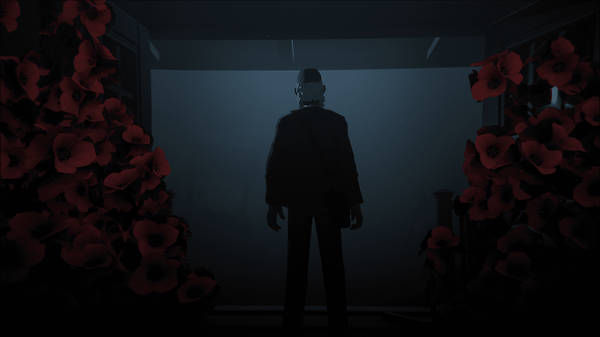
Given his advanced age, Alfred's journey is certainly not heart-pounding and finds its peaks in actions like choosing biscuits to buy or climbing over a fence.
Forever Ago mostly invites players to get lost in its environments and interact with the many objects and details scattered here and there.
The only tools at our disposal are the diary left by Audrey, where we can view various objectives, and Alfred's trusty camera with which to photograph what is around him.
In line with its super chill nature and its slow, aged protagonist, Forever Ago offers a whole series of secondary mechanics and elements, such as multiple choices or collectibles, which however have minimal impact on the game's events. A stylistic choice that can be understood, but is certainly debatable and risks becoming a missed opportunity.
Exploration, slow and relaxed, is therefore the core of the title and takes place in a stylistically magnificent world, strong in a successful graphic choice and a color palette capable of evoking a strong sense of nostalgia for a place one has never actually been, which the Finns call Kaukokaipuu.
The visited locations are further enhanced by excellent sound design capable of fostering immersion and a soundtrack that includes a series of tracks that perfectly accompany the most important moments of the experience.
Forever Ago is a Journey Worth Living

As is easy to imagine, Alfred's journey is above all an internal one, and the narrative device of places belonging to the past is functional to tell the character's growth, which is not obvious given that we are talking about an elderly person who theoretically has already seen and lived everything, and to accompany us in the analysis of themes that are certainly not original, but are treated from a new point of view.
While it is true that the theme of grief is widely used in video game creation, it is also true that it has never been proposed in old age, when the strength to move forward wanes and the world seems too big, too dangerous, and too fast to face alone.
Alfred is a disoriented character in a society that has moved on and with which he has not engaged for years; the result is that there no longer seems to be a place for him.
Young people are too talkative, girls fix cars, and once intimate places are now tourist traps.
Playing Forever Ago, one understands that processing grief is not Alfred's biggest burden; in fact, perhaps it is the simplest.
What is complex is finding the motivation, the will, and the strength to get back up and continue living, creating new adventures and memories.
And this is what makes his journey interesting to live and play.
Score
Editorial team

Forever Ago Review – The Future Cannot Be Programmed
Forever Ago is an adventure that tackles feelings and emotions widely explored in the video game landscape from a fresh perspective. A decidedly successful idea that, despite some areas for improvement, shines a spotlight on Third Shift.
The reversal of perspective, from the classic young and strong protagonist to an elderly and weary character, is just one of the work's pillars, which also boasts a remarkable artistic sector and a game world where it's a true pleasure to get lost.
Narratively, a few more nuances could have been dared to avoid a somewhat predictable plot, lacking major twists and too anchored to its comfort zone. Similarly, slightly deeper gameplay – perhaps with some environmental puzzles or mechanics dedicated to the camera – would not have hurt.
Despite this, Forever Ago remains a perfect title for anyone looking for an intimate, contemplative, and engaging experience.
Similar articles