Ashes of Singularity II: Lots of Action, Little Tactics in an RTS That Spectaculizes Pitched Battles
Huge armies clash in the solar system. Controlling them is accessible and a joy, but they suffer from limited content and a rather poor single-player experience.
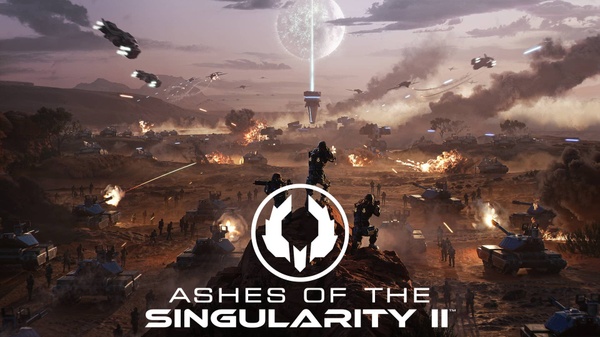


More than a decade after the release of the first installment, Oxide Games and Stardock Entertainment return to the battlefields of Ashes of Singularity with the sequel, expanding the narrative universe and factions in play. Like its predecessor, it's a "macro" RTS, meaning we won't be meticulously rationing resources or skillfully moving every single unit, but we'll still need to wisely manage income and logistics to ensure the victory of our enormous army. The impression, however, is that some pieces are missing...
Ashes of Singularity II - A Short and Unengaging Campaign
Ashes of Singularity II takes place a few years after the events of the original; there are several references, but you can easily start here without getting lost. In the not-too-distant future, the wealthiest individuals have abandoned their bodies to live in the metaverse, creating "post-humans." After leaving the planet in search of new stars to prosper, they have now returned to Earth to extract Turinium, a substance necessary for their computational needs, but at the expense of the surface and its inhabitants. Therefore, Earth's governments have united to face the common enemy. Meanwhile, the "substrate," led by the sentient AI Haalee, has other plans to prevent "obsolete" humans from causing chaos in the universe.
On paper, the world of Ashes of Singularity isn't all that original, but it offers very interesting insights into the nature of post-humans and how the conversion process isn't always painless, especially if unwitting. There's material for compelling debates, between one war council and another, but most of the time we're forced to endure this small group of politicians who do nothing but bicker and drag things out with clichés.
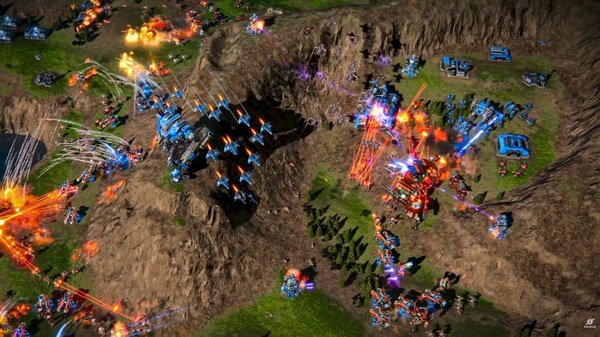
The campaign is from the human perspective, who must first reclaim Earth, then the moon, and finally the entire solar system, but it is short and filled with unbearable characters. The atmosphere is like a work call where no one has done their homework and has no intention of being there; it moves forward by inertia, also thanks to the post-humans who talk and act like cartoon villains. To top it all off, the story ends abruptly, anticipating a future expansion and leaving those who bought the game now high and dry. The single-player mode is little more than a tutorial; functional, but truly underwhelming.
The ten missions that make up the story take no more than 7-8 hours and barely cover the fundamentals, offering little challenge and even less replayability. If you want to test yourself, it's better to fall back on skirmishes or online multiplayer. Options are not lacking, with three factions available, many difficulty levels against a very competent CPU, and quite a few symmetrically designed maps that host four to eight players, even procedural ones (an editor, however, would have been useful). Online, we have casual, ranked, and custom matches, but it seems it's already difficult to find enough challengers.
Ashes of Singularity II - Large Armies, Logistics, and Multi-Front Battles
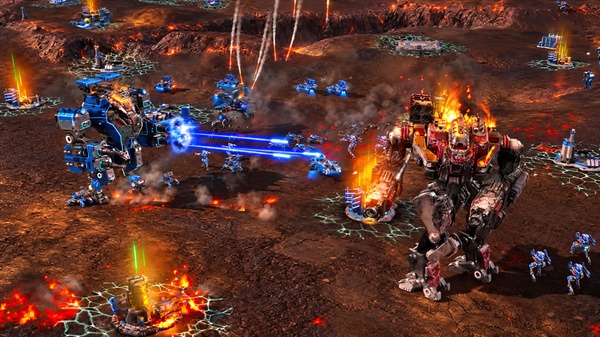
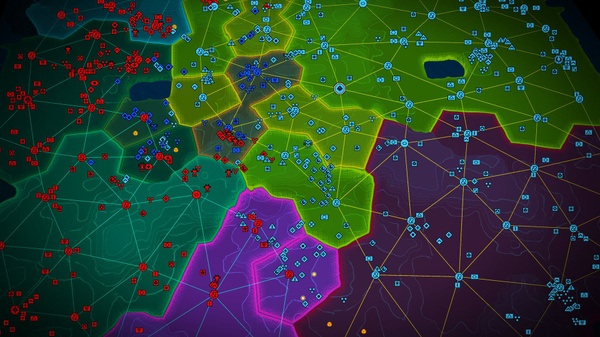
Unsurprisingly, to triumph we must eliminate the competition, whether militarily or economically. We can, of course, command individual units, but the game encourages the creation of large armies, to which we assign the troops we want and lead them en masse. Pathfinding isn't always optimal, and it can happen to see units wander off on their own or get stuck for no reason, but they tend to behave well in combat, with good distribution of firepower and correct positioning (tanks in the front line, artillery in the rear, and so on), and adequate reaction times to threats within their operational range. Units also open fire on anything that moves during the march, and we can activate automatic resupply for casualties; reinforcements will rejoin the rest of the forces as soon as they are ready. It's not at all uncommon, therefore, to prepare a battalion, throw it somewhere, and forget about it until further notice. In fact, it's a recommended practice, given that we'll regularly have to keep an eye on multiple fronts while optimizing the supply chain.
The regions under our command are not autonomous, but are part of a network that starts from the Nexus, the headquarters; if it falls, it's over, and a node does not generate resources if it is not directly connected to it. This means that expansion is slow and gradual, and a surgical raid is enough to leave entire sections of an empire in the dark. In addition, the mines from which to extract raw materials are limited, as is the number of buildable structures per sector, and we will not be able to mass-produce reinforcements by increasing the number of barracks and workshops, but rather one at a time, at the point closest to the request; having more reduces deployment time.
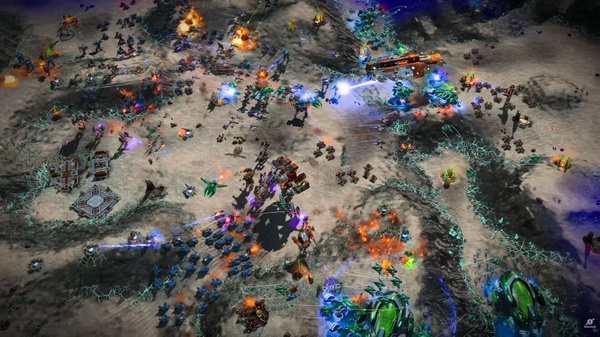
This means that battles are often won long before direct confrontation between armies, based on how efficient we have been in capturing strategic poles, advancing the front, and covering gaps in both routes and various squads. Once in the crossfire, it's too late to take cover, as creating defensive positions and new factories is a slow process, all units have a lot of health, and we will constantly be short on cash.
Ashes of Singularity II - Three Factions, Few Strategic Differences
Seeing a good plan come to fruition and inexorably decimating the opponent is satisfying, but you almost always end up applying the same maneuvers and the usual tactics: you conquer the surrounding areas as quickly as possible, establish a perimeter, and at the first sign of weakness, you scorch the earth with the biggest and baddest army you can assemble. The interface is readable, and you can issue orders even when zoomed out on the entire map; there's chaos, but you quickly understand where and how to intervene with a few clicks. Perhaps it's due to my not-so-advanced experience with the genre, but it seems to me that matches tend to follow very similar scripts, and the scarce differences between factions don't help.
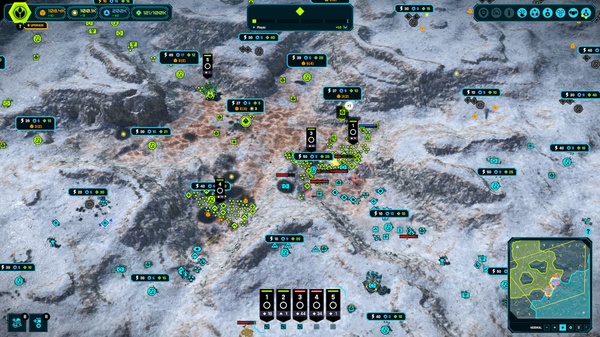
Humans are the most versatile and have decent mobility, post-humans boast greater firepower but are more expensive, while the substrate alternates economical infantry, with which to swarm in the early game, with imposing behemoths, protected by energy shields. Parameters, arsenal, and maintenance costs differ, as do the ways they accumulate research points to unlock abilities, bonuses, structures, and units, but the basic archetypes are the same; priorities change, but not the approach. It's understandable not wanting to stray too far from a certain standard for balancing reasons, but at least the dreadnoughts could have had more character. The post-humans come close, with the commander's mech that can be upgraded and captains to assign to armies; it's a shame that the other factions don't have something similar.
Ashes of Singularity II - Thousands of Units in Battle, with Some Technical Compromises
On the technical side, Oxide Games' title manages to host thousands of soldiers, drones, tanks, robots, and aircraft battling on large surfaces, maintaining good readability and without skimping on special effects and detail. On my configuration, a 7800X3D with an RTX 4070, performance fluctuates quite a bit during matches, understandably, but remains more than decent in all circumstances. Just remember to keep MSAA low or turn it off entirely, as it particularly cripples the frame rate. Having to restart the game every time you make changes, even in the main menu, is a bit annoying. Load times are fast; I encountered no bugs.
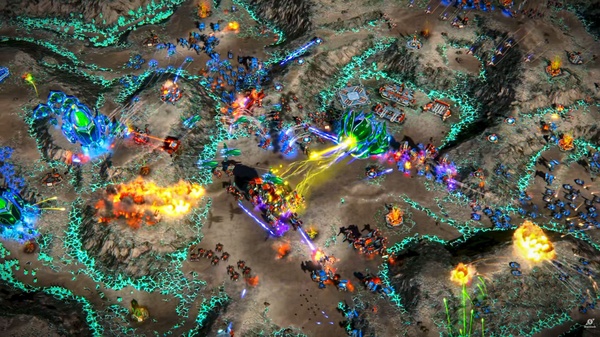
The soundtrack tries to create an atmosphere suitable for the context; the variety isn't the best, and it's soon drowned out by the plethora of gunshots and explosions and the monotonous, AI-generated statements of the troops. The voice acting during the campaign is "human," but it's not much better, and it's afflicted by a constant static background noise, which worsens with some characters. It's appreciable how the clangor of the clash transforms into a distant echo as we move the camera away from the ground, until it completely vanishes with the tactical view; however, the transition could have been more gradual.
Score
Editorial team
Ashes of Singularity II: Lots of Action, Little Tactics in an RTS That Spectaculizes Pitched Battles
Ashes of Singularity II delivers epic large-scale battles and proves to be an excellent starting point for RTS newcomers, thanks to a concise interface and easy-to-digest mechanics that reward the big picture without requiring too much player input. The truncated single-player mode and a certain lack of variables sink an experience that will nonetheless entertain those who love to see huge armies go at it, but might disappoint those seeking greater depth. The foundations are more than good, but need to be expanded; perhaps with future DLCs? For now, consider it on sale.
Similar articles