Screamer, full-throttle preview: we tried Milestone's cyberpunk arcade racer
We tried the first chapters of Milestone's new racing game in their studios
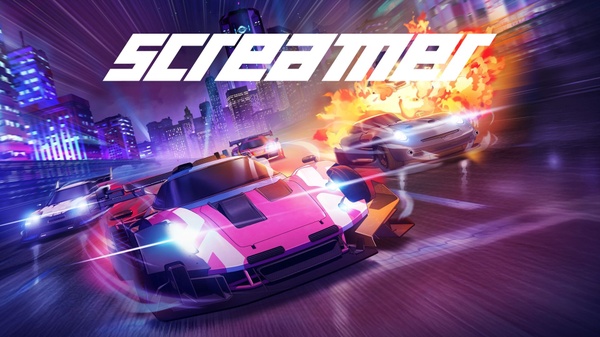


Just over 30 years have passed since the first, original Screamer made its debut on shelves, in an era when PC games were still sold on shelves in large, brightly colored cardboard boxes. In the three decades since, things have changed a lot, pretty much everywhere, but Milestone (which was still called Graffiti when Screamer was released) is still here, a milestone in Italian video game development that has managed to reinvent itself and change its skin multiple times when changes demanded it. And so, the 30-year mark seems like a good milestone to look back and draw new inspiration from its origins to evolve once again.
Screamer, from past to future
“Today it wouldn't be possible to make a racing game like in the '90s.” This is one of the first things Andrea Basilio, Head of Game Design at Milestone, tells us during a closed-door meeting for the presentation of Screamer, Milestone's new Screamer, scheduled for release on March 26, 2026. In reality, it would not only be possible but also easier: the now virtual shelves of stores are full of games that rely on nostalgia and little else, merely replicating styles and structures to try and pretend that time hasn't passed. I'm sure Andrea Basilio was referring to the structure of racing games of that era, too crude for today's racing games, but it seemed to me that his initial observation perfectly betrayed Milestone's ability to grasp the spirit of the times: today, those SEGA blue skies and OutRun-esque imageries, with that sense of calm that only a motionless canyon can convey, no longer reflect the spirit of the present.
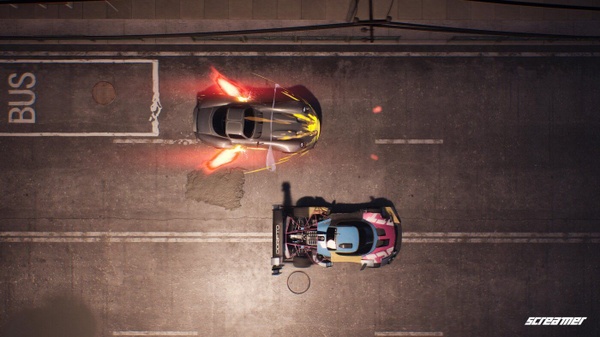
Screamer, beyond its title, takes little from its original source of inspiration in terms of look and structure, but the legacy from its predecessor is a cornerstone element: the desire to be something new, different, to represent for the arcade racing of 2026 what the original had represented in 1995. This means not only updating the aesthetics and reference scenarios but also conceiving a game that can combine the immediacy required of an arcade with the longevity demanded by the market. The formula, therefore, required some work in hybridizing mechanics borrowed from fighting games, a cyberpunk imagery strongly indebted to '80s and '90s anime, and a significant narrative component.
30 minutes in Neo Ray
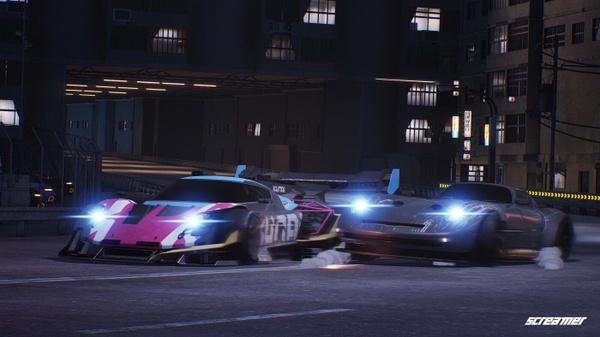
Controller in hand, Screamer undoubtedly boasts the look and rhythm of a 2026 game. The first section we were able to try, on a build close to completion but still needing polish, was the Story Mode, which is considered somewhat the backbone of the game, the first impact with the narrative universe, but also an ideal way to introduce the (many) new characters and the equally numerous new mechanics to the public. The first six chapters we explored follow each other at a dizzying pace, intertwining animated cut-scenes (created by the Japanese studio Polygon Pictures, with considerable class, by the way) with dialogues with 2D-drawn characters and races between supercars, neon, and skyscrapers.
Here we meet Hiroshi, Roísín, and Frederic, the first handful of characters that make up the cast of these initial chapters, with many more destined to be added. And in homage to the tradition of fighting games, particularly Tekken, the characters come from different corners of the world and each speaks their own language (with Italian subtitles to help non-polyglots, while the characters understand each other thanks to a convenient translator chip implanted in their brains). At this point, you're probably wondering if there are any Italian drivers: the answer is yes, during the test we met Lavinia (voiced in our language), but we don't rule out that Italy might hold other surprises for us later in the plot. Already in these first plot points, it's quite clear how the storyline will involve several competing organizations: our trio, for example, wants revenge for the death of a comrade, in which Gabriel, a local big shot, seems to have played a role.
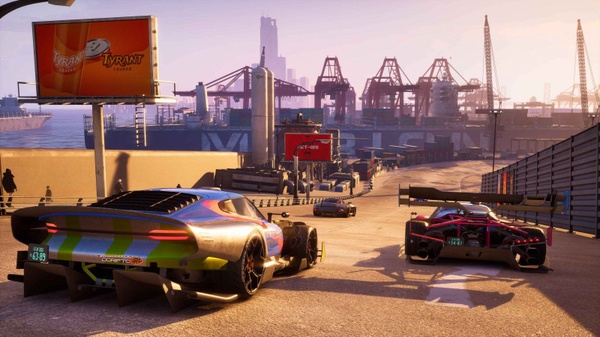
At the center of this mysterious circuit of underground races, which fits perfectly into the setting of cyberpunk, blasting neon, and megacorporations controlling society from above, is the revolutionary Echo technology, which proves to be a perfect deus ex machina for the story. It is thanks to this extraordinary engine that drivers can respawn after impacts (there's a spatiotemporal explanation behind it that you don't need to understand, don't worry), but above all, it allows them to use all the powerful and insane tools that Screamer's cars are equipped with. Our contact with the Story Mode ended before the tutorial was complete, yet it was more than enough to throw us into its colorful atmospheres and immediately find ourselves dazzled by this cel-shaded world that, like an anime, imagines a not-so-reassuring future for humanity, but blasted into the retinas and ears of the viewer with such an abundance of sensory stimuli as to be overwhelming.
Shield me from this Overdrive!
Before leaving, however, there's still time for a final taste, a few minutes in Team Race Mode to try all the power-ups available on Screamer's cars, but not yet unlocked in the Story portion we just tried. The first thing to get used to is the division between the two analog sticks of the controller for trajectory control and drifting. We've already said that Screamer boasts fighting game mechanics, and just like in a fighting game, it's necessary to always keep an eye on the upper bar where Sync and Entropy accumulate. The first fuels the classic turbo, a sprint that allows you to outrun enemies and gain a lot or a tremendous amount of speed by completing a quick QTE. A similar mechanism, close to the active reload introduced by Gears of War, is the automatic transmission which can be manually downshifted (called active shift) by pressing the left bumper when the engine reaches the right RPM.
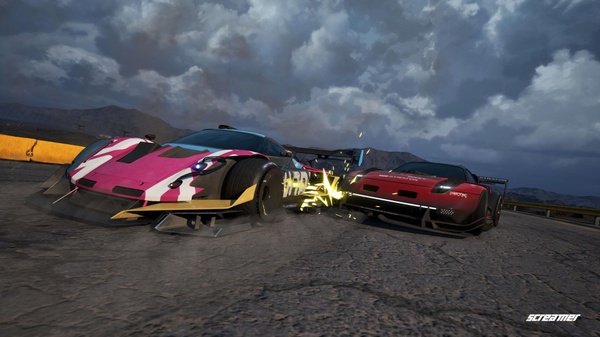
The real fun, however, begins when Entropy is activated on the asphalt: turbo, overtakes, and other spectacular actions performed on the track fuel this other side of the bar, allowing accumulated segments to be converted into two actions, Overdrive and Shield. The first provides furious acceleration that destroys enemy cars on impact (but can also cause our own death by accidentally hitting a guardrail), while the second serves to take cover from rivals' Overdrive, promptly signaled by the danger effect displayed by the HUD. Like in a fighting game: moves, super moves, and parries. And that's not all, because each character will have their own characteristics, through which Overdrive, Shield, and other power-ups might function slightly differently.
Screamer and its universe
In short, a brief but intense test, capable of conveying with a rush of adrenaline the sensations that Screamer wants to transmit with its futuristic, decadent, yet ultra-vivid universe, where everything now moves at lightning speed. A universe so interesting that it is not destined to remain confined to the monitor's frame: a graphic novel, created in collaboration with Panini, is also in the works, which will tell more details about some of the game's characters.
We are probably influenced by a touch of local pride, but it is frankly difficult not to be infected by the spirit of this project that invents a new formula (bringing to maturity ideas already experimented in indies like Japanese Drift Master), combines many genres without ever missing the trajectory of the different elements, and at the same time updates Screamer's structure by offering a good number of modes, single-player or team-based, online or alone in your room. Probably, the secret ingredient is the passion of the Milestone team poured into a game where they were able to unleash their imagination a bit more freely compared to other licensed racing games, which are necessarily more rigid. A great way for Milestone to show the world that it still retains, and not too secretly, the same flair. The green light for Screamer flashes on March 26: in the meantime, buckle up and charge the Echo, we'll see you at the finish line for the review.
Similar articles