Dark Scrolls: "dungeon scroller" preview
The chaotic blend of platformer, shoot 'em up, and roguelike
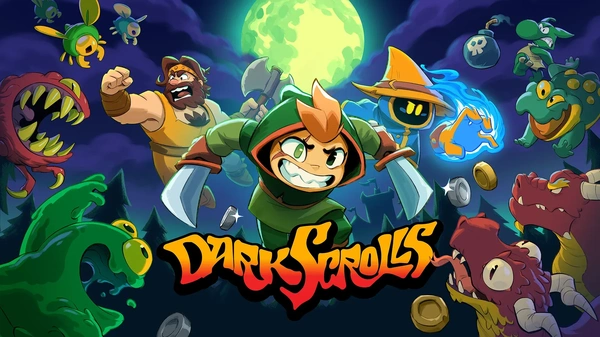


When you look at Dark Scrolls, the first thing you notice is a style that clearly harks back to video games of the last century, but the affinity with past works isn't limited to the artistic profile alone. The title developed by Doinksoft (known for Gato Roboto and Gunbrella) willingly draws on gameplay mechanics dating back to the 8 and 16-bit generations, to which more modern ones are added.
First off, we find the good old 2D platformer: specifically, it's a continuous side-scrolling platformer, meaning the scenario constantly moves and the player is forced to do the same, a design choice with very significant consequences. Then there's an incessant horde of enemies on screen, to be eliminated with a rain of bullets, prerogatives taken from shoot 'em ups.
To these classic aspects are added others that have become fashionable in more recent times. For example, levels are semi-procedurally generated, so when one is repeated, it's never identical to the one from the previous run, although many common recurring characteristics are found. But what most differentiates Dark Scrolls from the mass of 2D platformers of the '80s/'90s are undoubtedly its roguelike mechanics.
The result of this mixture of classic and modern is an immediate, lively video game, which its authors have called a "dungeon scroller": on the first term, there would be something to discuss, given that those contained in Dark Scrolls wouldn't be called "dungeons," but rather levels as we've always seen them in 2D games, no more, no less. "Scroller" on the other hand sounds appropriate, and now we'll explain why.
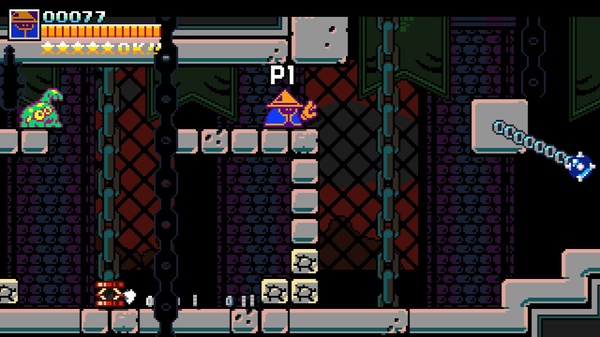
Dark Scrolls is a game in constant motion
As mentioned above, the choice to constantly scroll the screen is important; in fact, it defines the very nature of Dark Scrolls, because the player is given very little respite: they must constantly move forward, paying close attention not to get stuck on a platform or end up in a position where enemies and/or environmental hazards are lurking, risking the loss of precious health points.
Dark Scrolls relies heavily, if not entirely, on action characterized by rhythm and chaos: in this light, forcing the player into perpetual movement, constantly removing their points of reference, seems like a very apt expedient. It should be noted, however, that this dynamism is broken in specific situations: for example, the screen remains still when encountering the merchant in the middle of the level, or when clashing with the current boss.
Gameplay rests on a simple structure
At the core of Dark Scrolls is an elementary setup: the controlled character moves in four directions, jumps, shoots in front of them, and has one ability to use. To this essential core, extra elements can be added, such as a charged attack, some passive skills, or power-ups, but it always remains within the realm of simplicity. Doinksoft's intent is clear: to provide the user with an immediate experience that can be mastered and consumed in a short time.
In turn, enemies are designed to satisfy this setup. They have limited, easily recognizable movements and attack patterns; they are specifically designed to act quickly (and to die just as quickly, if possible). Taken individually, they are not strong, but when they become numerous and attack from multiple directions, perhaps even spawning in the immediate vicinity of the character, they prove to be quite annoying.
At the end of each level, a boss must be defeated. Like the other enemies, the final adversary is also designed to offer resistance that is anything but strenuous, with 2-3 attack patterns that can be read without too much difficulty (but one must still have a certain familiarity with the gamepad to dodge them). The battles, therefore, are not exhilarating, but the bosses couldn't be otherwise in a game designed to flow so smoothly and quickly.
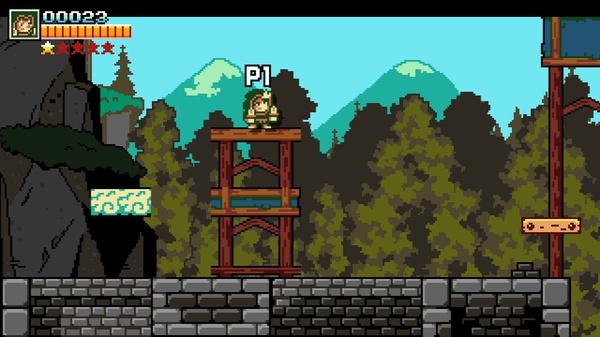
Dark Scrolls also succumbs to the charm of roguelike
This speed is also reflected in the duration of a run, which takes less than an hour: to complete the game, you only need to clear four levels. In Dark Scrolls, you strictly have only one life available, and HP can be lost with disarming rapidity if you're not careful. During a single run, coins are accumulated, to be spent on acquiring passive abilities, power-ups, or other items, all of which will be lost upon game over.
By performing multiple runs, additional passive abilities and, most importantly, extra playable characters are unlocked. Each of them is distinguished by their movement and jump type, projectile trajectory, equipped ability, damage dealt, and number of HP (in short, every possible parameter). These differences have a great impact on gameplay: the playstyle changes substantially when switching from one character to another.
The future prospects of Dark Scrolls
The build we had the opportunity to test is already playable from start to finish: the development of Dark Scrolls is well underway, and it probably shouldn't be long until its release, but there are several details to iron out. The technical department is deliberately minimal, in homage to 8/16-bit era titles, and if you've tried Doinksoft's previous works, then you know that this studio is perfectly at home with pixel art.
However, the developers warn that the assets are still provisional, and during the test, it did feel like there was still good room for improvement in terms of 2D models and animations. Some corrections will also need to be made to the gameplay: the current build works well, but a few small adjustments are needed to make everything run smoothly.
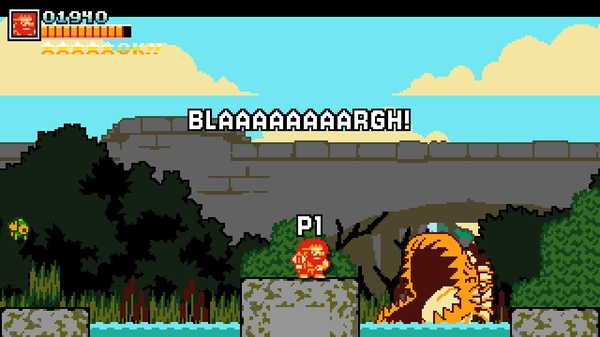
The impression so far is that Dark Scrolls has what it takes to combine scrolling platformer, shoot 'em up, and roguelike in a convincing way, thus becoming a video game capable of carving out its own niche: Doinksoft seems to have hit upon a successful game formula that shows a certain originality. However, there are two concerns to note: the first is related to the procedural generation of levels, which inevitably falls short a bit in terms of level design, and it's noticeable.
The second goes deeper and is linked to the very nature of this title. Dark Scrolls wants to be fast and immediate, which is fair, but it risks being put aside just as quickly. After a few hours, the spark might die out, and extra characters, alternative levels, secrets, and so on won't be enough if the motivation to continue has waned in the meantime. We'll have to see if Doinksoft can give it that extra something that manages to keep the player glued to the screen.
Similar articles