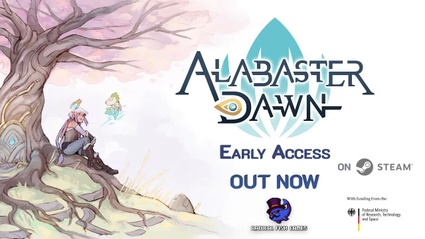
Alabaster Dawn was recently released in early access, and the definitive version's launch still seems quite far off, as developer Radical Fish Games expects the early access period to last at least a couple of years. However, the current build already allows for a precise understanding of the game, as it contains all the main elements of the work and is polished down to the details.
Brief Notes on the Game's Story
The world of Alabaster Dawn has been ravaged by a calamity called Nyx, which struck the planet and reduced it to a corrupted wasteland, a hopeless place that seems to have been abandoned even by the gods who watched over it. The Chosen Ones tasked with eradicating this evil have failed, and only one remains: the protagonist Juno, an outcast on whose shoulders rests the fate of humanity.
The story, at least in its initial stages, certainly doesn't shine with originality: in its essential features, it doesn't significantly deviate from what has already been heard in countless Japanese RPGs. However, the feeling of déjà entendu is intentional, as its author clearly intends to pay homage to the great Japanese productions of the Super Nintendo era, a purpose that was clear from the studio's previous work, CrossCode.
ADV
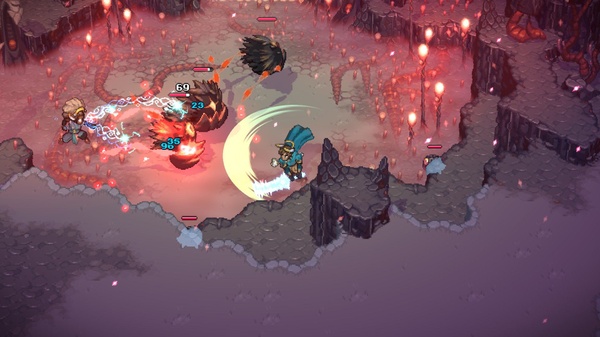
This is Alabaster Dawn's combat
Exploring Alabaster Dawn
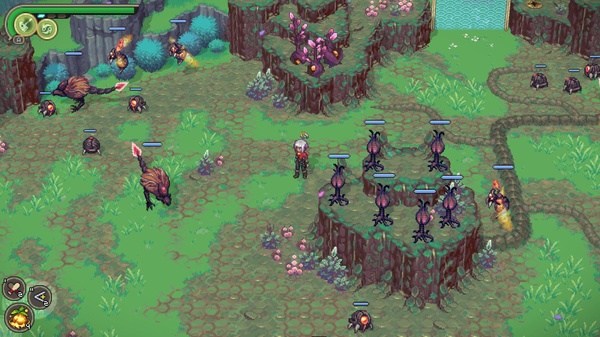
Speaking of CrossCode: if you've played it, then you know what to expect from Alabaster Dawn. A generously sized world, teeming with secrets to discover, with an intricate level design that requires careful observation of space to figure out which hidden path to take and which platforms to jump on to reach seemingly inaccessible treasures. As in CrossCode, the overworld has been chiseled to reward exploration, with intelligent use of automatic jumping.
Even Alabaster Dawn's first dungeon closely resembles those of CrossCode, due to its intricate puzzles. In almost every room, there's a problem to solve that requires not only a certain amount of reasoning but also familiarity with the controller and timing. These are very complex puzzles for an action game, which might delight those who aren't afraid of a more challenging logic and coordination puzzle than usual, but they risk generating frustration in those who lack patience.
The Combat System
Alabaster Dawn's combat system represents the natural evolution of CrossCode's. Weapons are of two main types, melee and ranged: in battle, two are used, one of each type, attacking either with one, the other, or both. Each weapon has peculiar characteristics (which can also be useful during exploration) and grants access to a series of abilities; if you add that Juno can dodge, parry, use four elements, and powerful divine arts, you can grasp the broad scope of combat.
The game doesn't hesitate to throw a large quantity of monsters at the poor protagonist: these enemies have rather simple attack patterns to read, but their strength lies in their numbers. Constant movement, dodging blows from all directions, and alternating appropriate weapons and abilities are essential; but not only that, because some opponents require specific actions to be defeated, and performing them in the chaos of battle will be anything but immediate.
ADV
In some situations (especially against bosses), it will almost feel like completing a mini-puzzle to defeat the enemy, demonstrating the same dexterity needed to overcome puzzles within dungeons. Some players might find it excessive, but this strong inclination towards puzzle-solving is a peculiarity that made CrossCode unique in its genre, so it's understandable that its successor would re-propose the same formula.
Lots of enemies, ready to attack all at once
Alabaster Dawn's Technical Department
With Crosscode, the developer paid homage to 16-bit era titles through vibrant and colorful pixel art. Alabaster Dawn takes the next step: an isometric perspective is maintained, and there's still colorful pixel art, but at its core, we find a 3D structure. The aesthetic is a very distinctive element of the production: a look like old JRPGs but at the same time modern, with rich colors and excellent animations.
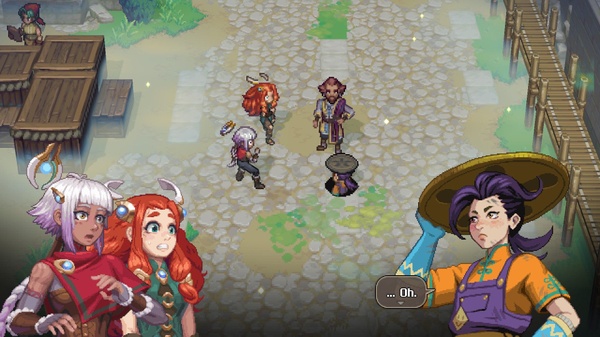
Unfortunately, the character and interface designs are not among the most successful, but these are flaws that do not irremediably undermine the experience. Alabaster Dawn possesses a rather strong visual identity, also because Radical Fish developed the graphics engine in-house, instead of resorting to the usual Unity like most of the competition. This decision benefits the artistic profile of the work, although it risks extending development times.
What Our First Contact with the Game Leaves Us With
The impression left by the first build of Alabaster Dawn is that Radical Fish intends to create an imposing video game. Several details suggest this, but one is enough to mention: not only does Juno have her skill tree, but even weapons have their own skill tree. There's already so much on the table today, let alone when the video game becomes complete. One cannot help but notice a constant pursuit of complexity, even within a context dedicated to fast-paced action.
After all, the first dungeon immediately made things clear: the puzzles will be at least as challenging as those in CrossCode, take it or leave it (side note: the first dungeon is always the simplest in a game...). Exploration and combat work great, but the opposite would have been strange, considering they largely rely on CrossCode's proven structure.
However, the most striking aspect, the one from which one understands that Radical Fish is doing things really well, is the surprising cleanliness of the build. Alabaster Dawn's 1.0 patch will arrive in no less than two years, but despite this, it feels like you already have the definitive version in your hands: everything runs as smoothly as expected, without encountering obvious bugs or glitches.