Spider-Man: Blue - Why it's important to revisit a story like this today
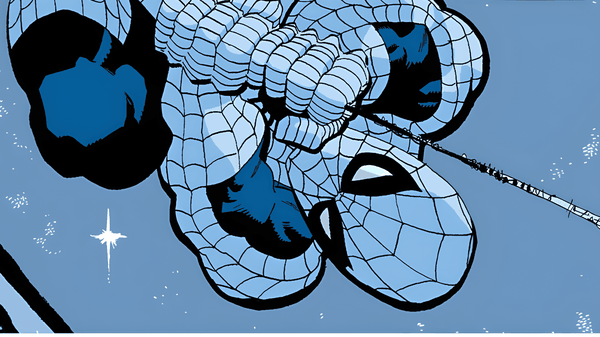


If you close your eyes and think of your Friendly Neighborhood Spider-Man, the image that springs to mind is probably that of a kinetic hero, an urban acrobat who dodges Rhino's blows while unleashing a barrage of sharp quips. This is the Peter Parker we've come to love in cinema, especially if you recall Sam Raimi's debut in 2002, where irony and heroic zeal served to mask daily struggles. But now, imagine taking off that mask and finding yourself facing a man who, once home, no longer feels like joking. In Spider-Man: Blue, Jeph Loeb and Tim Sale perform an intentional sabotage of this archetype: here, the "friendly Spider-Man" is nothing more than a faded memory, a public interface Peter Parker uses to avoid collapsing under the weight of what he can no longer fix.
Don't be fooled by Sale's visual style, which seems to echo the glamorous brightness of classic films, because this is not a celebration of good times past. It is, rather, a narrative friction that transforms the story into a kind of degraded signal, similar to the ghosting typical of old screens where images from the past seem to haunt the present. Published just as the Wall-Crawler was conquering global audiences with his spectacular cinematic acrobatics, this work acts as an autopsy of emotion, laying bare the brutal tension between the hero who cracks jokes at the Vulture and the man who, in the dark of a room, records a confession on an old tape recorder. Look beyond the nostalgic veneer: what you hold in your hands is a man's desperate attempt to use memory as a time machine, only to discover that the past is an unstable system designed to strike your limbic system, leaving you staring into the void alongside a hero who has stopped laughing.
Beyond Blue: Loeb and Sale's Chromatic Prism
To truly grasp the complexity of this operation, you must contextualize it within the Colors Trilogy, an experiment where Loeb and Sale dismantle and reassemble the myths of the House of Ideas through a chromatic lens that acts as an absolute emotional filter. If you think of Daredevil: Yellow, you'll realize that yellow is not just an aesthetic reference, but represents the visceral link to the past: that yellow costume was originally sewn from the material of his father, Battling Jack Murdock's, boxing robes. That color embodies the naive optimism of his beginnings and the desire to honor a fallen parent, a sunny phase that precedes the inevitable descent into noir symbolized by the transition to the red costume, the uniform of the "Red Devil" that marks Matt Murdock's maturation as a tormented and relentless urban vigilante.
In Hulk: Gray, however, gray becomes the fog of moral confusion and identity uncertainty. Many of you associate the Jade Giant with emerald green, but the Gray Hulk is a return to the origins of 1962, when the creature was less powerful but much more subtle, cunning, and psychologically unstable. The transition from gray to the classic Green Hulk is not just a change in pigmentation due to printing reasons, but represents the character's evolution towards a wild and uncontrollable fury: the definitive loss of rationality in favor of a brute force that erases all moral nuances.
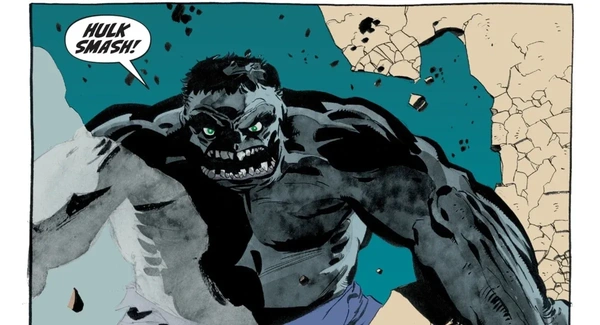
In this spectrum of primary emotions, Peter Parker's Blue takes on a different specific gravity: it is the color of forced maturity, the kind that arrives at the exact moment you realize that your most dangerous enemy is not some eccentric guy in a costume, but the deafening silence that fills the house after a funeral. While in Yellow we find a laborious search for redemption and in Gray a struggle to define the boundaries of the self, in Blue we clash with unconditional surrender to what Peter has become. It is a cold analysis, conducted by a man who interposes an old tape recorder, an obsolete technological barrier, between his present and a past that seems almost a feverish dream sweetened by nostalgia marketing, making the entire narrative a confession that seeks not forgiveness, but only a form of grief processing.
Dismantling the Silver Age: Instructions for Use
If you try to dismantle the circuits of this narrative, you will notice how Loeb and Sale invent nothing new, preferring to re-assemble the pieces by performing an alchemical synthesis between Steve Ditko's claustrophobic paranoia and the glamorous optimism subsequently introduced by John Romita Sr.'s art. Imagine the Silver Age not as an intact golden age, but as a period of violent transition in which Peter Parker stops being the tormented outsider from the suburbs to become the center of a university love triangle at Empire State University. The use of the old tape recorder is not a mere narrative embellishment, but a technical device that simulates the decay of memory: every time Peter presses "Play," he is trying to rewind a life that can no longer be corrected, dragging us readers into this layered audio-visual archive where time does not flow, but is forcibly rewound between the warmth of the voice and the cold silence of the mechanical click of the "Stop" button.
In this system, innovation is not to be sought in the chronology of events or in the parade of historical enemies like Rhino, the Vulture, or Lizard, who are here relegated to almost mere mnemonic bookmarks. These clashes are not the ultimate goal of the work, but act as physical anchors necessary for Peter not to drown in the flow of his own feelings, transforming each battle into a temporal marker that allows him to say "I was there when I fell in love." If you think this is an objective chronicle, you are mistaken: Peter is confessing how he feels today observing that past through the distorting lens of regret, unmasking the deception of a nostalgia that would sell us the past as a safe zone, when in reality it is an unstable system where every memory is a potential breaking point that can collapse the entire house of cards of our current identity.
The true technical engine of the work remains Tim Sale, whose hand transforms Loeb's script into a visually overwhelming noir ballad, where every line seems to vibrate with an electric melancholy. Think of a style deeply influenced by 1960s advertising aesthetics and mid-century interior design, capable of creating an atmosphere that manages to be simultaneously welcoming and profoundly unsettling, almost spectral. His women, Gwen Stacy and Mary Jane Watson, are not mere characters, but icons of a lost elegance that Sale draws with a grace that fluctuates between Vogue fashion and the expressionistic shots typical of genre cinema, where New York takes on the contours of an abandoned film set.
The danger represented by the Goblin, in this context, ceases to be merely a physical threat to become a symbolic shadow that looms over the protagonist's psychic stability. However, if you look with a critical eye, you cannot ignore how the narrative agency of the female figures often risks appearing two-dimensional, a collection of ideal projections lacking real autonomy. Gwen and MJ orbit Peter's system, serving as mirrors for his insecurities: the former elevated to a symbol of purity precisely because her death prevents her from evolving, the latter confined to the role of consoling vitality. Yet, Sale compensates for this structural fragility with masterful direction of white spaces and a management of timing that elevates each panel to a frame of an auteur melodrama, where the unspoken communicates much more than the dialogues themselves, directly striking the reader and leaving them at the mercy of a beauty that hurts because it is true.
Why Peter Parker Needs This Color
If you stop to reflect, you will understand that Blue is not just an aesthetic filter applied for marketing purposes, but the color of acceptance of systemic failure. Steve Buccellato's chromatic choice perfectly supports Sale's vision, with saturated and rich colors that always seem veiled by a subtle patina of temporal dust, as if we were looking at the world through an old cathode ray tube television struggling to hold the signal. This volume is fundamental because, paradoxically, it redefines the relationship with Mary Jane Watson more than it does with Gwen, as it is not a celebration of the past, but an admission of dependence on the present, a recognition of how difficult it is to remain human when the weight of one's mistakes becomes unbearable.
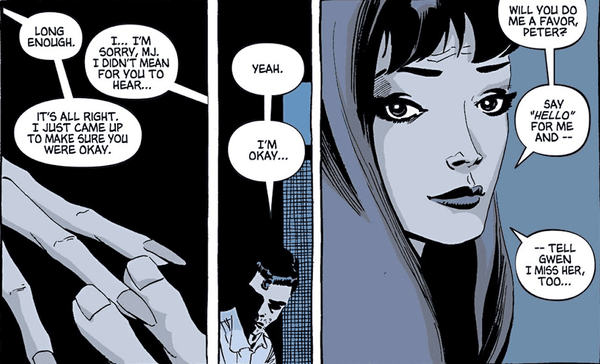
The ending, where MJ appears in the shadow of the room and simply says "Tell him I miss him," represents the only true moment of system resolution, the instant when the narrative stops being an obsessive soliloquy to become a shared dialogue between two survivors. In that moment, Peter's pretense of living in an eternal return collapses to re-establish a connection with reality, demonstrating that MJ is the only element of the system capable of managing Gwen's cumbersome emotional legacy without being destroyed. Imagine the strength required to accept living in the shadow of a perfect ghost and you will understand why Spider-Man: Blue is, ultimately, an operation of nostalgic engineering executed with such technical precision as to save it from cynicism, reminding us that it was not his powers that defined Peter, but his ability to bear the unbearable weight of an absence.
Is it worth revisiting today?
If you're wondering if it's still worth investing time in this melancholic ballad, the answer is an unreserved yes, especially now that the release of the Marvel Pocket version has made this gem accessible to anyone who wants to carry a piece of history in their pocket. Despite the reduced format, Tim Sale's visual power does not lose an ounce of its dramatic effectiveness, transforming every page into a historical artifact that every reader, from novice to veteran, should own. It's a must-have story because it acts as a perfect bridge between the classic Masterworks era and modern sensibility, an ideal entry point for anyone who wants to understand the true emotional core of the Web-Slinger before the multiverse complicated everything. Reclaiming Spider-Man: Blue in this edition is not just an act of economical collecting, but a way to reclaim the human dimension of a hero who, between one leap and another, just needs to be heard confessing to the void that, despite everything, Mary Jane is right: we miss you too, blonde.
Similar articles