Ultimate Spider-Man: Incursion Review - Miles Morales (re)turns to the Ultimate Universe
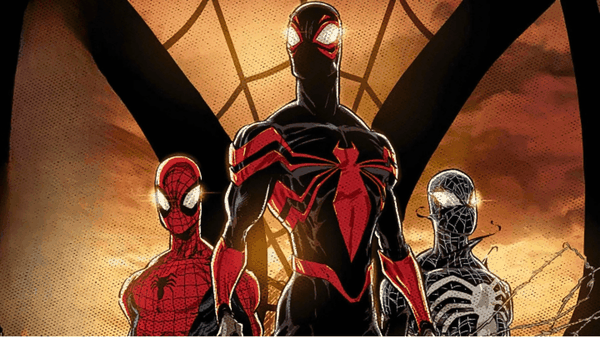


With Ultimate Spider-Man: Incursion #1, Marvel immediately makes it clear that the new season of the Ultimate Universe is not a mere nostalgic exercise. The choice to entrust Miles Morales with the protagonist role is not accidental: the character, born as an alternative to the Peter Parker myth, now becomes the ideal means to verify the solidity of a newly reborn narrative universe. No longer the young hero observing with wonder, but a figure capable of bringing with him the experience of the multiverse and questioning the very future of the Spider-saga.
The encounter with an adult Peter Parker and his son Richard is not handled as a pure "crossover event," but as an intimate, almost familial confrontation that opens up broader reflections: who is Spider-Man today when it's no longer just Peter embodying him? And what does it mean to pass that role on to a new generation in a still fragile context like that of the reborn Ultimate Universe?
This approach, deliberately more subdued than spectacular sagas like Spider-Verse or Spider-Geddon, defines the identity of the editorial project. It's not about multiplying alternative versions of the hero, but about observing how a consolidated character like Miles can serve as a critical mirror for the new direction. It's an approach that speaks not only to long-time fans but also to those who seek in superhero comics a reflection on the cycles of growth, legacy, and the transformation of myth.
In the background remains the shadow of the Maker, a latent threat that recalls what happened in Secret Wars (2015): there's no need for a direct appearance for the reader to feel that every action by Miles, even the smallest, risks producing broader consequences. It's a debut that doesn't seek immediate impact but chooses the path of slow construction, transforming Miles into a true critical conscience of the new Ultimate Universe.
The plot of Ultimate Spider-Man: Incursion shows us a new team of superheroes
Ultimate Spider-Man: Incursion #1 opens with a narrative pretext that leads Miles Morales to cross the threshold of the Ultimate Universe. It's a quick, almost forced device that leaves the feeling of a weak narrative engine, not entirely up to the importance of a crossover debut. The idea that such a fragile element pushes Miles to take such a decisive step makes the beginning less impactful than one might have expected.
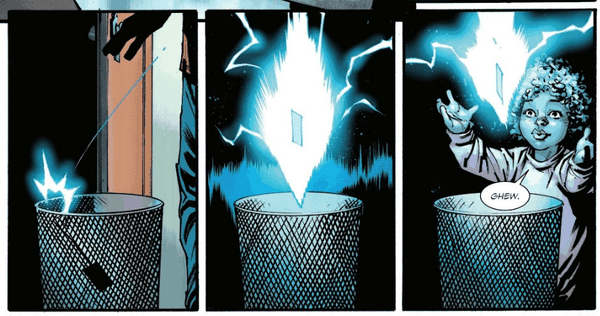
Once inside the new world, however, the focus shifts to the confrontation with an adult Peter Parker and his son Richard. It is here that the issue finds its most interesting dimension: not so much in the spectacle of the action, but in the family dynamic that emerges. Seeing Peter in the role of a father introduces a significant variation compared to the Peter of Earth-616, traditionally marked by the eternal conflict between private life and heroic responsibilities. Here, instead, the paternal figure adds a new layer: Spider-Man must not only protect a city but also guide a son who is approaching a superhero destiny.

Into this scenario enters Spot (a villain historically linked to Spider-Man, capable of opening interdimensional portals), recently re-evaluated in the film Across the Spider-Verse. In the comics, his function is less catastrophic and more contained, but precisely for this reason, he appears interesting as a narrative tool: rather than raising the stakes, he serves to show the contrast between Richard's enthusiasm and Miles' experience. The comparison with the animated version helps to understand how versatile the character is: capable of embodying a universal threat on the big screen and, at the same time, a more intimate and functional obstacle in this editorial context.
In the background, almost as a reminder that nothing in this world is harmless, the Maker's Council operates. Their presence remains discreet, but the fact that they observe and react to Miles' passage suggests that his incursion is not a fleeting detail. Every movement, every encounter, thus becomes part of a broader design, where family dynamics intertwine with political balances and systemic threats.
Camp and Ziglar stage an interesting, but perhaps somewhat weak, narrative
If the plot functions more as a prologue than a true event, much also depends on how Deniz Camp and Cody Ziglar decided to set up the writing. The screenwriting duo favors a register that doesn't aim for immediate impact but for the gradual construction of interpersonal dynamics. It's a choice consistent with the desire to give depth to Miles and his interaction with Peter and Richard, but it risks slowing down the issue, leaving the feeling of a less impactful debut than one might have expected. The balance between dialogue and action doesn't always hold: while the moments of family confrontation are interesting, the conflict with Spot appears as a missed opportunity to truly raise the narrative tension.
Visually, Jonas Scharf delivers a solid and functional style, yet far from the epic scope one might expect from a debut issue. The action sequences between the Spider-Men and Spot show flashes of energy and inventiveness, but they remain isolated within an overall structure dominated by "talking heads" and conventional graphic solutions. The character rendering is convincing, especially in the father-son dynamic that emerges between Peter and Richard, but it lacks that striking visual impact capable of transforming the reading into a memorable experience.
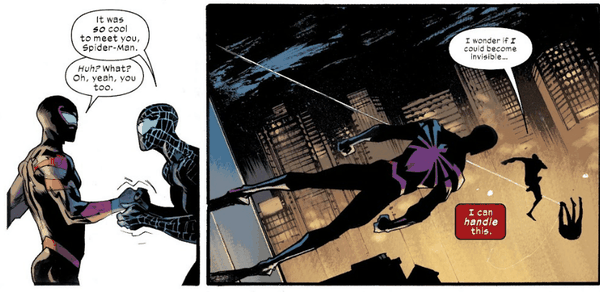
To compensate, the color palette intervenes, which, thanks to the colorists' work, manages to give depth to environments and figures, differentiating domestic tones from the darker ones of the Maker's Council. It's an element that enriches the reading, but it's not enough to mask the general impression of an issue that, while well-packaged, lacks the visual force of a major event.
On an editorial level, Ultimate Spider-Man: Incursion #1 takes on a particular role. It's not the issue that shakes the foundations of the Marvel universe, but the one that must legitimize the new Ultimate direction by showing how it can dialogue with the legacy of Miles Morales. It's a test bed more than a manifesto, and its value lies primarily in signaling the will to build a coherent universe, where each title contributes to defining the overall meaning of the project. In this sense, the impact of Incursion is less spectacular and more subtle: it serves to establish coordinates, to create a shared language, to prepare the ground for future events that will have to prove themselves truly worthy of the definition of "epochal."
Similar articles