Ashgard: Infinity Mask, an Android with Human Consciousness - Preview
We found ourselves in a post-apocalyptic world with echoes of Norse mythology.
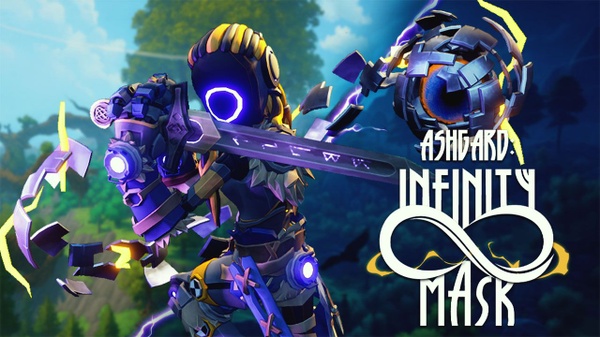


Every work, be it literary or, as in this case, a video game, always tries to convey something that can leave a mark or impress with its originality. After all, what matters when programming a video game is primarily heart, investing one's passion into something with a precise identity. And Ashgard: Infinity Mask chooses a very specific path for its train of creativity, offering an adventure made of exploration, puzzles, and platforming sections in an open-world context.
This is no easy feat, considering that the development team (Ashgard Games) consists of only seven developers plus three audio specialists. And as often happens with small productions, funding is limited, which translates into a greater number of bugs scattered everywhere. Indeed, Ashgard: Infinity Mask is not yet a definitive game, and there are several things to fix in the coming months: this is where early access comes in, a release of the title that is still under development, where players can provide feedback to the developers to make the experience more engaging.
For our part, we found this journey not exactly exceptional: the themes feel familiar, and post-apocalyptic worlds are starting to become a bit too redundant. However, there is untapped potential, but it's as clear as day that Ashgard Games' title is not yet truly ready for its grand debut.
A World Devastated After Ragnarök
Norse mythology is fascinating, there's no denying it, and it has become more popular in recent years thanks to iconic video game productions (including the new God of War and Assassin's Creed Valhalla). Ashgard: Infinity Mask transports us to the days following Ragnarök, a catastrophic event in which the world will be destroyed and then regenerated. Not very comforting, some might say, yet the context in which the events unfold seemed exquisite at times.
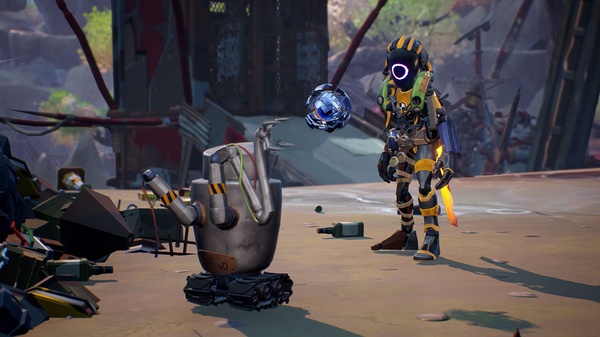
In this journey, we will become Embla, a hybridized being who hides a human soul in an entirely metallic body. Upon first awakening, we will find ourselves disoriented, without memories, and we will meet a flying robot called Flying Orb, our guide in this new robotic epic. Behind a world of destroyed villages, biomes, and ancient ruins, lie our origins and the truth about the secret of the Infinity Mask.
On paper, the project might seem ambitious, perhaps even too much, but it inevitably results in a realization that sometimes felt schematic. The inspiration, after all, is very strong; one can feel a lot of Ratchet & Clank (especially in the relationship between the two companions) as well as a portion of the open world of Legend of Zelda. But, alas, the title seemed to lack a bit of bite and, above all, depth in its mechanics, and this is evident from the very first moments of the game.
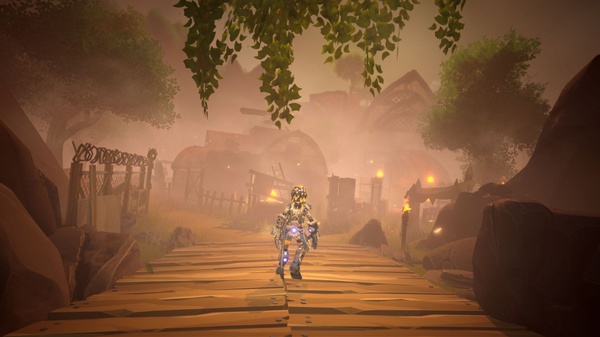
Let's start with the basics: Ashgard is a third-person adventure where you make your way through decaying ruins (at least initially) and worn-out platforms. In short, Embla can jump, run at high speed, and climb certain grates or ladders. The gameplay sections alternate between moments where you have to jump from one platform to another, sometimes calibrating the momentum which might be excessive, and moments where you draw a good sword to save your skin. And it is from here that the production's limitations begin to emerge.
A Combat System Not Always Responsive
Without yet knowing the reasons, our Androm (as it is called) will have to contend with some of its kind who seem intent on making our bolts fly. Once we cross their gaze, we will be called to respond with force, directing slashes at the metallic anatomical parts of the opponents.
Embla can attack, but must consider the stamina bar which, once depleted, will not allow any action. While this feature makes the combat system more challenging, it also loses the immediacy of the action, causing struggles on more than one occasion. In addition to attacking, one can parry (the Flying Orb will transform into a shield) and dodge to avoid taking more damage than expected.
Along with the ordinary weapon, Embla also has a modern crossbow in its arsenal, suitable for hitting so-called "snipers" or for gaining an advantage in close combat. Let's be honest, the battles are challenging even at normal difficulty level (especially those against bosses), with moments marked by the repetition of the same phases.
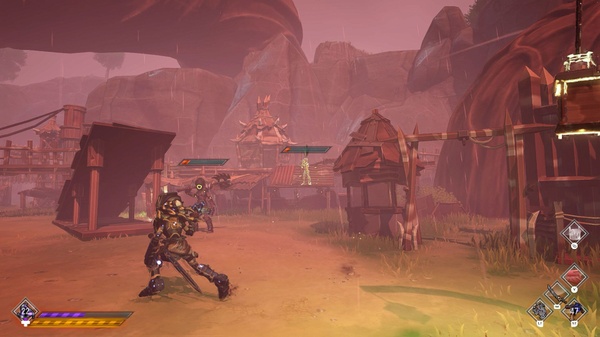
As you may have guessed, the combat in Ashgard: Infinity Mask closely resembles that of the purest action-adventure games and, in some respects, those experienced in soulslikes: attack, defend, dodge, and counterattack to prevail. And from this genre, and more specifically from RPGs, it also inherits the upgrade system: in fact, during exploration, new alloy components can be found, including torsos, new legs, and accessories that will increase general stats.
Despite the good premises, we found the combat system unresponsive, and to be more precise, we would say "heavy." At the moment, there is no fluidity, and combat becomes unmanageable if you "lock" onto an opponent. In this case, the camera never leaves the enemy and prevents the player from having full freedom in area combat. By releasing the lock, everything becomes more manageable, albeit with some frustration.
Ashgard: Infinity Mask seemed to us a game that draws inspiration from other titles, and this is not a bad thing; on the contrary, but one must always give a precise imprint to what is created and implement functionalities that make a work unique in its genre. There are good foundations, this is undeniable, but they must be exploited to the fullest, and above all, the overall experience must be made more immediate and have a more user-friendly interface.
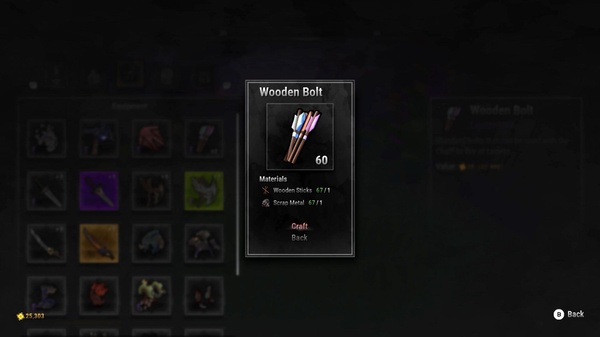
Let's give an example: in the game, we can craft arrows by collecting the right materials. And this is perfectly fine, but the player shouldn't have to open the menu every time, select, and then craft the item. Crafting should be more immediate, as should changing the ammunition for our crossbow. What do we mean? Ashgard: Infinity Mask should facilitate the player's progress, and the simplification of mechanics should be a necessary implementation: however, we are sure that the developers will receive feedback on this to improve the situation.
Let's be honest, the game is in early access and is clearly incomplete: right now, we haven't been able to fully understand how far it wants to go. In our humble opinion, there is interesting potential, but this needs to be refined over time, and the platforming and aiming sections also need improvement. If they manage to adjust these aspects and make the combat system more dynamic, then Ashgard: Infinity Mask could become an enjoyable adventure to play from start to finish.
Similar articles